Facebook
 Google
 GitHub
 Linkedin
Basic Electricity
Soldering
13 questions By Tony R. Kuphaldt
-
Question 4 of 13
As in all technician tasks, safety must be your first priority. Soldering harbors specific dangers of its own that you need to be aware of. Explain what precautions you need to take with regard to the following aspects of soldering:
- • Safe handling of soldering iron/gun
- • Safe handling of solder and flux
- • Personal protective equipment
- • What to do (and not do) after soldering
Reveal answerSafe handling of soldering iron/gun
- • Never hold it by the metal end - always by the handle!
- • Place iron on a stand when idle, and be careful that no flammable materials contact it.
- • Never leave the iron on, unattended.
Safe handling of solder and flux
- • Never hold solder in your mouth, as it contains heavy metals that are not healthy for your body.
- • Avoid breathing fumes - use a ventilation hood if available.
- • Do not eat food while soldering.
- • Wash your hands after soldering.
Personal protective equipment
- • Safety glasses or goggles - an absolute must!
- • If soldering large wires, use heat-resistant gloves.
What to do (and not do) after soldering
- • Clean up worksite.
- • Give the soldering iron enough time to cool down before putting it away.
- • Put soldering equipment away where it belongs, and where others can find it.
- • Never leave the iron on, unattended.
Notes:Much of this is common sense, but some of it is not. Students must realize that even though soldering is a relatively low-temperature process, it is still hot enough to start fires and burn skin. Also, molten droplets of solder can cause major damage to the eyes, so safety glasses/goggles are imperative.
-
Question 5 of 13
Semiconductor components such as diodes and transistors are easily damaged by the high temperatures of soldering, so care must be taken to protect these components during the soldering process. One way to do this is to use a heat sink to draw heat away from the component without cooling the connection point too much. Heat sinks made out of sheet metal may be temporarily clipped to the component leads, one at a time, to prevent the solder’s high temperature from thermally conducting all the way to the component body:
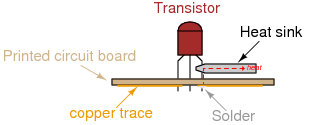
In the absence of a formal heat sink, can you think of any ways to fashion your own “impromptu” heat sinks out of commonly available tools and/or objects?
Reveal answerOne trick that works well is to wrap a rubber band around the handles of a pair of needle-nose pliers, so the jaws clamp together on their own, then clip the jaws on to the component lead being soldered.
Notes:This is an exercise in creative thinking, as well as an introduction to one of the practical concerns of soldering. Even some passive components (electrolytic capacitors, for example) do not handle high temperatures well, and so learning to manage temperatures is an important skill when performing maintenance or prototype soldering. See if you and your students can invent any other simple “heat sinks” for use when a formal heat sink is not available.
-
Question 6 of 13
When soldering a wire into a metal lug, which of these positions would be considered best for soldering iron and solder?
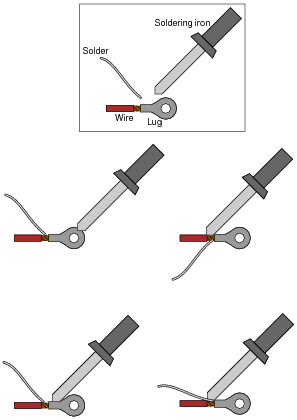
Explain why you think one of these positions is better than the others for producing a sound solder connection between the lug and the wire.
Reveal answerThe following illustration shows the best positions for iron and solder, when soldering a wire into a lug:

Notes:Discuss with your students why the positions shown in the answer would be superior to the others shown in the question. Keep in mind principles of heat conduction and the necessity for all parts of the connection to be at sufficient temperature as to melt the solder. What, precisely, would be wrong with trying to solder this connection in any of the other ways shown?