
 Facebook
 Google
 GitHub
 Linkedin
AC Electric Circuits
Step-up, Step-down, and Isolation Transformers
34 questions By Tony R. Kuphaldt
-
Question 16 of 34
Calculate all listed values for this transformer circuit:
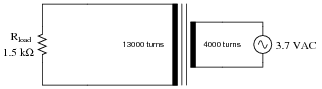
- Vprimary =
- Vsecondary =
- Iprimary =
- Isecondary =
Explain whether this is a step-up, step-down, or isolation transformer, and also explain what distinguishes the “primary” winding from the “secondary” winding in any transformer.
Reveal answer- Vprimary = 3.7 volts
- Vsecondary = 12.0 volts
- Iprimary = 26.1 mA
- Isecondary = 8.02 mA
This is a step-up transformer.
Notes:Most transformer problems are nothing more than ratios, but some students find ratios difficult to handle. Questions such as this are great for having students come up to the board in the front of the classroom and demonstrating how they obtained the results.
Note to your students how the distinction between a step-up and a step-down transformer is simply a matter of usage. It is possible to use a transformer either way!
-
Question 17 of 34
In a typical step-up or step-down transformer, the higher-voltage winding usually uses finer gauge wire than the lower-voltage winding. Explain why this is.
Reveal answerThe higher-voltage winding handles less current than the lower-voltage winding.
Notes:If you happen to have a transformer that has been cut in half (right through the core), it will make an excellent demonstration piece for discussion. The difference between windings will be immediately apparent to the students when they see one.
-
Question 18 of 34
A mechanic goes to school and takes a course in AC electric circuits. Upon learning about step-up and step-down transformers, he makes the remark that “Transformers act like electrical versions of gears, with different ratios.”
What does the mechanic mean by this statement? What exactly is a “gear ratio,” and is this an accurate analogy for a transformer?
Reveal answerJust as meshing gears with different tooth counts transform mechanical power between different levels of speed and torque, electrical transformers transform power between different levels of voltage and current.
Notes:Not only is this a sound analogy, but one that many mechanically-minded people relate with easily! If you happen to have some mechanics in your classroom, provide them with the opportunity to explain the concept of gear ratios to those students who are unaware of gear system mathematics.





Creative and interesting excercises.