
 Facebook
 Google
 GitHub
 Linkedin
AC Electric Circuits
Step-up, Step-down, and Isolation Transformers
34 questions By Tony R. Kuphaldt
-
Question 13 of 34
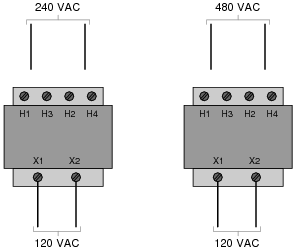
Industrial control power transformers are used to step down 480 or 240 volts to a level more acceptable for relay control circuitry: usually 120 volts. Some control power transformers are built with multiple primary windings, to facilitate connection to either a 480 volt or 240 volt AC power source:

Such transformers are usually advertised as having “240 × 480” primary windings, the “×” symbol representing two independent windings with four connection points (H1 through H4).
Show the connections on the four “H” terminals necessary for 240 volt operation, and also for 480 volt operation, on the following illustrations:
Reveal answer
Notes:This type of transformer is very common in industrial control systems. Discuss with your students why the primary winding terminals are arranged as they are (H1-H3-H2-H4), to facilitate near-terminal jumpering with metal clips.
-
Question 14 of 34
If an isolation transformer (a transformer with the same number of “turns” in the primary and secondary coils) is connected between an AC source and an AC load, we will measure the same voltage and the same current at both source and load terminals:

If we calculate power output by the source and power dissipated by the load, the value is the same: 420 Watts (P = IV).
Now suppose we analyze a circuit containing a step-up transformer (one with more turns of wire in the secondary coil than in the primary coil). With a step-up transformer, the load voltage will be greater than the supply voltage. In this example, I show a step-up transformer with a 1:2 step ratio:

Assuming the load resistance is completely different from the first (isolation transformer) circuit, what can you deduce about the load current and the power (both source and load) in this circuit? Is the load current less than the source current? Is the load current greater than the source current? Is the load power greater than the source power? Explain your answers.
Reveal answerThe basic physical law known as The Law of Conservation of Energy tells you all you need to know about source power and load power! And from that, you should not only be able to qualitatively determine the load current in this circuit, but also calculate it with a fair degree of precision.
Notes:The only reason I hesitate to tell students they can calculate load current precisely is because it was not stated whether or not the transformer is “lossy” at all. No real transformer is 100% lossless, of course, and this is something that we must take into consideration in “real life.”
I have found that the Conservation of Energy approach not only makes sense to students as they learn to calculate transformer behavior, but it is an excellent reinforcement of a basic physical law, a good understanding of which will serve them well throughout their careers.
-
Question 15 of 34
Calculate all listed values for this transformer circuit:

- Vprimary =
- Vsecondary =
- Iprimary =
- Isecondary =
Explain whether this is a step-up, step-down, or isolation transformer, and also explain what distinguishes the “primary” winding from the “secondary” winding in any transformer.
Reveal answer- Vprimary = 48 volts
- Vsecondary = 14.77 volts
- Iprimary = 30.3 mA
- Isecondary = 98.5 mA
This is a step-down transformer.
Notes:Most transformer problems are nothing more than ratios, but some students find ratios difficult to handle. Questions such as this are great for having students come up to the board in the front of the classroom and demonstrating how they obtained the results.






Creative and interesting excercises.