
 Facebook
 Google
 GitHub
 Linkedin
AC Electric Circuits
Step-up, Step-down, and Isolation Transformers
34 questions By Tony R. Kuphaldt
-
Question 22 of 34
Shunt resistors are commonly used to measure current in power circuits, by producing a small voltage drop in direct proportion to the circuit current. They are especially useful for measuring complex current waveforms in AC circuits, since they do not distort the waveform at all.
Suppose you wished to measure the current waveform in this power circuit by using an oscilloscope to measure voltage dropped across the shunt resistor:
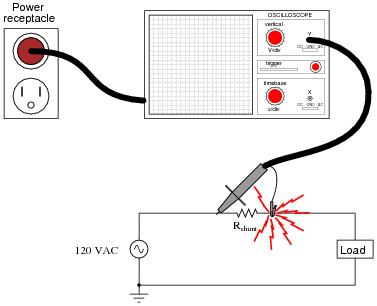
If you connect an oscilloscope to the power circuit as shown, very bad things will happen, like the oscilloscope’s ground clip melting, with lots of sparks!
After replacing the damaged probe assembly, and taking a long break to soothe your nerves, an experienced technician suggests you plug the oscilloscope’s power cord into an isolation transformer to avoid this problem in the future. Explain what an isolation transformer is, why it prevents the short-circuit problem experienced in this circuit, and what precautions must be taken when using one.
Reveal answerAn “isolation transformer” neither steps voltage up or down, but rather simply provides electrical isolation between primary and secondary windings. In this particular case, an isolation transformer inserted into the oscilloscope’s power circuit breaks a circuit formed by the probe ground clip’s connection with the oscilloscope metal chassis, which in turn is connected to the ground prong on the power cord plug, which is connected to earth ground for safety.
If an isolation transformer is used in such a way, it avoids the short-circuit problem, but only at the cost of “ungrounding” the oscilloscope chassis, making it unsafe to touch!!!
Follow-up question: identify a way to safely use an oscilloscope to measure the shunt resistor’s voltage, without having to use an isolation transformer.
Notes:This lesson on oscilloscope usage is a valuable one, as students are sure to encounter problems with their circuits resulting from earth ground connections through the oscilloscope’s chassis ground. Having an oscilloscope and an ohmmeter in the classroom during discussion time would be a good idea, so students may test the common connections themselves.
-
Question 23 of 34
Suppose you need to power a 120 volt, 600 watt heating element from a 240 volt source. You happen to have several 240V/120V step-down transformers on hand, but each one is only rated at 400 VA. Draw a schematic diagram showing how multiple transformers could be used to match the 120 volt load to the 240 volt source.
Reveal answer
Notes:In case you students have not yet studied AC power (watts, volt-amps, and volt-amps reactive), let them determine what “VA” means first, and then let them know it is simply equivalent to “watts” for a resistive load.
It is a very realistic problem to have to match available components to a particular task, so this question is worth your students’ while to discuss and understand thoroughly.
-
Question 24 of 34
Explain how the construction of a step-down transformer differs from that of a step-up transformer.
Reveal answerStep-down transformers have fewer secondary turns than primary turns, while step-up transformers have more secondary turns than primary turns.
Notes:Ask your students to explain the relationship between primary and secondary turns, and how this affects the voltage transformation ratio, based on mutual inductance.







Creative and interesting excercises.