Facebook
 Google
 GitHub
 Linkedin
Mathematics for Electronics
Trigonometry for AC Circuits
23 questions By Tony R. Kuphaldt
-
Question 4 of 23
Explain why the “impedance triangle” is not proper to use for relating total impedance, resistance, and reactance in parallel circuits as it is for series circuits:

Reveal answerImpedances do not add in parallel.
Follow-up question: what kind of a triangle could be properly applied to a parallel AC circuit, and why?
Notes:Trying to apply the Z-R-X triangle directly to parallel AC circuits is a common mistake many new students make. Key to knowing when and how to use triangles to graphically depict AC quantities is understanding why the triangle works as an analysis tool and what its sides represent.
-
Question 5 of 23
Examine the following circuits, then label the sides of their respective triangles with all the variables that are trigonometrically related in those circuits:

Reveal answer
Notes:This question asks students to identify those variables in each circuit that vectorially add, discriminating them from those variables which do not add. This is extremely important for students to be able to do if they are to successfully apply “the triangle” to the solution of AC circuit problems.
Note that some of these triangles should be drawn upside-down instead of all the same as they are shown in the question, if we are to properly represent the vertical (imaginary) phasor for capacitive impedance and for inductor admittance. However, the point here is simply to get students to recognize what quantities add and what do not. Attention to the direction (up or down) of the triangle’s opposite side can come later.
-
Question 6 of 23
Use the “impedance triangle” to calculate the necessary reactance of this series combination of resistance (R) and inductive reactance (X) to produce the desired total impedance of 145 Ω:
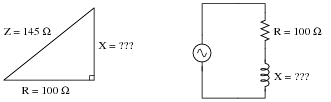
Explain what equation(s) you use to calculate X, and the algebra necessary to achieve this result from a more common formula.
Reveal answerX = 105 Ω, as calculated by an algebraically manipulated version of the Pythagorean Theorem.
Notes:Be sure to have students show you the form of the Pythagorean Theorem, rather than showing them yourself, since it is so easy for students to research on their own.