Facebook
 Google
 GitHub
 Linkedin
Mathematics for Electronics
Trigonometry for AC Circuits
23 questions By Tony R. Kuphaldt
-
Question 7 of 23
A series AC circuit exhibits a total impedance of 10 kΩ, with a phase shift of 65 degrees between voltage and current. Drawn in an impedance triangle, it looks like this:

We know that the sine function relates the sides X and Z of this impedance triangle with the 65 degree angle, because the sine of an angle is the ratio of opposite to hypotenuse, with X being opposite the 65 degree angle. Therefore, we know we can set up the following equation relating these quantities together:
sin65o = X ZSolve this equation for the value of X, in ohms.
Reveal answerX = 9.063 kΩ
Notes:Ask your students to show you their algebraic manipulation(s) in setting up the equation for evaluation.
-
Question 8 of 23
A series AC circuit exhibits a total impedance of 2.5 kΩ, with a phase shift of 30 degrees between voltage and current. Drawn in an impedance triangle, it looks like this:

Use the appropriate trigonometric functions to calculate the equivalent values of R and X in this series circuit.
Reveal answerR = 2.165 kΩ
X = 1.25 kΩ
Notes:There are a few different ways one could solve for R and X in this trigonometry problem. This would be a good opportunity to have your students present problem-solving strategies on the board in front of class so everyone gets an opportunity to see multiple techniques.
-
Question 9 of 23
A parallel AC circuit draws 8 amps of current through a purely resistive branch and 14 amps of current through a purely inductive branch:
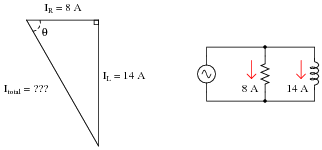
Calculate the total current and the angle Θ of the total current, explaining your trigonometric method(s) of solution.
Reveal answerItotal = 16.12 amps
Θ = 60.26o (negative, if you wish to represent the angle according to the standard coordinate system for phasors).
Follow-up question: in calculating Θ, it is recommended to use the arctangent function instead of either the arcsine or arc-cosine functions. The reason for doing this is accuracy: less possibility of compounded error, due to either rounding and/or calculator-related (keystroke) errors. Explain why the use of the arctangent function to calculate Θ incurs less chance of error than either of the other two arcfunctions.
Notes:The follow-up question illustrates an important principle in many different disciplines: avoidance of unnecessary risk by choosing calculation techniques using given quantities instead of derived quantities. This is a good topic to discuss with your students, so make sure you do so.