Facebook
 Google
 GitHub
 Linkedin
AI Pipeline Storage Demands Optimal Performance, Efficiency
Artificial intelligence data pipelines are placing new pressures on enterprise storage, and data centers must rapidly adapt storage capabilities with SSDs as their backbone.
With massive amounts of data being collected from edge sources like Internet of Things (IoT) devices and autonomous vehicles, efficient AI data storage isn’t just about density and capacity—performance, power use, security and total cost of ownership are also key metrics.
AI pipelines have unique storage requirements—they process vast, varied data sets through stages like ingestion, preparation, training and inference in data centers. The lifecycle of AI data after it’s collected and ingested includes constant reading, moving and transformation, requiring storage infrastructure that manages both high performance sequential and mixed workloads.
Cyclical AI Pipeline Demands Read and Write Performance
A typical AI data pipeline for a large language model (LLM) requires storage that maximizes data efficiency and minimizes total system power; the storage is expected to reduce training completion times.
Ingesting large amounts of raw, unstructured data from sources like IoT devices and web scraping requires high-throughput sequential writes, but when this data is cleaned and prepared, the AI pipeline now requires a mix of efficient sequential reads and writes as the unstructured information is processed and categorized.
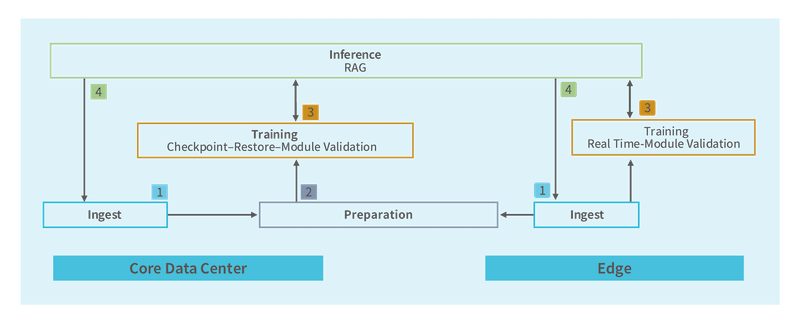
Flowchart of an AI data pipeline
The training stage of the pipeline needs low latency and high IOPS storage for random reads and writes. Just as important is reliable checkpointing to enable recovery if issues arise. Inference workloads, such as recommending products to users as they shop online, rely on both sequential and random read/write performance.
Data is ultimately archived, which calls for high-capacity storage and sequential writing. However, this archived data may be reused for future AI workloads.
The different stages of the AI pipeline illustrate the dynamic, continuous and cyclical processes driving storage requirements—t must adapt to shifting performance needs in a cost-effective manner while ensuring data integrity.
Valuable Data Must Be Secured
Maintaining data integrity across the AI pipeline intersects with data security and privacy. Both are more important than ever because of legislation and regulations that govern how data is managed, and because AI workloads represent valuable intellectual property.
The AI pipeline must be secure if the integrity of training models and ultimate inference are to be trusted. Data accuracy and validity must be ensured throughout the AI data pipeline from the point of ingestion to the final inference.
Security must ensure both data protection and platform protection by using data encryption and/or obfuscation techniques to prevent unauthorized access to data and secure boot with root of trust and prevent unauthorized mutable code access with authentication.
SSDs provide software encryption, hardware encryption and Advanced Technology Attachment (ATA) to secure data and the device from tampering.
Edge Data Puts Pressure on Capacity and Bandwidth
The shift from core to edge computing supports more real-time inference, increasing storage needs outside data centers to meet AI demands.
AI workloads demand increasing memory bandwidth and capacity, as well as quick access to exabytes of data. AI servers typically require two to four times more storage capacity than regular servers. Hard drives are good for storing substantial amounts of static data, while SSDs are ideal for handling data transformation, which involves intermittent data surges and straggler data, causing tail latency.
SSDs offer the ultra-fast read and write speeds necessary to manage large data sets in intensive AI pipelines, but performance per watt has become a key benchmark for AI storage. Because these pipelines must be fed data quickly, data efficiency is critical, as AI consumes an unprecedented amount of power.
Smart Data Placement Optimizes AI Pipeline
Optimal data efficiency can be achieved by leveraging the Non-Volatile Memory Express (NVMe) protocol that adds capabilities to SSDs.
Features such as NVMe Zone Namedspaces (ZNS) and Flexible Data Placement (FDP) reduce latency, boost performance and enhance endurance for AI data access. Silicon Motion's MonTitan technology provides further capabilities for large-capacity AI data center storage.
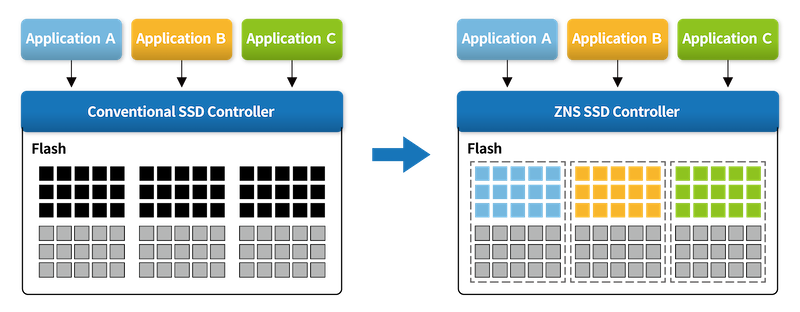
ZNS-enabled SSDs separate data into zones for more efficient placement and retrieval, reducing internal data movement.
ZNS and FDP ensure proper placement of data at the ingest stage—by being able to accurately place the data where it needs to be, when it needs to be there, there’s much less round tripping from a memory perspective, and the GPUs are kept as busy as possible. ZNS enhances SSD efficiency, longevity, lowers latency and increases throughput, making them ideal for high-performance AI tasks.
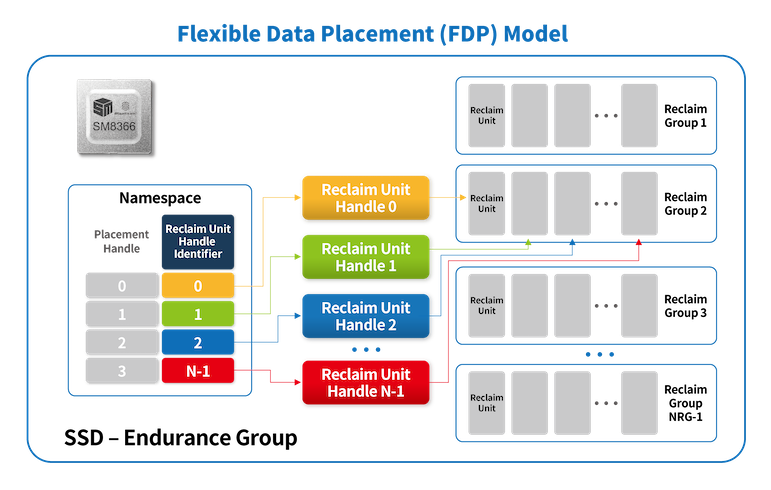
FDP addresses the write-amplification problem in SSDs by allowing the host to have a simplified view and moderate awareness of media topology.
AI data centers must contend with the “I/O blender effect” because the storage is accessed by multiple stages of the AI pipeline simultaneously. Silicon Motion's proprietary performance shaping technology reduces these conflicts by dynamically configuring Quality of Service (QoS) sets using a dual stage shaping algorithm tailored for specific workloads in the AI data pipeline.
MonTitan Adds Intelligence to SSDs
Silicon Motion’s MonTitan Enterprise Development platform provides purpose-built firmware, hardware and ASIC technologies that uniquely address the needs of AI pipelines.
MonTitan is a high-performance, user-programmable PCIe Gen5 development platform, which leverages our PerformaShape technology, a multi-stage shaping algorithm configured in firmware that optimizes SSD performance on a per user-defined QoS set basis.
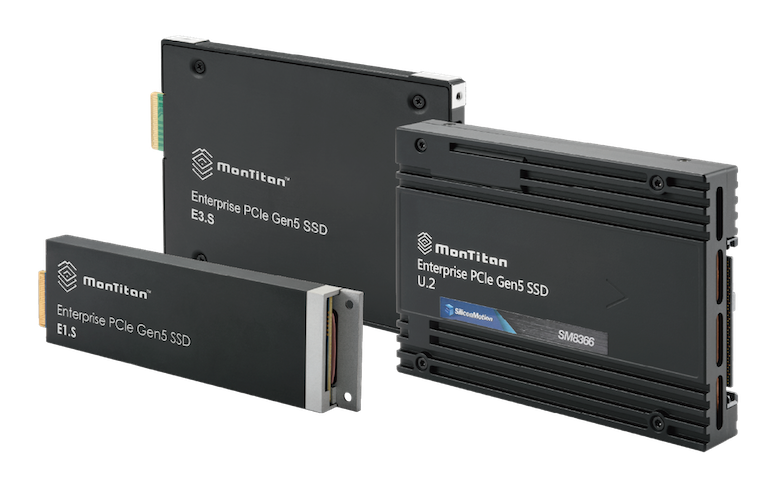
Silicon Motion’s MonTitan Enterprise PCIe Gen5 SSD family
MonTitan addresses the I/O blender effect with its focus on control plane efficiency and coherency making it ideal for AI pipelines—it isolates guaranteed traffic in different stages and maximizes GPU utilization.
MonTitan platform also includes capabilities to ensure data integrity, as well as security features that support NIST/FIPS (USA) standards and AES-XTS/SM4 Data at Rest protection, and the ability to enable post-quantum encryption.
As part of our comprehensive AI strategy spanning enterprise data centers and edge applications, Silicon Motion’s MonTitan Enterprise Development platform was designed with dynamic AI pipeline in mind, so that SSDs can meet key metrics organizations are looking for throughout every stage.
More information is available in our white paper Transforming AI Data Pipelines with Advanced SSD Technology.
All images used courtesy of Silicon Motion.