Facebook
 Google
 GitHub
 Linkedin
AI’s Appetite for Memory: Can Hardware Designs Keep Pace?
Memory selection has become a priority, as AI system designs demand more memory. Learn how to navigate hardware designs impacts and supply chain issues, and how BOM management tools help smooth the way.
The rise of AI—from smart speakers and wearables to autonomous vehicles and cloud-scale models—is putting unprecedented pressure on electronic hardware design. While GPUs and accelerators often steal the spotlight, memory is quickly becoming the defining bottleneck for AI systems at every level of the stack.
AI workloads depend on fast-access, high-density memory to feed data-hungry models. Whether you’re training a generative model in a datacenter or running object detection on an edge device, memory bandwidth and capacity now act as gating factors for system performance, power efficiency, and thermal stability.

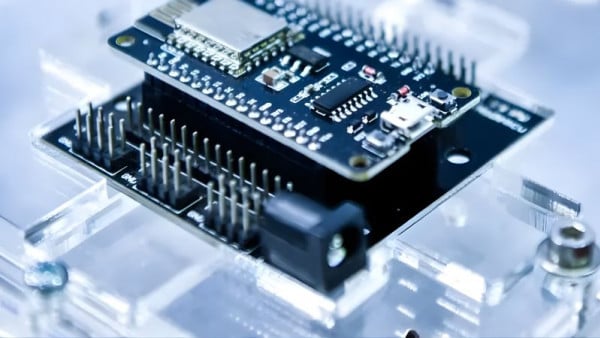
Figure 1. The demands of AI workloads are putting new demands on memory architectures.
To meet these demands, hardware teams are turning to several options for memory architectures. These include:
- High-Bandwidth Memory (HBM) for wide I/O and throughput in AI training.
- GDDR6/GDDR7 for graphics-rich or inference-heavy tasks.
- LPDDR5/LPDDR5X for energy-constrained edge AI devices.
- 3D-stacked DRAM to pack more capacity into smaller footprints.
- Emerging non-volatile options like MRAM and ReRAM for persistent AI state and edge boot-time optimization.
Each of these technologies introduces unique constraints into the hardware development process, around power, compatibility, thermal design, and availability, forcing design tradeoffs at the system level.
Design Is Now Defined by Memory
In traditional hardware development workflows, memory selection came after deciding on CPU or GPU. In the age of AI, that order is flipped. Today’s hardware designers are finding that memory selection drives outcomes for the entire hardware stack, influencing layout, power strategy, and product form factor.
For example, selecting high-speed GDDR6 may enable faster inferencing but requires dedicated power rails and more complex PCB routing, adding thermal and EMI challenges. Choosing LPDDR5 for battery-powered mobile devices helps save energy, but limits bandwidth and may restrict model size or inference rates. Using HBM unlocks massive throughput, but it also demands advanced packaging and cooling innovations, such as vapor chambers or liquid systems, both of which increase cost.
These are not theoretical concerns. Because AI memory needs are evolving rapidly, designers must lock in memory footprints and interfaces earlier, often before software models and firmware are stable. This raises the risk carried by early-stage design decisions. A miscalculated memory choice could require board re-spins or limit future upgrade paths.
PCB layout and 3D visualization (Figure 2) shows how early memory decisions influence the entire hardware footprint—including component placement, routing complexity, and thermal strategy.
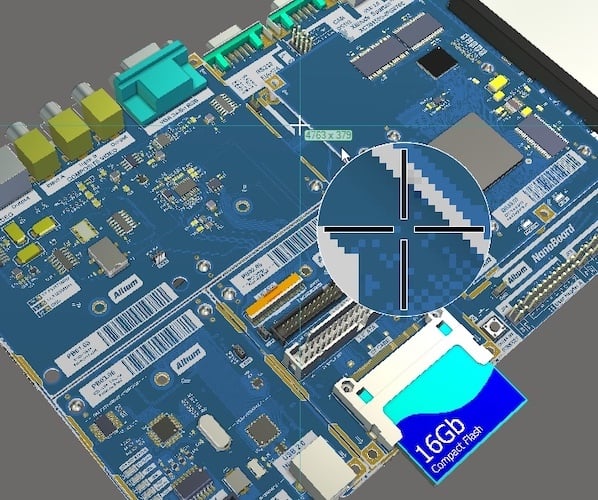
Figure 2. 3D PCB layout in Altium can highlight how memory choices impact placement, routing, and thermal design.
Volatility in the Memory Supply Chain
As AI model adoption explodes, so too does demand for advanced memory. Unfortunately, memory—particularly DRAM and NAND—has long been a cyclical and price-sensitive market. Today’s surge in AI demand makes that volatility worse.
HBM, GDDR6, and LPDDR5 are now considered strategic assets. Their production is concentrated in South Korea, which is dominant in DRAM; Taiwan, for advanced packaging and foundry services; and Japan, for materials and specialty memory.
This geographic concentration also concentrates certain risks, such as geopolitical instability (for example, tensions in the Taiwan Strait); export controls and trade restrictions; fabrication bottlenecks, as EUV lithography and DRAM-specific equipment are limited to only a few fabs; and material shortages (for example, fluorinated gases, specialty photoresists) that can choke supply and delay delivery.
For designers working on AI-enabled new product introductions, this means longer lead times and increased exposure to component obsolescence if memory roadmaps shift or if a given part becomes scarce.
To help mitigate this, Altium’s BOM management capabilities (Figure 3) allow hardware teams to quickly source, compare, and lock down the right memory components early in the design process. This is critical for avoiding costly delays due to AI-driven part volatility.
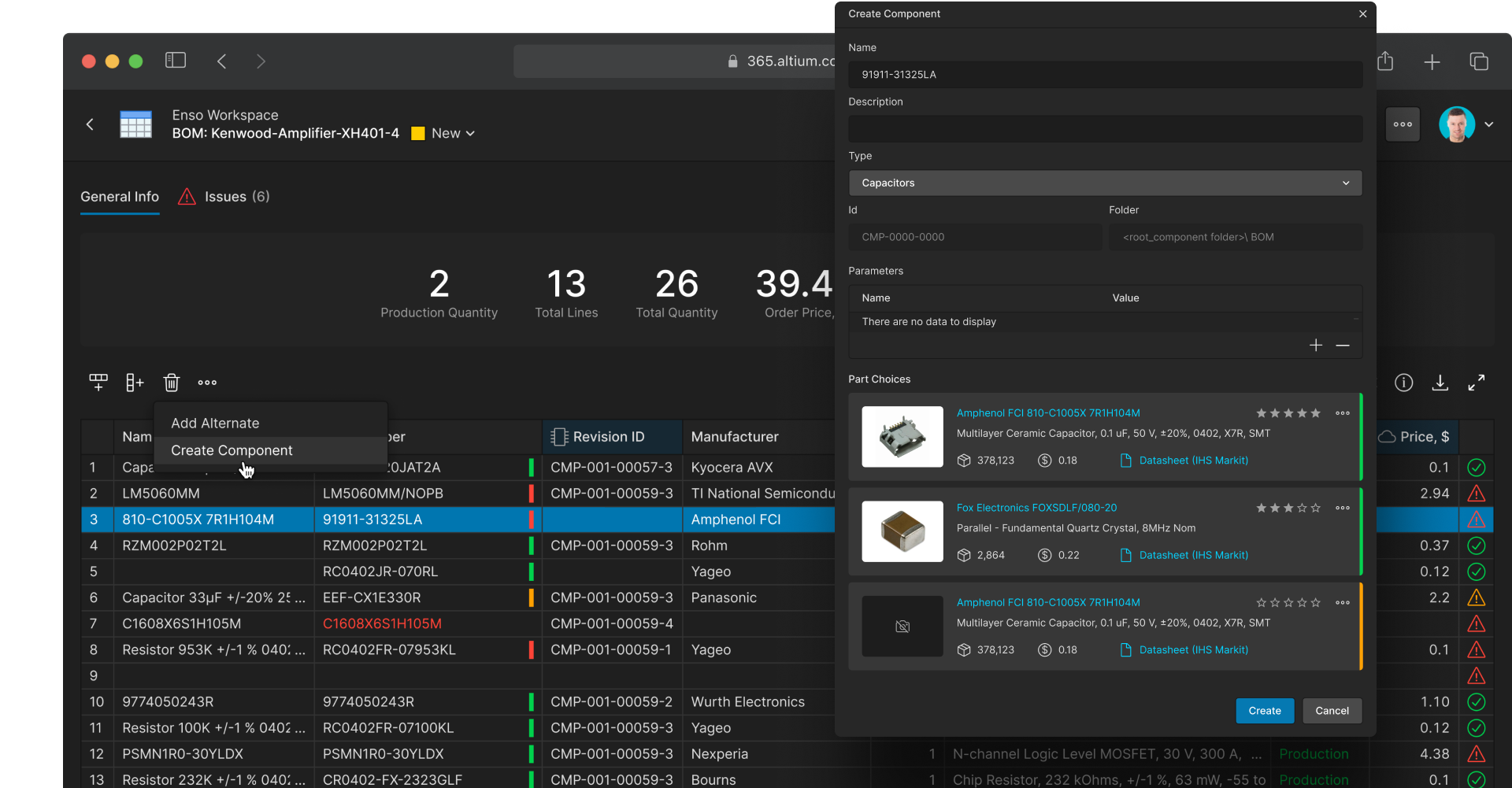
Figure 3. Altium’s 365 BOM management capabilities help teams source and secure memory components early. (Click on image to enlarge)
It’s Not Just About Quantity—It’s About Access
In AI hardware, more memory is only helpful if it’s the right kind of memory, in the right place, connected in the right way.
The shift from general-purpose computing to AI-centric workloads allows product development teams to consider new design approaches. Tightly coupled memory, for example, reduces latency but requires deeper integration with processors or SoCs. Loosely coupled memory offers flexibility, but may introduce bottlenecks.
Memory access patterns—such as tensor reuse, strided access, or sparsity—must be optimized according to the model’s structure and compute pipeline. Partitioning decisions, such as storing weights in HBM, activations in LPDDR, and intermediate data in NVM, can dramatically affect performance, thermal profiles, and battery life.
Compatibility is a technical minefield. Engineers must validate that memory is not only electrically compatible with AI chips, FPGAs, or SoCs, but also logically matched for bandwidth, latency and parallelism. A mismatch here can undercut compute performance, inflate power budgets, or lead to underutilization of expensive hardware accelerators.
Forward-Thinking Memory Planning is Now a Competitive Advantage
The companies launching successful AI hardware today aren’t just optimizing performance—they’re building resilience into their memory strategy from the start.
This means factoring in sourcing risk and lifecycle status during memory selection, simulating memory access and throughput early in the design phase, collaborating across hardware, software, and supply chain teams to anticipate roadblocks, and investing in design platforms that support real-time collaboration and component intelligence.
When design and sourcing teams operate in silos, decisions regarding memory can be delayed or made in isolation, resulting in costly errors and missed market windows. But when teams work together from the start, they can identify alternatives, de-risk availability issues, and engineer systems that balance power, performance, and supply chain security.
System designers are moving towards embedding AI into everything from edge sensors to datacenter infrastructure. Memory is the new battleground, where strategies for performance, scalability, and component availability compete. Designers who treat memory not as an afterthought, but as a central constraint, will successfully bring their products to market and win their race to create the next great products.
All images used courtesy of Renesas-Altium.