Facebook
 Google
 GitHub
 Linkedin
STMicro Debuts Single-Die Mobile Chip With Post-Quantum Cryptography
The ST54M places an NFC controller, secure element, and eSIM on one die and adds a hardware accelerator for NIST's post-quantum algorithms.
STMicroelectronics has introduced the ST54M, a mobile security chip that pairs a post-quantum cryptography accelerator with an NFC controller, a secure element, and eSIM functionality on a single piece of silicon.
Announced June 24th, the device is sampling now, with production and security certifications targeted for July this year. ST is aiming it at smartphone and wearable makers that want quantum-resistant protection in place well before the cryptographic requirements the industry expects to arrive around 2030.
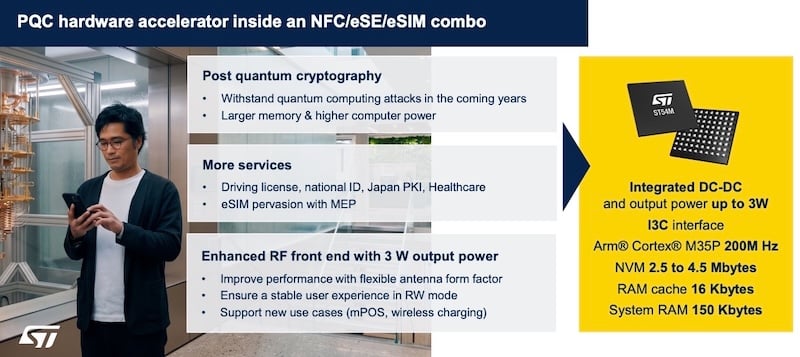
The ST54M is a secure mobile chip with PQC for next-gen connected services.
Why Post-Quantum, and Why Now
The public-key cryptography that protects payments, identity, and connectivity today relies on math that a sufficiently powerful quantum computer could eventually unwind. The nearer-term worry is the "harvest now, decrypt later" tactic, in which an attacker records encrypted traffic and stores it until quantum hardware can crack it. Credentials with a long useful life, such as identity documents and financial records, are the most exposed.
Standards bodies have started to respond, and in August 2024, the U.S. National Institute of Standards and Technology finalized its first post-quantum standards, among them ML-KEM (FIPS 203) for key encapsulation and ML-DSA (FIPS 204) for digital signatures, both lattice-based schemes drawn from the CRYSTALS family.
The ST54M runs both algorithms in a dedicated hardware accelerator, and ST built it to support a hybrid migration that pairs classical and post-quantum cryptography before a full switchover. The engine also includes countermeasures against side-channel and fault-injection attacks, and it works alongside ST's certified software libraries, NesLib-PQML for secure elements and X-CUBE-PQC for STM32 microcontrollers.
ST is billing the part as the first secure mobile chip to carry a post-quantum hardware accelerator, a claim that says as much about how early this transition is as it does about the silicon. Rival secure-chip makers, including NXP Semiconductors and Infineon, have been moving in the same direction, so the ST54M lands in a market that's starting to treat post-quantum readiness as a design requirement. More information is available in the ST54M data brief.
One Die for NFC, Secure Element, and Embedded SIM
Integration is the ST54M's other selling point, placing an NFC controller, a secure element, and an embedded SIM on one die, extending ST's mobile-convergence platform. Folding together three functions that often occupy separate packages frees board space, trims the bill of materials, and eases the routing and antenna constraints that phone and wearable designers work around.
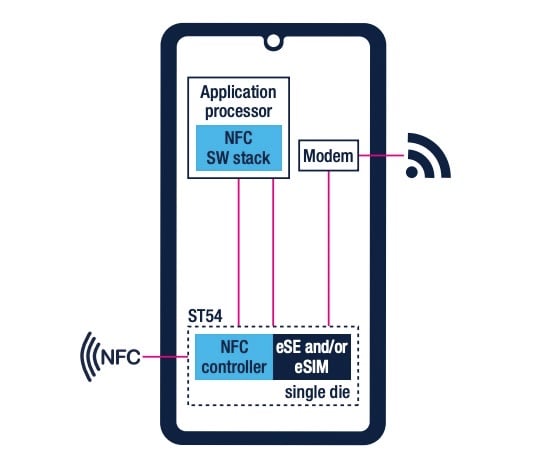
Example of a ST54M NFC AND ESE/ESIM combo solutions in an mobile design
Consolidating onto a single secure die also narrows the physical attack surface. The shift is important as removable SIM trays give way to embedded SIM across flagship phones, which pushes carriers and handset makers toward tighter, more secure integration, and putting the controller, secure element, and embedded SIM under one certification simplifies qualification for device makers that would otherwise validate each block on its own.
An enhanced RF front end backs that up, with ST saying it delivers steadier performance with smaller and single-ended antennas, more stable reader-to-writer operation, and enough headroom for demanding cases such as mobile point-of-sale and wireless charging. Expanded on-chip memory lets the secure element host several applications at once, so one device can carry contactless payment, transit passes, digital identity, and a digital car key without dedicated hardware for each.
Certification and Availability
Security silicon depends on its certifications, and ST is putting the ST54M through Common Criteria 2022 EUCC and EMVCo evaluation, both targeted for July 2026. That timeline matches production, so customers moving from samples to volume should have the approvals that identity issuers require.
EMVCo certification clears the chip for use across major payment networks, while the Common Criteria EUCC scheme is the European framework that many government identity and travel-document programs now use. ST frames the roughly 2030 horizon as industry-driven rather than tied to a single named regulation, which gives device makers room to ship quantum-ready hardware now instead of re-spinning designs later.
Target applications span contactless payments, transit ticketing, access control, digital identity and driving licenses, connectivity services, and digital car keys. The stakeholders ST lists around those uses, including mobile network operators, banks, governments, transit operators, automakers, and digital-wallet providers, are the same groups that will have to account for post-quantum migration.
All images used courtesy of STMicroelectronics.
Related Content