Facebook
 Google
 GitHub
 Linkedin
Bluetooth Channel Sounding Unlocks New Distance-Ranging Applications
Learn how this new Bluetooth feature enhances distance ranging and enables new device positioning and location service applications.
Bluetooth LE has found widespread use in healthcare, consumer, audio, and industrial applications. Bluetooth LE has also established itself as a pervasive and reliable technology for building device positioning solutions. The short-range wireless technology can be used to:
- Detect and report the presence of another nearby device.
- Estimate the distance between devices.
- Calculate the direction in which another device can be found.
Now, the most recent update to the Bluetooth Core Specification (detailing Bluetooth 6.0) adds a new distance-ranging feature called Bluetooth Channel Sounding. The technology enables secure fine ranging between two Bluetooth devices and promises many new innovative wireless proximity and distance-ranging applications.

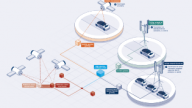
Figure 1. Bluetooth Channel Sounding will enable new proximity and location applications. Image used courtesy of Adobe
Moreover, Channel Sounding is expected to be widely adopted in mobile phones and a broad range of other battery-powered Bluetooth LE products, providing standardization and interoperability.
This article explains what Channel Sounding is and how developers can use Nordic Semiconductor SoCs and development tools to build new distance-ranging applications.
Early Bluetooth Location Services
Bluetooth LE has long incorporated device positioning and location services technology. For example, the Find Me Profile was included as part of the Bluetooth Core Specification when Bluetooth LE was first released (as a hallmark element of Bluetooth 4.0).
Later, as beacons became a popular Bluetooth LE application, a value in the Bluetooth specification known as TX Power provided a reference power level at a distance of one meter from the beacon or other transmitting device. RF signals attenuate approximately inversely proportionally to the square of the distance from the transmitter. Therefore, with knowledge of the TX Power value, a measured Received Signal Strength Indicator (RSSI) could be used as a coarse estimate (Close, Connected, or Out of Range) of the distance between the beacon or other transmitter and receiver.
Then, in 2019, Bluetooth Direction Finding was introduced as part of Bluetooth 5.1. The technique enables applications to accurately calculate the direction of a received signal using phase measurements made by the Bluetooth LE controller. Two methods were defined: Angle of Arrival (AoA) and Angle of Departure (AoD).
An Introduction to Channel Sounding
Channel Sounding now brings a simple and reliable solution for distance-ranging applications. Four key characteristics of Channel Sounding are:
- It is standardized and interoperable
- It can be supported by very simple devices or as an addition to a more advanced product without extra hardware costs and with a minimal software footprint.
- Power consumption is as low as regular data transfer over Bluetooth LE.
- It supports various hardware and software configuration options for accuracy, latency, security, and power consumption.
The Bluetooth specification for Channel Sounding defines new features of the radio (PHY), features of the controller, security measures, and procedures needed to collect raw measurement data. However, the conversion of raw data into the resulting distance measurement using dedicated algorithms is performed at the application level and is outside the scope of the specification. The configuration of the measurements and the algorithms can be adjusted to balance the required accuracy, latency, security and power consumption of the application.
The technology underpinning Channel Sounding is complex but is founded on Phase-Based Ranging (PBR) and Round-Trip Timing (RTT). Let’s dive into these technologies in detail.
Phase-Based Ranging
Phase-based ranging (PBR) uses an Initiator and a Reflector to perform distance ranging (Figure 2). The Initiator sends a signal of a known frequency, which is then returned by the Reflector. The phase difference between the transmitted and received signal is measured.
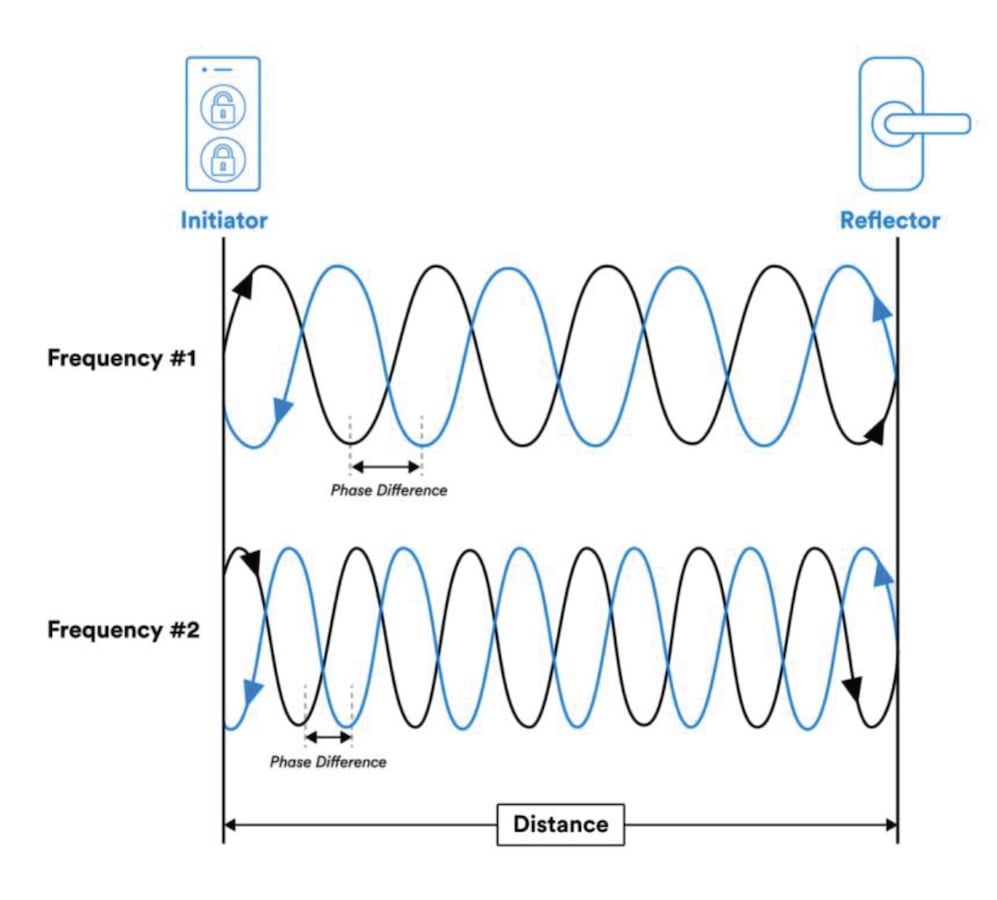
Figure 2. Phase-based ranging uses phase differences between signals at two different frequencies to determine the distance between an Initiator and a Reflector. Image used courtesy of the Bluetooth SIG [click to enlarge]
The process is then repeated using a signal of a different frequency. With knowledge of the phase differences and the differences between the frequencies, a dedicated algorithm reveals the distance between the Initiator and the Reflector.
Round-Trip Timing
Round-trip timing (RTT) works by measuring the time it takes for a packet to travel between the Initiator and the Reflector and back, as illustrated in Figure 3. A known amount of time is subtracted from the overall time-of-flight to account for the time taken for the reflector to receive and then retransmit the packet. The distance is tehcn calculated by multiplying the round-trip flight time by the speed of light (c), and finally dividing by two.
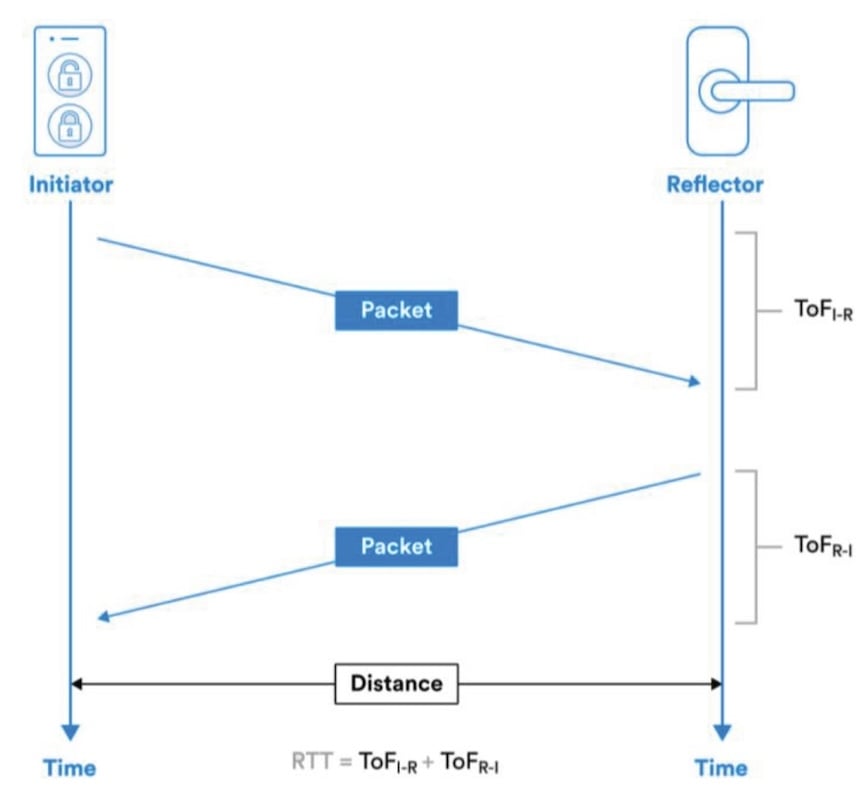
Figure 3. In round-trip timing, the time-of-flight of a radio packet between an Initiator and a Reflector can be used to determine the distance between the devices. Image used courtesy of the Bluetooth SIG [click to enlarge]
RTT acts as a secure distance bounding technique to cross-check PBR. The algorithms used for RTT to calculate the distance are simpler than those used for PBR.
Powering New Applications
Like all Bluetooth LE enhancements, Channel Sounding will lead to many applications that are hard to imagine. However, a few examples do come to mind.
One example is improved tags. Today’s tag solutions work well, but problems can arise when the vibration or sound they emit when activated is muffled by sofa cushions or blankets. Channel Sounding will enable accurate ‘hot-cold’ proximity alerts over longer distances to overcome the limitations of sound or vibration alarms.
Smart locks will also gain an advantage from Channel Sounding. Presence detection of the person wishing to activate the lock will be improved. This will improve protection against man-in-the-middle and relay attacks.
Appliances will also be enhanced by the technology. Presence or distance contextualization will promote significant improvements in user experiences. For example, physical context information provided by Channel Sounding will be useful when interfacing with multiple devices. It can also enable safety features that activate control functions only when the user is near the device.
Bluetooth LE is already in extensive use for asset-tracking location services. However, Channel Sounding will bring greater precision, reliability, and convenience to such applications without adding significant complexity and cost to existing solutions.
Developer Support for Channel Sounding and Alternative Distance Measurements
Nordic’s fourth-generation wireless SoCs, the nRF54L and nRF54H series, support Bluetooth 6.0 and Channel Sounding. Development support for the nRF54 Series is provided by Nordic’s unified and scalable software development kit, the nRF Connect SDK.
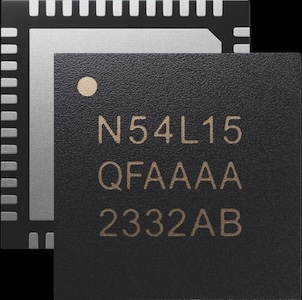
Figure 4. The nRF54L15 fourth-generation wireless SoC supports Bluetooth LE, Mesh, and Channel Sounding. Image used courtesy of Nordic Semiconductor
While Bluetooth Channel Sounding will provide a good basis for PBR- and RTT-based proximity and distance-ranging applications, there is a proprietary alternative. The Nordic Distance Toolbox (NDT) offers PBR and RTT-based advanced distance measurements and proximity sensing capabilities for developers that need these capabilities outside the Bluetooth ecosystem or would like to implement related applications on selected Nordic nRF52 and nRF53 Series SoCs.
The accompanying software library for the nRF Connect SDK includes an algorithm that accurately determines the distance between two NDT-enabled devices, significantly enhancing accuracy compared to solutions based solely on the received signal strength indicator (RSSI). There is a sample in the nRF Connect SDK that demonstrates the functionality of NDT.
Channel Sounding Is Ready To Go Far
The asset tracking market alone was valued at $21.25 billion in 2023. According to Fortune Business Insights, it is projected to grow $59.64 billion by 2032. Many other applications will also be supported by advanced distance measurements and proximity sensing capabilities. With the advent of Bluetooth Channel Sounding, developers now have a powerful new tool to help them build winning applications for booming markets, such as asset tracking and security.
Feature image is a composite used courtesy of the Bluetooth SIG and Adobe.