
 Facebook
 Google
 GitHub
 Linkedin
Breaking the Thermal Wall Using Monolithic Ceramic Cooling for Power Electronics
Learn how monolithic ceramic cooling using Selective Laser Reaction Sintering (SLRS) eliminates the "thermal wall" in high-density power electronics by creating single-piece, reliable heat exchangers.
Article co-authored by Colin Harmer and Stephen Farias.
Modern power electronics development is governed by a ruthless set of metrics, but one stands out above the rest: density. Engineers across industries from automotive traction inverters to AI data center server racks are being tasked with processing more energy in smaller volumes than ever before.
This push for density is largely driven by the adoption of wide bandgap (WBG) semiconductors. Materials like silicon carbide (SiC) and gallium nitride (GaN) have unlocked electrical efficiencies and switching speeds that were previously impossible with silicon. However, these electrical gains have pushed thermal management to its breaking point.
The Thermal Wall in the Age of Densification
With power densities now targeting 100 kW/L, heat fluxes are exceeding 100 W/cm². At this intensity, the limiting factor is no longer the semiconductor die itself. WBG devices can theoretically operate at junction temperatures exceeding 200°C. The limit is the packaging that surrounds it.
The industry faces a paradox: We have chips capable of surviving extreme heat, yet we encase them in a traditional "thermal stack" of solders, thermal interface materials (TIMs), and copper baseplates that fail well below the chip’s limits. To unlock the full potential of WBG semiconductors, we must move beyond the legacy "sandwich" architecture and embrace monolithic, near-net-shape ceramic manufacturing.
The Physics of Failure: Why the Stack Fails
To understand the solution, we must first rigorously define the problem. The standard power module architecture is a legacy of the silicon era, relying on a multi-layered approach where heat must travel through distinct interfaces to reach the coolant.
The CTE Mismatch: The most critical failure mode in this stack is driven by the Coefficient of Thermal Expansion (CTE). In a high-power module, materials with vastly different expansion rates are bonded together: Silicon Carbide (SiC): ~4.0 ppm/K; Copper (Baseplate/Traces): ~17.0 ppm/K; Aluminum (Heatsink): ~23.0 ppm/K.
In an application like an electric vehicle drive train, which undergoes aggressive drive cycles and rapid thermal swings, these materials expand and contract at different rates. This differential expansion creates significant shear stress at the bond lines. Over thousands of cycles, this stress leads to delamination—the layers literally pull themselves apart.
The Weakest Link: Thermal Interface Materials (TIMs): Furthermore, the interface between the module baseplate and the liquid cold plate typically requires a Thermal Interface Material (TIM) (grease or pad) to account for surface roughness. TIMs are notoriously poor thermal conductors compared to metals or ceramics, often acting as a thermal bottleneck. Worse, they suffer from "pump-out" effects where thermal cycling physically squeezes the grease out of the joint, increasing thermal resistance over time and leading to premature device failure.
The Solution: Monolithic Ceramic Heat Exchangers
The ideal solution to these mechanical and thermal challenges is to eliminate the layers entirely. Ceramics like Silicon Carbide (SiC) and Aluminum Nitride (AlN) are excellent candidates; they possess high thermal conductivity and, crucially, a CTE that closely matches the WBG semiconductor die (removing the shear stress). However, manufacturing complex active cooling shapes out of these materials has historically been impossible.
- Machining: Prohibitively expensive due to the diamond tooling required for hard ceramics.
- Binder Jetting: Produces porous parts that require silicon infiltration, which compromises thermal performance.
- Lithography: Limited to thin walls because thick parts crack during debinding. To break this manufacturing deadlock, the industry is exploring Selective Laser Reaction Sintering (SLRS).
How SLRS Works: The Zero Volume Change Mechanism
Unlike traditional sintering, which fuses powder particles together and causes parts to shrink by roughly 20%, SLRS utilizes a chemical reaction to synthesize ceramics with effectively zero volume change.
This process begins with a powder bed containing a mixture of a metal and its oxide (for example, Silicon and Silica). The build chamber is filled with a reactive gas. When the laser strikes the bed, it triggers two simultaneous reactions:
- Expansion: The pure metal reacts with the gas to form a ceramic, expanding the crystal lattice.
- Contraction: The metal oxide reacts and releases oxygen, causing the lattice to collapse.
By precisely tuning the ratio of metal to oxide, the expansion cancels out the contraction. The result is a part that emerges from the printer fully dense, with no shrinkage and, therefore, no residual stress.
This "Zero Volume Change" is not just a chemical curiosity; it is a manufacturing enabler. It allows for the production of massive, thick-walled parts that maintain tight tolerances—a requirement for mating with precision semiconductor dies. It also eliminates the need for long debinding cycles, streamlining the production of complex, monolithic heat exchangers.
Engineering Design Freedom: The Gyroid Advantage
The ability to print "unprintable" ceramic shapes allows thermal engineers to utilize geometries that were previously confined to simulation software, such as Triply Periodic Minimal Surfaces (TPMS), commonly known as Gyroids.
In a traditional pin-fin or micro-channel cooler, fluid flow can become laminar, creating a boundary layer that insulates the hot surface from the cool fluid. Gyroid structures, however, force the fluid into a continuously mixing, chaotic flow path. This turbulence breaks up the thermal boundary layer, significantly boosting the heat transfer coefficient.
By printing these Gyroid channels directly into a ceramic block that serves as both the electrical insulator and the heat sink, engineers can reduce the thermal resistance path to its absolute minimum.
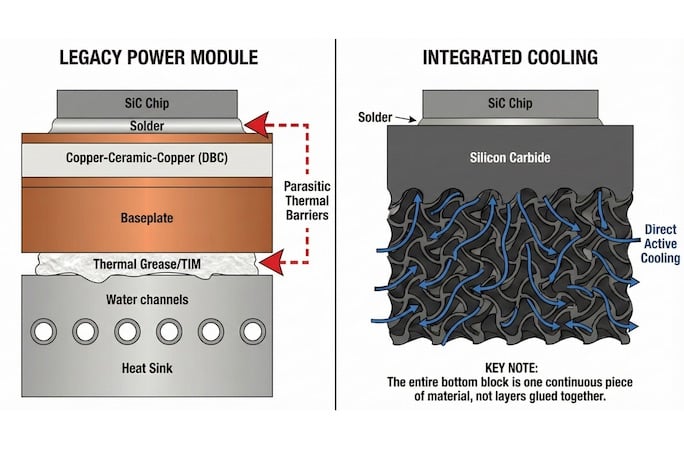
Figure 1. Schematic showing comparison of legacy power module vs. proposed integrated cooling.
Case Study: The "Breaking the Board" Project
To validate this approach, Synteris (a Materic LLC portfolio company) partnered with the National Laboratory of the Rockies (formerly NREL) and Packet Digital on an ARPA-E funded project titled "Breaking the Board."
The objective was to replace a traditional liquid-cooled system with a monolithic SLRS ceramic module. The team utilized the Synteris process to print a single ceramic component featuring internal Gyroid channels, effectively combining the substrate, baseplate, and heat sink into one continuous material.
Data & Results: The results from the project highlighted the efficacy of removing parasitic thermal interfaces:
- Volume Reduction: The overall module volume was reduced by approximately 60%, a critical gain for space-constrained EV and aerospace applications.
- Cooling Efficiency: Thermal performance improved by 50% compared to the baseline liquid-cooled assembly.
- Reliability: By eliminating the copper-to-ceramic bond layers, the primary mechanism for fatigue failure (CTE mismatch) was removed, significantly extending the projected lifespan of the module under thermal cycling.
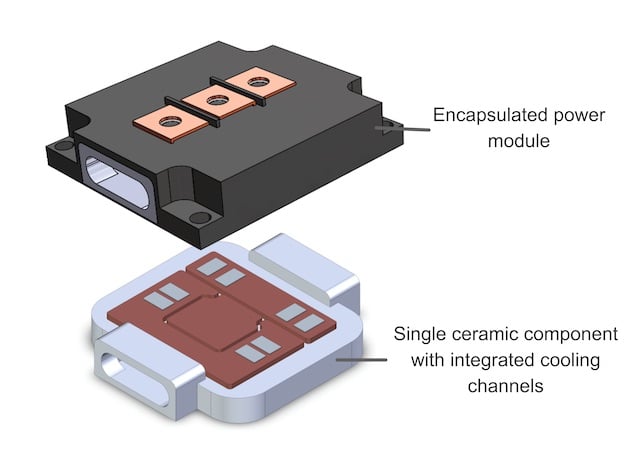
Figure 2. Exploded view showing the final encapsulated power module (top) and the underlying single monolithic ceramic component with integrated cooling channels (bottom) produced via SLRS.
Strategic Implications for High-Power Markets
The shift toward monolithic ceramic cooling offers strategic advantages across three high-value sectors:
- Electric Vehicles (EVs): As automakers transition to 800V architectures to enable faster charging, the thermal load on traction inverters spikes. Current aluminum water jackets are reaching their physical limits. Ceramic heat exchangers provide a pathway to power densities of 100 kW/L, enabling lighter, more compact inverters that directly contribute to extended vehicle range.
- AI Data Centers: With artificial intelligence workloads surging, server rack power densities are surpassing 100 kW/L. Traditional air cooling is obsolete, and metal cold plates pose corrosion and electrical short risks. Inert ceramic cold plates offer a "set and forget" solution—chemically impervious to coolants and electrically insulating, ensuring safety in high-voltage rack environments.
- Defense and Hypersonics: The defense sector demands materials that can survive extreme environments. The SLRS process is compatible with ultra-high temperature materials like Hafnium Carbide, which can withstand temperatures above 3000°C. This opens applications beyond electronics, such as leading edges for hypersonic vehicles, where thermal shock resistance is paramount.
The Method, Not the Material
The "thermal wall" in power electronics has long been accepted as a necessary evil of the manufacturing process. However, the materials needed to breach this wall (Silicon Carbide and Aluminum Nitride) have existed for decades. The challenge was never the material; it was the method.
By leveraging reactive 3D printing technologies like SLRS, engineers can finally match the packaging performance to the semiconductor performance.
For the design engineer, this means a newfound freedom to optimize for thermal dynamics rather than manufacturing constraints. For the industry at large, it represents the next step toward the truly dense, efficient power systems required for an electrified future.
All images used courtesy of Materic.
Related Content










This is a very insightful article on the future of thermal management in power electronics. The concept of monolithic ceramic cooling using SLRS is particularly interesting because it addresses one of the biggest real-world challenges, CTE mismatch and thermal interface failure. The integration of gyroid structures and single-piece ceramic heat exchangers could significantly improve reliability and power density in EVs and AI data centres. I look forward to seeing more real-world deployment and long-term performance data on this technology.