Facebook
 Google
 GitHub
 Linkedin
Enabling High-Performance AI PC Web Cameras Using eUSB2V2 Version of USB
Learn how eUSB2V2-based enabling technology for next-generation AI PC web cameras delivers the high bandwidth, local intelligence, and power efficiency required for emerging edge AI use cases.
As AI moves from the cloud to endpoint devices, SoC and system designs that enable intelligence to operate locally and in real time will become the new norm. By processing data closer to where it is captured, edge AI offers several advantages, such as lower latency, greater privacy, and reduced system power, all of which are key factors for modern electronics.

AI PCs are taking on more sophisticated tasks such as presence detection and facial recognition. Image used courtesy of Adobe Stock (licensed).
This shift is particularly evident in AI PCs, where cameras are evolving from simple video conferencing components into always-on sensing devices that enable richer user experiences, advanced privacy features, and more intelligent system behavior (Figure 1). These advancements are driving new technical challenges and raising the bar for laptop camera system design.
A Smarter Camera Pipeline for AI PCs
A camera in an AI PC is no longer just for video calls. It can now support features such as user presence detection, wake-on-approach, attention awareness, and privacy protection when someone other than the registered user is looking at the screen.
These experiences depend on fast, local decision-making, which is why edge AI is becoming so important in camera subsystem design. Rather than constantly waking the host processor, more intelligence is moving closer to the sensor itself through AI-capable ISP and bridge devices that can process raw image data locally and generate only the necessary output signals. As a result, the embedded interface connecting the camera to the system has become much more important.
Why Legacy USB Is Struggling to Meet AI PC Camera Demands
For years, internal laptop webcams have relied on USB 2.0 to connect the camera module or ISP device to the main host processor because it is familiar, cost-effective, more noise-resistant for longer cables, and supports easy plug-and-play operation. However, USB 2.0 High-Speed is limited to 480 Mbps, which has become a clear constraint as PC OEMs push for better image quality, higher resolutions, improved low-light performance, HDR, multi-camera designs, and more advanced always-on features.
In premium AI PC systems, camera quality is increasingly becoming part of the product narrative, which means higher bandwidth is now a critical part of the camera system that can't be ignored for richer user experiences.
Some designers have explored MIPI CSI-2 as an alternative to USB 2.0 because it can offer higher bandwidth and is designed for direct sensor-to-processor connectivity. But in notebook designs, MIPI can also introduce practical challenges around routing, reach, signal integrity, and eventually system cost, especially in thin-and-light systems. At the same time, SoC roadmaps with small footprint and low power consumption requirements are applying pressure from another direction.
As SoC designs move to advanced process nodes, sustaining traditional USB 2.0 higher-voltage (3.3V) I/O becomes more difficult and expensive. That is one of the main reasons that embedded USB (eUSB2/eUSB2V2) was introduced. eUSB2V2 (Embedded USB2 Version 2.0) preserves the value of the USB 2.0 ecosystem while supporting lower-voltage operation better aligned with modern SoC integration.
eUSB2V2 Addresses SoC and Camera Subsystem Constraints
eUSB2V2 provides a modern embedded interconnect that is well-suited to advanced-node SoCs and next-generation camera subsystem requirements. It delivers a major step up from legacy USB 2.0, supporting data rates up to 4.8 Gbps while maintaining a low-voltage electrical interface. That makes it appropriate for embedded camera links in AI PCs, especially where designers need to move high-bandwidth image data efficiently without taking on the full complexity and validation burden of USB 3.x.
The value of eUSB2V2 becomes even clearer when paired with edge AI. In a modern AI PC camera module (depicted in Figure 2), raw or compressed high-resolution data (≥4K) at fast frame rates (≥120fps) with HDR10 can move efficiently over MIPI C/D-PHY to a local AI-enabled bridge or ISP device.
Control and metadata can still be handled over simple sideband interfaces, such as SPI or I²C, toward the main host processor (CPU), while the main visual data path benefits from the higher throughput of eUSB2V2. This allows the bridge to convert raw frames into useful and smart AI signals, such as user present, attention lost, or unknown viewer detected, without forcing the host CPU to stay active for continuous processing. This efficient edge AI system partitioning model keeps sensing local, maintains low latency, improves privacy, and wakes the host only when necessary.
Camera Intelligence Becomes a Key Differentiator in AI PCs
These capabilities are important because camera-based AI features are becoming real differentiators in AI PCs. Attention-based dimming, automatic blanking, and screen locking when a non-user is detected improve both privacy and power efficiency. Camera subsystems are also becoming more advanced from a security standpoint.
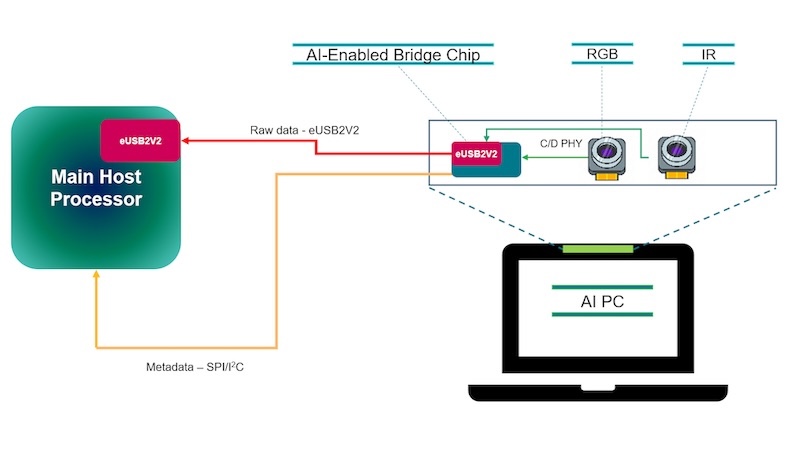
AI smart bridge camera architecture (eUSB2V2 + local AI).
Many premium laptops combine RGB and near-infrared (NIR) cameras to deliver both high-quality imaging and robust facial authentication. In these systems, RGB supports conferencing and perceptual features, while IR supports secure login with stronger low-light performance and anti-spoofing behavior.
For high-end applications, global shutter-based (all pixels in the image are exposed at the same time) IR cameras have been adapted to minimize image artifacts, false acceptance rate (FAR), and false rejection ratio (FRR) below 0.001%.
Other low-end devices may still use a single RGB-IR camera (RGB and IR pixels are mixed in a camera sensor) with AI-based presence and privacy functions to optimize cost. In either case, the camera subsystem is becoming smarter, which increases the importance of having an interconnect designed for robust and power-efficient embedded operation.
Designing Smarter AI PC Camera Links with eUSB2V2
To help designers implement the next generation of AI PC camera architectures, Cadence offers eUSB2V2 IP that operates at up to 4.8Gbps. Its multi-gigabit throughput, including asymmetric operation, is beneficial for camera traffic since most data moves in one dominant direction while return traffic is typically limited to control or status information.
Because it is designed specifically for embedded implementation, it simplifies both short and long-reach integration. It also supports the low power, signal integrity, and EMI requirements for thin notebook designs where displays, antennas, and high-speed interfaces must all coexist in a constrained space. With eUSB2V2 IP, designers can increase throughput without adding unnecessary protocol overhead.
Enabling the Next Wave of Intelligent Cameras at the Edge
To demonstrate eUSB2V2 IP capability for edge AI applications, Cadence showcased its eUSB2V2 PHY, together with host and device controller IP, validated on a 3nm test chip and FPGAs in a live end-to-end demonstration at CES 2026, shown in the video below.
A live end-to-end silicon demonstration of 3nm eUSB2V2 IP.
As AI PCs continue to evolve, cameras are becoming central to user awareness, privacy protection, and premium differentiation. eUSB2V2 has emerged as an enabling technology that delivers the image quality, local intelligence, system efficiency, and user trust required for both new and emerging edge AI use cases.
Recognizing the value of this new standard to the edge AI ecosystem, Cadence has expanded its USB product portfolio with complete, end-to-end eUSB2V2 solutions, including host and peripheral controllers, PHYs, drivers, and Verification IP.
All images used courtesy of Cadence, except where otherwise.specified.