Facebook
 Google
 GitHub
 Linkedin
TDK Unwraps Software Tools for Sensor Data and IMU Evaluation
Today, the company released two new AI software products at Sensors Converge, SensorGPT, for creating sensor data at scale, and SensorStage to accelerate development workflow for the company’s latest IMUs.
Today, at Sensors Converge 2026, TDK announced two new AI-based software tools. The first, SensorGPT uses AI to generate simulated datasets to augment real data in the development and test phases of intelligent edge-AI IoT devices. The second software package, SensorStage, utilizes AI for the selection, development, and validation of TDK’s SmartMotion inertial measurement units (IMUs).
Complex Sensor Environments Require Extensive Simulation Data
Testing a one-dimensional sensor like a single axis accelerometer requires relatively simple test data. The developer needs to look at and calibrate to variations in input, speed of variation, and response at the upper and lower limits. Each additional dimension, such as adding multiple axis, gyro input, and magnetic input adds permutations that need to be observed and validated. Adding in AI interpretation of sensor data exponentially adds to the necessary test regime.
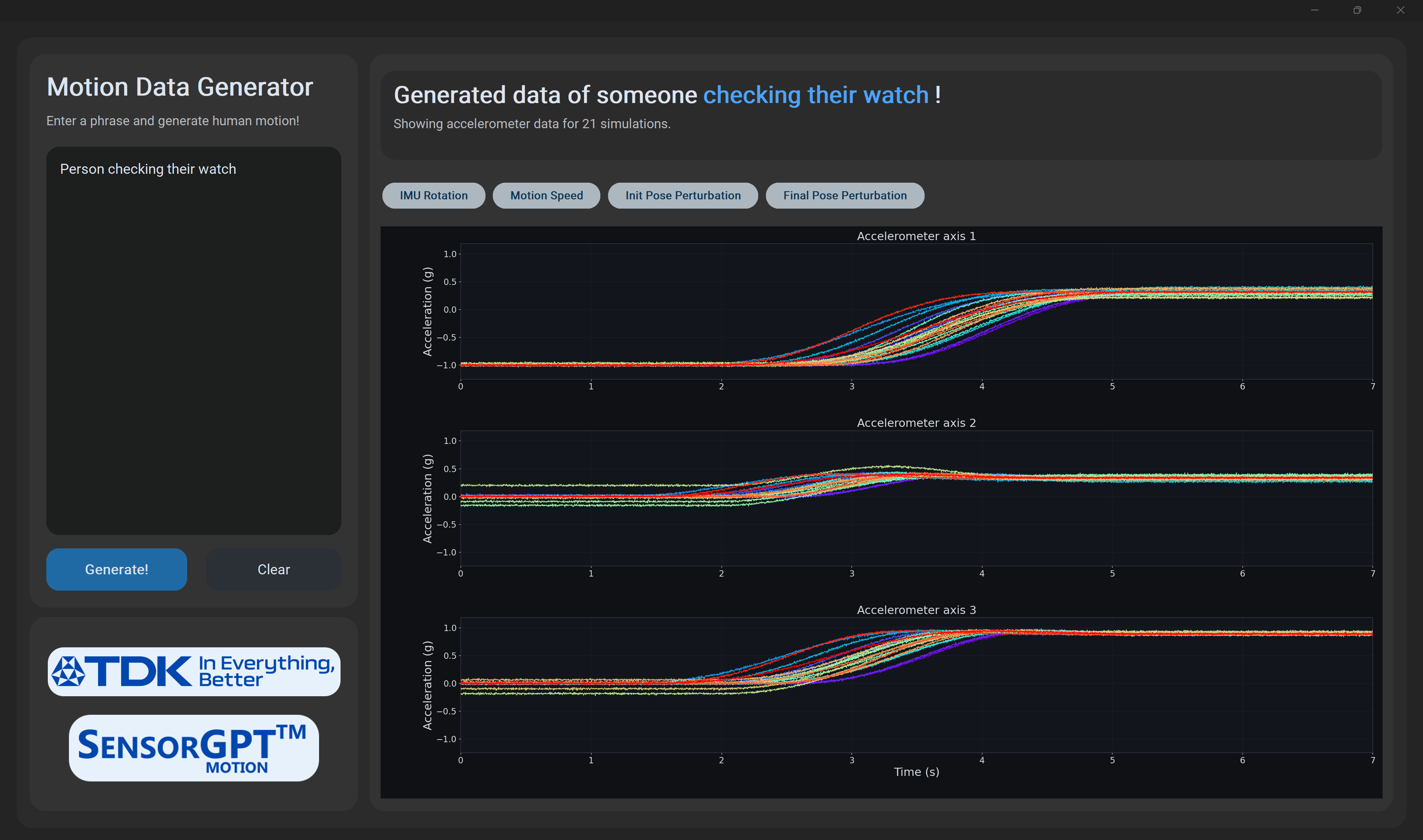
Generated dataset covering wristwatch accelerometer motion. (Click on image to enlarge).
Edge-AI model development requires large data sets. It is not practical, or in many cases, possible, to utilize real-world data to test and validate the operation of modern multi-dimensional edge-AI sensors. The data necessary for adequate testing and modeling often does not exist until the AI product has been released into the field and operated long enough to build a sufficiently large data set. This leads to a bit of a “which came first, the chicken or the egg?” problem. TDK’s answer comes with accurately synthesized data.
SensorGPT—Generating Synthetic Data and Augmenting Real-World Data
TDK references a Forbes report stating that: “Nearly 80% of AI solution development time is spent on data collection and curation.” TDK goes on to state that creating the test dataset takes more time than the product development. SensorGPT utilizes generative AI, with a small real-world dataset as the prompt.
According to Abbas Ataya, Sr Director Software and Systems at TDK, a typical edge-AI development cycle involves four, five or six months of data collection. Then the team must identify the scenarios, determine what was left out and then iterate. SensorGPT cuts the time from months to weeks by extrapolating from a small real-world dataset.
SensorGPT simulated data is physics-based and mathematically modeled. During creation it is subjected to signal processing and computation that mimics real-world sensor input. The result, according to TDK, has a 90% similarity with real-world sensor data. Further, TDK’s software annotates and labels training data to improve its usefulness during system development and testing.
SensorStage Evaluation Software for Motion and Inertial Sensor Development
TDK’s line of SmartMotion IMUs are highly accurate, versatile motion sensors used in consumer products, industrial devices, and automotive applications. Products range from cell phones to robots to vehicle stability.
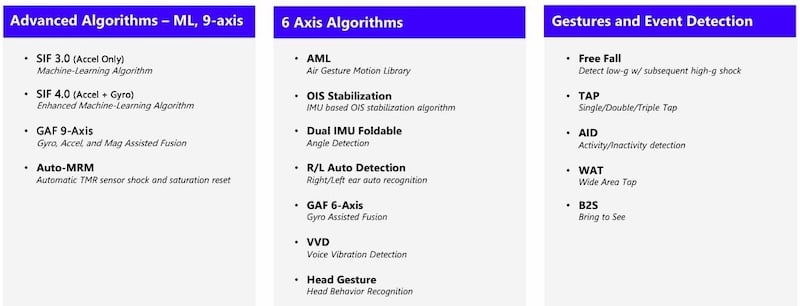
TDK IMU algorithm set
The SmartMotion line includes 9-axis IMU/magnetometer, 6-axis accelerometer/gyro, and 3-axis stand-alone gyros and accelerometers. The smart IMUs come with a wide-selection of algorithms to choose from.
Shortcutting Selection Time while Improving Results
Choosing the best IMU product for a specific application is traditionally an arduous process made more difficult by the rapid pace of advancement in the IMU arena. SensorStage is designed to provide a unified evaluation environment of the latest features of TDK’s MEMS IMUs and TMR magnetometers.
Older generation GUI tools allow for development but do little for direct part to part comparison. Complex custom test benches give a more comprehensive set of tools but may require nearly as much development time as does the product. SensorStage bridges the gap between the two tools with AI-based workflow automation.
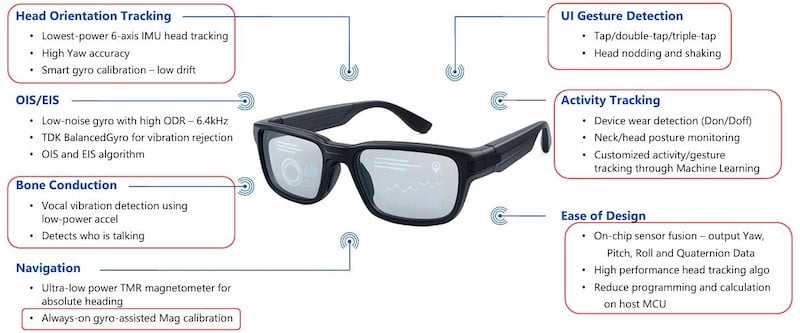
Smart glasses—and advanced TDK IMU application example
Jim Lin, Director Software Applications Engineering at TDK InvenSense, stated: “What SensorStage does is it’s a ground-up redevelopment of our hardware evaluation software."
"We are able to basically use just one tool to evaluate not only the sensor performance but any kind of complex algorithms that the sensor will report on the chip itself.”
Lin pointed out the complex algorithms utilized with smart glasses, such as determining if the glasses are being removed, head tracking, activity tracking, and navigation. Product developers need to evaluate not just the IMU chip, but the algorithms, response speed, and power consumption under harsh real-world conditions.
SensorStage includes all algorithms, parametric, and functional data from every TDK SmartMotion sensor. This allows complete feature-to-feature comparison and detailed analysis. The ability to evaluate on-chip operational parameters allows for tradeoff comparisons, such as real-time chip-level power consumption vs. sensor data rates.
SensorStage operates with a visual metaphor and allows complex Python scripting for better workflow control and is extensible for the addition of future products to its selection bench. The result is an all-in-one sensor evaluation and development platform that delivers advanced visual analytics, customization, and expansion for future products.
All images used courtesy of TDK.