Facebook
 Google
 GitHub
 Linkedin
Exclusive—Cadence Debuts Platform For Breaking Fragmented Component Workflows
Launched today, Cadence’s OrCAD Xplore Design Platform slashes component research time and eliminates disconnected workflows to enable seamless, integrated system development for electronics engineers.
Today, Cadence announced a fully connected design environment that bridges the gap between component research and system design by launching the OrCAD Xplore Design Platform.
As electronics system complexity continues to scale, hardware engineering teams are confronting an unforgiving workflow reality: selecting and sourcing components can no longer be treated as a separate, background process. It has evolved into a major bottleneck in overall system development.
In modern electronics design, individual engineers and small teams must constantly shift between disconnected websites, datasheets, and procurement portals to validate component choices. This structural inefficiency means that raw design skill is often sidelined by manual data entry and cross-referencing.
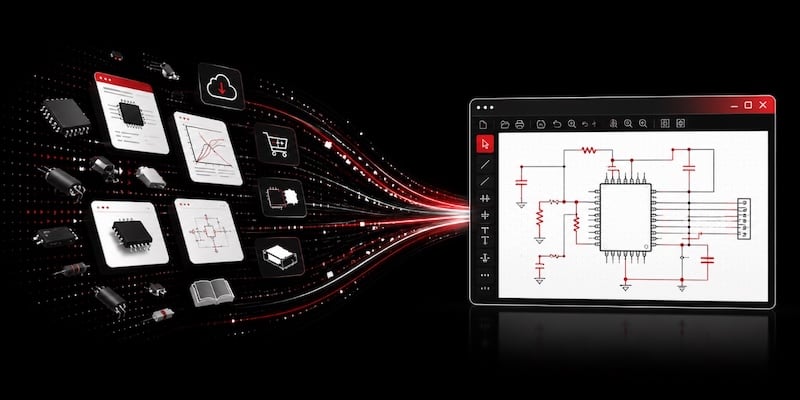
Cadence's new OrCAD Xplore Design Platform
Cadence’s new OrCAD Xplore platform is designed to eliminate this systemic friction, reducing time-consuming component research by up to 80% and helping engineers move faster from evaluation to production-ready designs.
To learn more about the new platform, we were pleased to engage in an exclusive interview with Gopu Achath, Software Engineering Group director at Cadence. In this article, first we’ll cover the new Cadence platform. After that, we’ll share the highlights from our talk with Achath in a Q &A format.
Behind the Tech: The Component Sourcing Dilemma
Traditional component selection workflows have operated on a disconnected model where manual footprint creation, fragmented lifecycle checks, and isolated supply-chain verification are accepted trade-offs. However, that foundational paradigm breaks down under the strict, rapid-prototyping requirements of modern electronics markets.
In a typical hardware design cycle, overall time-to-market is heavily influenced by component research. According to Cadence, engineers routinely spend more than half of their working hours outside of their core design tools—hunting down components, verifying supply-chain status, and searching for suitable replacements. At scale, these inefficiencies trigger a cascading sequence of system penalties:
- Unpredictable Workflows: Moving between disparate databases introduces delays that break deterministic project timelines. The new platform aims to turn these hours of manual research into mere minutes.
- Manual Overhead: Engineers waste an average of three hours per component simply manually creating and verifying basic symbols and footprints.
- Late-Stage Supply Surprises: Disconnected procurement processes mean a finalized design might rely on unavailable parts, forcing costly rework and delays.
Evolving the Design Environment
Rather than treating component research as a separate chore, Cadence is actively evolving the core workspace. The OrCAD Xplore platform introduces a targeted suite of optimizations specifically tuned for tightly coupled design-to-procurement topologies, all while keeping the fundamental architecture anchored to the familiar OrCAD X Capture environment.
One of the most immediate structural efficiency gains occurs at the component level. By leveraging the Ultra Librarian ecosystem, engineers gain immediate, native access to over 16 million verified symbols, 3D models, and footprints directly inside their primary tool. This radical reduction in manual data entry slashes overhead to maximize effective design time and minimize errors.
Furthermore, OrCAD Xplore transitions supply-chain reliability from reactive late-stage checks to proactive workflow intelligence. By implementing real-time lifecycle status, compliance data, and pricing, transient supply shocks are caught and corrected instantly at the design boundary, entirely bypassing slow, legacy sourcing paths.
Inside the OrCAD Xplore Stack
To accelerate the global deployment of seamless electronics infrastructure, Cadence has delivered a fully integrated platform designed to eliminate systemic supply risks.
The complete software integration stack includes:
- Manufacturer-Verified Models: Provides immediate access to reference designs, documentation, and simulation-ready models from industry heavyweights like Texas Instruments, STMicroelectronics, Murata, and Molex.
- AI-Powered Navigation: Features advanced, natural-language interaction mechanisms to simplify component evaluation and rapid replacement searches.
- Real-Time Supply Intelligence: Delivers native, low-latency execution of supply chain health checks, lead times, sourcing risks, and qualified alternative options.
- Seamless E-Commerce Integration: Built upon a direct integration with DigiKey, allowing engineers to push a complete bill of materials into a unified shopping cart without leaving the application.
Company representatives note that leveraging years of collaboration with IC manufacturers has paved the way to extend their partnerships beyond design and directly into the path to market. By placing manufacturer expertise exactly where component selection happens, Cadence aims to simplify research and boost product adoption for its partners.
Similarly, executives from major semiconductor firms like Texas Instruments and STMicroelectronics emphasized that providing reference designs, simulation models, and system-level insights natively within daily workflows enables faster evaluation and cuts time to market. Component manufacturers such as Murata and Molex echoed this sentiment, pointing out how integrated models remove friction and improve architectural accuracy.
On the distribution side, DigiKey leadership noted that injecting real-time supply chain intelligence into the workspace allows designers to lock in decisions confidently while streamlining the transition from selection to final sourcing.
One Architecture for Scale-Up Growth
A key advantage of this unified software subsystem is its architectural adaptability. Engineering teams can leverage the exact same underlying environment as an accessible starting point for individual designers or small teams, while maintaining a clear path to scale up into more complex enterprise systems.
This versatile framework directly addresses the strict continuity constraints of modern product lifecycles. By serving as a core pillar of the broader Cadence Intelligent System Design ecosystem, this solution integrates smoothly alongside Allegro X PCB System Capture and the wider Allegro X platform. This flexible, cohesive foundation ensures that as project demands step into the future, component data, design tools, and procurement can finally scale tightly together.
Highlights From Our Interview with Gopu Achath
Jeff Child, All About Circuits: What component research does Xplore eliminate?
Gopu Achath, Cadence: Xplore brings what is traditionally a fragmented, multi-site research process into a single component research experience. The includes these three areas:
- Electrical and technical research: voltage/current limits, power, timing, memory, tolerances, operating conditions, and other key specifications.
- Application and design research: recommended usage, reference designs, package/footprint information, CAD models, and implementation guidance.
- Supply-chain research: availability, pricing, lead times, lifecycle status, and compliance information such as RoHS.
Child: How does Xplore integrate into an engineering workflow?
Achath: Xplore removes friction between component research, component selection, and implementation in the design. It does so in three ways:
- Easy entry point: Engineers can start with component discovery and research before entering the traditional EDA design flow.
- CAD-ready content: Access symbols, footprints, 3D models, and component information, reducing manual content creation and rework.
- Open downstream workflow: OrCAD schematics, standard netlists, and BOMs can feed Cadence tools as well as third-party EDA, procurement, distributor, and manufacturing workflows.
Child: How will the Xplore ecosystem evolve?
Achath: The vision is to evolve Xplore from a component research tool into an ecosystem connecting engineers, manufacturers, distributors and the design workflow. We plan to evolve the platform in these three ways:
- Broader partner ecosystem: Expand participation from semiconductor, passive, connector, electromechanical and other manufacturers, along with distributors.
- Richer component intelligence: Massively expand supply-chain, simulation/analysis models, thermal parameters etc.
- Powerful network effect: As the Xplore engineering audience grows, the platform becomes more valuable to manufacturers and distributors; as partner participation and content grow, Xplore becomes more valuable to engineers.
Related Content