
 Facebook
 Google
 GitHub
 Linkedin
Innovative Impact Tracking: How MEMS Sensors Change the Game
We explore the implications of a new MEMS technology that reliably measures both low-rate accelerations and high-intensity impacts.
Micro-electromechanical systems (MEMS) sensors are compact devices that provide precise and reliable measurements of physical parameters. They’re essential in a variety of industries. For example, MEMS accelerometers are used in applications ranging from consumer electronics to industrial automation, healthcare, and automotive systems.
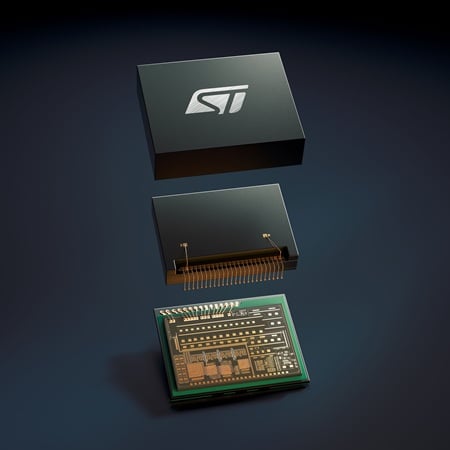
A MEMS sensor has mechanical and electrical components in one land grid array (LGA) package.
One critical aspect of MEMS accelerometers is their ability to measure and respond across a wide range of inputs, from gradual acceleration to high-intensity impacts.
Sensors from ST typically employ capacitive sensing mechanisms to detect changes in physical parameters. When integrated into electronic systems, they allow for real-time data acquisition and processing. In this way, they enable immediate responses to impact events.
High-intensity impacts are characterized by acceleration applied on a person, object, or system over a brief period. In many applications, accurately measuring and analyzing these impacts is essential for monitoring performance, detecting faults, and ensuring safety. MEMS sensors are uniquely suited for this task due to their small size, high sensitivity, and fast response times.
Measuring Impacts Accurately Can Be Challenging
MEMS sensors face several challenges in accurately measuring intense impacts. Addressing these challenges is crucial for optimizing the performance and efficiency of MEMS sensors in high-impact applications.
One significant issue is the loss of inertial information and missing high acceleration events due to sensor saturation. This can lead to incomplete or inaccurate data.
Additionally, there’s an inherent tradeoff between range and accuracy. Low-g sensors provide high sensitivity and accuracy over a limited range, while high-g sensors offer an extended range but with reduced accuracy. Often, this makes it necessary to use two separate devices to detect both high-g and low-g accelerations.
Using two devices helps to capture a wide range of acceleration, but it also increases the required PCB space and the complexity of the system design. Moreover, it can significantly drain battery life, posing a challenge for portable and other battery-operated applications.
An Innovative Solution
A new sensor technology from ST could potentially solve these problems. Using a novel MEMS mechanical structure, it’s designed to accurately and efficiently measure both high and low acceleration levels within a single integrated solution. The structure houses a gyroscope and two accelerometers—one up to 16 g and the other above 80 g—within a standard package, optimizing space and simplifying system design.
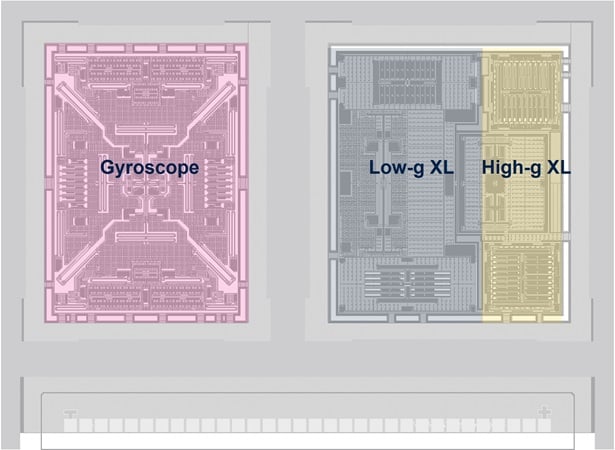
The mechanical structure of ST’s LSM6DSV80X inertial measurement unit houses two accelerometers: one up to 16 g (low-g XL) and the other above 80 g (high-g XL).
The digital component of this inertial measurement unit (IMU) sensor eliminates the need for constant intervention from the host processor. Its advanced capabilities include:
- Edge processing, including a finite state machine (FSM) and a machine learning core (MLC).
- Sensor fusion.
- Adaptive self-configuration (ASC).
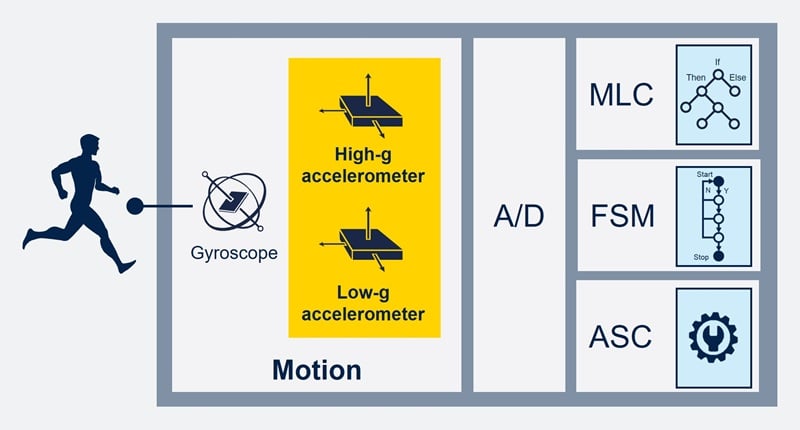
The IMU features edge processing along with two accelerometers and a gyroscope.
Together, the innovations listed above help the sensor perform consistently and deliver valuable insights about standard motion and impact events. In addition to enhancing the accuracy and range of acceleration measurements, this design also significantly minimizes system power consumption, making it a good choice for a wide array of applications.
Emerging Applications for High-Intensity Impact Tracking
High-impact IMUs have opened the door to innovative applications across several industries. Before we wrap up this article, let’s discuss some of them.
Personal Electronics
High-impact IMUs in smartphones, tablets, and smartwatches can detect drops, enabling protective measures such as retracting hard drives or locking screens. They can also provide critical information in the form of car crash detection, ensuring timely assistance.
In gaming controllers, IMUs enhance the gaming experience by detecting rapid movements and impacts, offering more immersive and responsive gameplay. Smart tags use high-impact IMUs to provide real-time tracking and impact monitoring, ensuring the safety, security, and integrity of the items they’re attached to.
Automotive
In the automotive industry, event data recorders equipped with high-impact IMUs can be used in black boxes and children's seats. They record data during accidents, helping to understand the cause and providing detailed information on the intensity of the impact.
Industrial
Logistics companies, shipping services, and transportation providers use high-impact IMUs to monitor items for damage. Wearable devices equipped with IMUs for workers in hazardous environments can detect falls or impacts, triggering emergency responses and otherwise enhancing workplace safety.
Healthcare
Wearable devices for elderly or disabled individuals use high-impact IMUs to detect falls and alert caregivers or emergency services in a timely manner. IMUs can also be used to monitor impacts during physical therapy exercises, ensuring proper technique and potentially preventing injuries during rehabilitation.
Athletics
Athletes, both professional and amateur, use wearables with high-impact sensors to track performance and detect injuries. These wearables help them to optimize their training and prevent long-term damage.
Sensors embedded in helmets, for example, monitor and record impacts. By providing real-time data on the force of those impacts, they help to prevent concussions and other head injuries. A few more use cases are provided below.
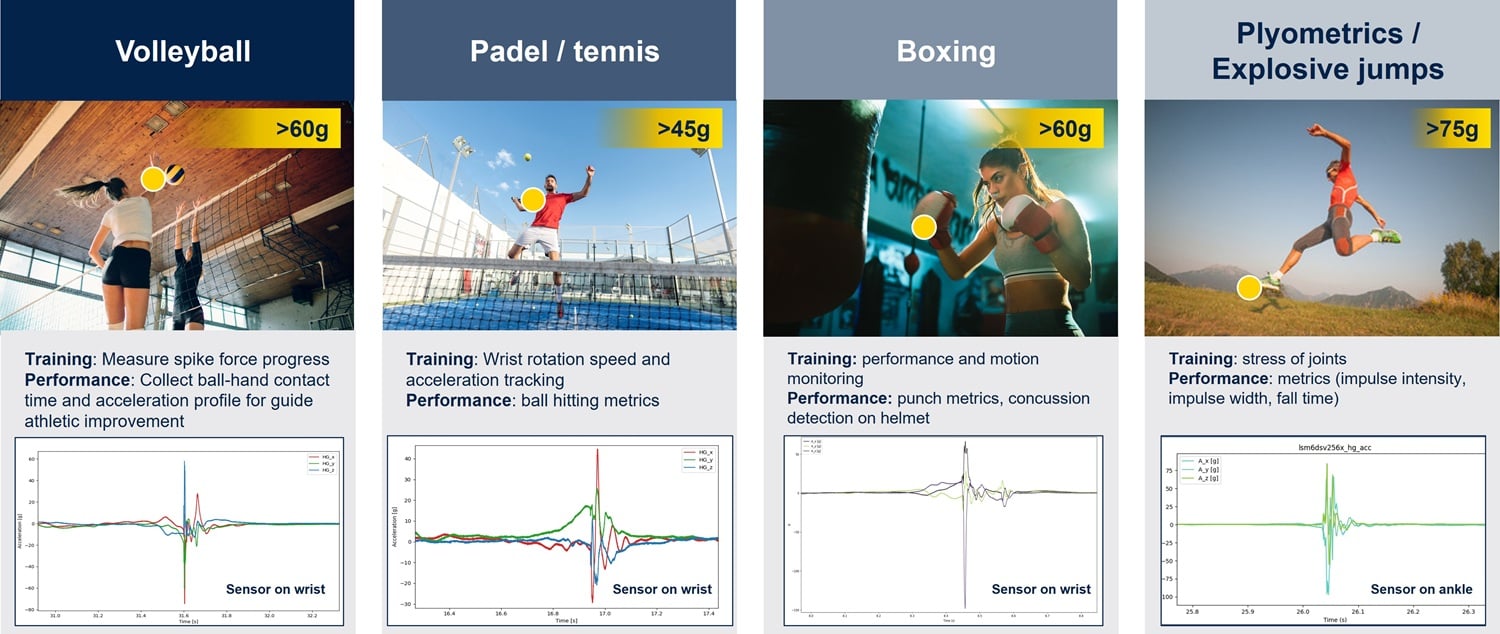
Some sports-centric use cases for wearable IMUs. [click to enlarge]
The Future of Impact Tracking
In all of the above applications, the integration of high-impact IMUs marks a significant advancement in technology. The innovative designs and advanced features of modern IMUs ensure accurate measurements and consistent performance while minimizing power consumption.
As these sensors continue to evolve, their transformative potential will undoubtedly lead to even more groundbreaking applications, improving outcomes across a wide range of industries. The future of impact tracking and measurement looks promising, and high-impact IMUs will be at the forefront.
All images used courtesy of STMicroelectronics
Related Content











The technology is impressive, having a gyro, a low-g and a high-g in the same device is quite special. If you need help to integrate this device in your products we can help.