Facebook
 Google
 GitHub
 Linkedin
Understand and Mitigate Temp Effects in InGaAs Avalanche Photodiodes
InGaAs Avalanche Photodiodes (APDs) use avalanche multiplication to amplify weak optical signals. Learn how adding antimony (Sb) into the APD structure enhances temperature stability and reduces noise.
An InGaAs (Indium Gallium Arsenide) Avalanche Photodiode (APD) is a type of photodetector that leverages the properties of InGaAs semiconductor materials to detect light, particularly in the infrared spectrum. APDs are designed to convert light into electrical signals and are known for their ability to amplify weak optical signals through an internal gain mechanism known as avalanche multiplication. This makes them highly sensitive and suitable for applications where detecting low levels of light is critical.
InGaAs APDs consist of several layers (Figure 1), typically including an InGaAs absorption layer and a multiplication layer made of a different material, such as AlGaAsSb, which is lattice-matched to the InP substrate. The absorption layer is where incoming photons are absorbed, generating electron-hole pairs.
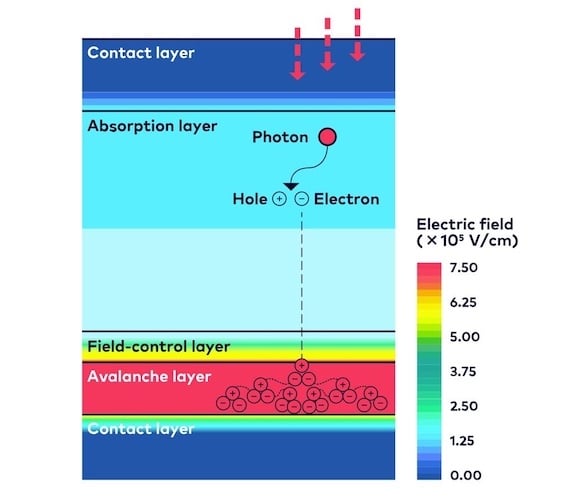
Figure 1. The InGaAs APD process structure
These carriers are then accelerated by an electric field in the multiplication layer, causing a cascade of further carrier generation—a process known as avalanche multiplication. This results in a significant amplification of the initial signal, allowing the APD to detect very low levels of light.
InGaAs APDs can detect low light levels due to their internal gain mechanism, which amplifies the initial signal generated by incoming photons. The avalanche multiplication process occurs rapidly, allowing for quick detection and InGaAs APDs are particularly sensitive to infrared light, typically in the range of 900 nm to 1700 nm, making them ideal for infrared applications at around 1550 nm, a commonly used wavelength in many applications.
Applications in Infrared Systems
Optical Communication
InGaAs APDs are extensively used in optical communication systems, particularly for long-haul fiber optic networks. They are employed as receivers to detect light signals transmitted over optical fibers. The high sensitivity of APDs allows them to detect weak signals over long distances, making them essential for efficient data transmission.
LiDAR and Range Finding
LiDAR (Light Detection and Ranging) systems use laser pulses to measure distances by detecting reflected light (Figure 2). InGaAs APDs are used as sensors in these systems due to their ability to detect low levels of light reflected from distant objects. Their fast response time enables precise distance measurements, which are crucial for applications such as autonomous vehicles and topographical mapping.
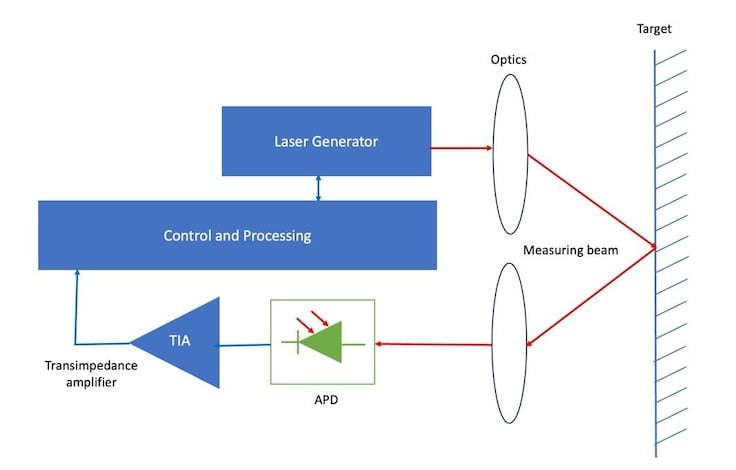
Figure 2. Laser rangefinders and other time-of-flight applications use InGaAs APDs as infrared sensors, typically at 1550 nm wavelength.
Imaging and Spectroscopy
InGaAs APDs are also used in imaging systems, particularly for infrared imaging. They can be used to detect thermal emissions from objects, which is valuable in applications such as night vision, surveillance, and environmental monitoring. In spectroscopy, InGaAs APDs are used to detect specific wavelengths of light, aiding in the analysis of material compositions and chemical properties.
Quantum Key Distribution
In quantum key distribution (QKD) systems, secure communication is achieved by transmitting quantum bits (qubits) over optical channels (Figure 3). InGaAs APDs play a crucial role in detecting single photons, which are used as qubits in QKD. Their high sensitivity and low noise characteristics make them ideal for ensuring the security and reliability of quantum communication systems.
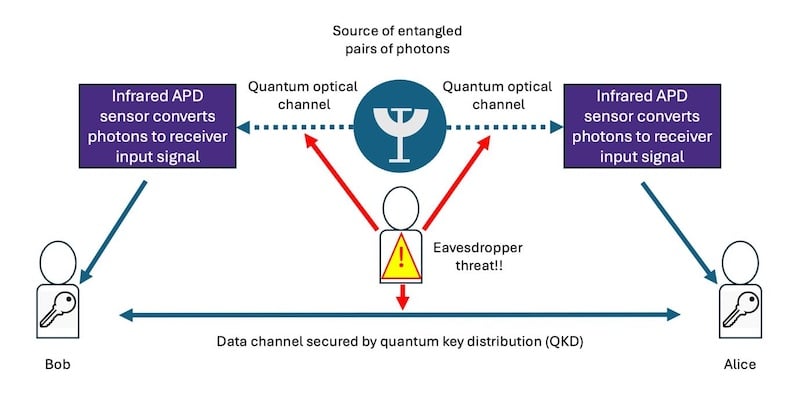
Figure 3. Cryptographic keys are securely transmitted over infrared links utilizing APD sensors.
Optimizing the Performance of InGaAs APDs in Infrared Systems
In addition to their high sensitivity, InGaAs APDs can be engineered to exhibit good temperature stability, which is crucial for maintaining performance across a range of environmental conditions. This stability is often achieved by optimizing the materials used in the APD structure, such as incorporating antimony (Sb) alloys.
The addition of Sb alloys can minimize excess noise, which is a common issue in photodetectors that use avalanche multiplication. By selecting materials with dissimilar ionization coefficients, the excess noise factor can be significantly reduced, leading to better signal detection.
The same technique enables APDs to recover quickly from overload conditions, where the detector is exposed to high levels of light. This fast recovery is essential in applications like LiDAR, where the detector may encounter intense reflections from nearby objects.
Temperature Effects on Avalanche Photodiode Performance
The performance of APDs is influenced by temperature, which affects parameters such as dark current and breakdown voltage. Dark current, the current that flows through the photodiode in the absence of light, increases with temperature due to enhanced thermal generation of carriers. For instance, in InGaAs/AlGaAsSb APDs, the dark current increases from 2.7 nA at 0°C to 211 nA at 85°C at a voltage of -56 V. This increase is a common challenge in APDs, as higher dark currents can degrade the signal-to-noise ratio.
In a recent evaluation, the temperature coefficient of the operating voltage, which indicates how much the voltage required for a fixed gain changes with temperature, was measured to increase from 19.2 mV/°C at a gain of 10 to 22.7 mV/°C at a gain of 200. This coefficient is significantly lower than that of other commercially available InGaAs APDs, which typically have coefficients 3 to 7 times higher, indicating better temperature stability in the Sb-enhanced devices.
Noise Equivalent Power (NEP)
Noise Equivalent Power (NEP) is a critical metric for assessing the sensitivity of photodetection modules. It represents the light power required to produce a signal equal to the noise level of the detector. For the InGaAs/AlGaAsSb APDs, the NEP was measured at various temperatures, demonstrating their high sensitivity.
At room temperature, the APD achieved an NEP of 29 fW/Hz0.5 at a gain of 130 (fW/Hz is femtowatts per hertz). This value decreased to 18 fW/Hz0.5 at 0°C with a gain of 200, indicating the ability to detect as few as 10 photons at a 180 MHz bandwidth. At 85°C, the NEP increased to 77 fW/Hz0.5 at a gain of 60, demonstrating the APD's capability to maintain high sensitivity without active cooling systems.
Improvements with Antimony (Sb)
The incorporation of Sb into the APD structure significantly enhances its temperature stability (Figure 4). Sb-based materials, such as AlGaAsSb, have highly dissimilar electron and hole impact ionization coefficients, which result in a lower excess noise factor. This dissimilarity allows for more stable operation across a wide temperature range, reducing the need for active temperature control mechanisms.

Figure 4. Adding antimony into the InGaAs APD manufacturing process reduces avalanche noise, boosts sensitivity and improves temperature stability.
The weak temperature dependence of avalanche breakdown is attributed to high alloy disorder potentials, which make temperature-independent alloy scattering dominate over temperature-dependent phonon scattering. This property allows the APDs to operate effectively from 0°C to 85°C.
The Sb-enhanced material system reduces the noise associated with avalanche multiplication by ensuring dissimilar ionization coefficients, which lower the excess noise factor. This leads to a 12-fold improvement in sensitivity over previous components, allowing for clearer detection of signals in low-light conditions. The combination of low excess noise and high gain makes these APDs suitable for applications requiring high sensitivity and precise detection capabilities.
Antimony-Driven Advantages and Advancements
The development of InGaAs/AlGaAsSb APDs with antimony represents a significant advancement in the field of photodetection. These APDs exhibit low noise, high gain, and robust performance across a wide temperature range, making them suitable for demanding applications such as LiDAR and quantum key distribution.
The addition of Sb to the APD structure reduces excess noise and enhances temperature performance, providing a promising solution for high sensitivity photodetection in various optical systems. The advancements reported in this study indicate a substantial step forward in the design of APDs with improved temperature stability and performance metrics.
In summary, the integration of Sb into InGaAs APDs addresses key challenges associated with temperature sensitivity and noise, paving the way for more efficient and reliable photodetection technologies. This improvement not only enhances the operational stability of APDs but also broadens their application scope, particularly in environments with varying temperature conditions. As technology continues to evolve, the role of Sb-enhanced APDs is likely to expand, offering new possibilities for innovation in optical systems.
UK-based Phlux Technology has developed a family of Noiseless InGaAs APDs based on the Sb-enhanced compound semiconductor fabrication process discussed above. They are drop-in replacements for existing parts, enabling immediate performance advantages to be achieved in the applications described, and others.
All images used courtesy of Phlux Technology.