Facebook
 Google
 GitHub
 Linkedin
Proving Reliability in Critical Embedded Systems
Learn how formal verification uses math to prove the absence of runtime errors in complex embedded software for critical defense/space systems, offering stronger reliability than testing.
Flight control computers, satellite payloads, missile guidance units, secure communications stacks, radar processing pipelines, and autonomous ground vehicles all rely on complex embedded software.
This software must operate correctly under strict timing, environmental, and safety constraints. In many cases, failure is not recoverable. A defect may lead to mission loss, equipment destruction, compromised intelligence, or loss of life.

Figure 1. Aircraft cockpit highlighting complex, software-driven avionics systems
As functionality expands, so does complexity. Modern embedded platforms integrate multicore processors, hardware accelerators, mixed criticality workloads, and network connectivity. Code bases that once measured in thousands of lines now extend into the millions.
Even when written in disciplined subsets of C or C++, these systems remain exposed to subtle runtime errors. Memory corruption, integer overflow, undefined behavior, and concurrency defects do not always surface during testing. In mission critical environments, latent defects can persist for years before triggering under rare conditions.
Formal verification addresses this risk at its root. Rather than relying solely on testing or heuristic inspection, it uses mathematical reasoning to prove properties about software behavior. When applied correctly, it can demonstrate the absence of entire classes of runtime errors. For critical and defense systems, this shift from testing to proof represents a fundamental improvement in assurance.
The Limits of Testing in Critical Systems
Testing remains essential. Unit testing, integration testing, hardware in the loop validation, and system level stress testing all contribute valuable evidence. Certification standards such as DO 178C for avionics and various military standards require extensive verification artifacts. However, testing can only demonstrate the presence of defects, not their absence.
Consider a memory buffer in a guidance system. Tests may exercise typical inputs and boundary conditions and may even achieve high structural coverage. Yet coverage does not guarantee that every possible execution path has been explored. Embedded software often depends on complex combinations of interrupts, asynchronous events, and input sequences. The number of potential execution paths can exceed what any practical test campaign can enumerate.
Some defects depend on environmental or timing conditions that are difficult to reproduce in a laboratory. A rare sensor value combined with a specific scheduling interleaving may trigger undefined behavior only once in millions of cycles. If that cycle occurs during a mission, the opportunity to diagnose and correct the issue may never arise.
Static analysis tools attempt to fill part of this gap by scanning code for patterns associated with common errors. Many rely on approximations to remain scalable and to reduce noise. As a result, they may report large volumes of warnings that require manual review while still missing corner cases that fall outside their heuristic models. Engineers are then forced to balance false positives against the risk of undetected defects.
Formal verification takes a different approach. Instead of sampling execution paths or applying pattern-based checks, it constructs a mathematical model of program behavior and reasons about all possible executions under defined assumptions.
What Formal Verification Proves
Formal verification asks a precise question: given a set of assumptions about inputs and the operating environment, does the program satisfy specified properties for all possible executions?
For embedded C and C++ systems, these properties often include the absence of out of bounds memory accesses, null pointer dereferences, use of uninitialized variables, integer overflows that alter control flow or memory safety, division by zero, and violations that would trigger undefined behavior under the language standard.
Undefined behavior deserves particular attention. The C and C++ standards define numerous operations whose behavior is not specified by the language. Signed integer overflow, invalid pointer arithmetic, or accessing an object through an incompatible type can all yield unpredictable results. Compilers are permitted to assume that such situations never occur, enabling aggressive optimizations. If they do occur, the resulting behavior may vary across platforms, builds, or optimization levels.
In a defense context, undefined behavior is more than a correctness issue. It can become a security vulnerability. Memory corruption may open the door to unintended control flow changes or data leakage. In systems exposed to adversarial inputs, such weaknesses can be exploited deliberately.
A sound formal verification tool does not merely indicate that a risky pattern exists. It attempts to prove that, under the given assumptions, no execution path can lead to these runtime failures. If it succeeds, the absence of those classes of defects is guaranteed within the scope of the model. If it fails, it produces a concrete counterexample demonstrating how a failure could occur.
This distinction between heuristic detection and mathematical proof is critical in high assurance systems. A proof tied to explicit assumptions and source code provides a stronger and more defensible foundation than statistical testing results or pattern-based alerts.
Relevance to Defense and Space Systems
Defense and space applications amplify the need for exhaustive reasoning.
In space systems, physical access is impossible once deployed. A memory fault that triggers only after extended uptime can jeopardize an entire mission. Radiation induced bit flips may interact with latent software defects in unpredictable ways. While hardware mitigation techniques reduce some risks, they do not address logical errors embedded in source code.

Figure 2. Rocket launch with high stakes that require mission critical software reliability
Military systems operate in adversarial environments. Software must function correctly while resisting malicious inputs and hostile conditions. Secure communication stacks, cryptographic libraries, and protocol handlers are frequent targets. A single unchecked length field or arithmetic overflow can undermine an otherwise carefully engineered system.
Autonomous defense platforms further increase software density and interdependence. As sensor fusion and decision-making algorithms grow more sophisticated, the underlying runtime infrastructure becomes more complex. Even if higher level algorithms are validated separately, the operating environment that manages memory, tasks, and interrupts must remain dependable. A low-level fault can cascade upward, corrupting data or disabling critical functions.
Formal verification is particularly effective at securing these foundational layers. By eliminating entire categories of runtime failures at the source level, engineers reduce the attack surface and strengthen resilience under extreme conditions.
Integration with Certification Frameworks
Certification standards increasingly acknowledge the role of formal methods. DO 178C includes guidance on the use of formal verification as a means of providing verification evidence. Other safety and security frameworks similarly recognize that mathematical proof can support assurance cases when properly justified.
Formal verification does not replace engineering discipline. Assumptions must be explicit and defensible. Models must accurately reflect the target architecture, including integer widths, memory layout, and compiler behavior. Tool qualification may be required when verification results are used as certification artifacts.
When integrated thoughtfully, formal verification can reduce downstream verification effort. Proving the absence of certain runtime errors at the source level decreases reliance on defensive programming patterns and reduces the likelihood of late stage defect discovery. It also strengthens traceability, allowing proven properties to be directly linked to safety and security requirements.
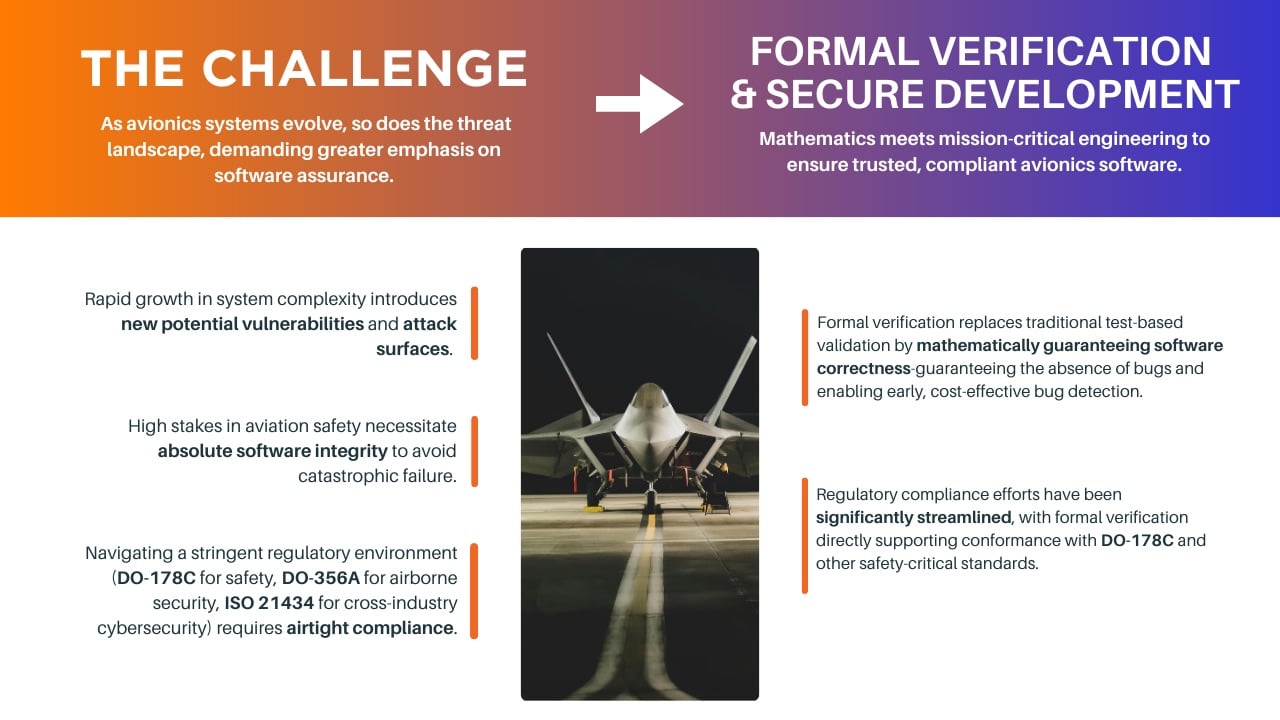
Figure 3. Shift from traditional testing to formal verification for provable software correctness. (Click on image to enlarge).
Formal Verification in Practice
Formal verification analyzes software using mathematical reasoning to evaluate all possible execution paths under defined assumptions. Engineers specify constraints such as input ranges and operating conditions, and the analysis determines whether runtime errors can occur.
This approach can prove the absence of common runtime failures in embedded C and C++ software, including out of bounds memory access, null pointer dereferences, use of uninitialized variables, division by zero, and other sources of undefined behavior.
By eliminating these classes of faults at the source level, formal verification reduces the risk of unpredictable behavior and strengthens the reliability of critical systems.
As embedded software continues to grow in scale and complexity, formal verification provides engineering teams with deeper insight into software behavior and stronger guarantees of reliability and security in critical systems.
Traditional Static Analysis and the Role of Formal Verification
Traditional static analysis and formal verification are not interchangeable. Conventional static analysis tools typically rely on pattern matching, rule checking, and approximations to identify likely defects. They are valuable for enforcing coding standards, detecting common mistakes, and providing rapid feedback during development. However, they do not generally provide mathematical proof that a class of runtime errors cannot occur across all possible executions.
Formal verification, by contrast, is specifically designed to reason for program behavior across all execution paths within a defined model. It seeks to prove the absence of certain categories of runtime failures rather than estimate their likelihood. A warning free report from a traditional static analysis tool does not constitute proof of safety.
For critical and defense systems, where tolerance for residual risk is minimal, understanding this distinction is essential. Traditional static analysis can improve code quality. Formal verification can establish provable guarantees about runtime safety properties. Together, when applied thoughtfully, they support a more comprehensive and defensible assurance strategy.
Putting Mathematical Rigor to Work
Critical and defense systems operate in environments where failure is costly and often irreversible. As embedded software continues to grow in scale and complexity, reliance on testing and heuristic analysis alone becomes increasingly insufficient. Rare execution paths, undefined behavior, and subtle memory errors can evade conventional verification strategies, leaving residual risk in systems that cannot afford it.
Formal verification introduces mathematical rigor into the development lifecycle. By modeling program behavior and proving properties across all possible executions under explicit assumptions, it provides a level of assurance that testing and pattern-based analysis cannot deliver. For space and defense applications, this approach aligns directly with the fundamental requirement that certain categories of runtime failure must not occur.
In critical and defense systems, reliability is not measured by probability. It is established through proof.
All images used courtesy of TrustinSoft.
Related Content