Facebook
 Google
 GitHub
 Linkedin
5 Ways that 5G will Transform the Automotive Landscape
In this video from YAGEO Group, learn more about how 5G is transforming the automotive industry.
5G marks the fifth generation of broadband cellular networks, and it boasts increased data bandwidth and decreased latency. But 5G is expected to enable far more than just better video streaming on your phone or tablet. The advanced technological capabilities of 5G will make new applications possible, from mission-critical video and data for public safety to fixed high bandwidth data connections replacing cables, to increased intelligence and safety in automotive applications.
Advances in cellular networks require reliable components for 5G and beyond. High-reliability components for high temperatures and harsh conditions are ideal for 5G base stations, while miniaturized capacitors and inductors are ideal for 5G end devices.
What is 5G?
Cellular phone companies first began deploying 5G in 2019, and it is expected to grow rapidly for several years as the successor to 4G. As with previous generations, 5G is a cellular architecture, meaning service is provided to end devices in geographically-defined small cells from a local antenna.
The promise of 5G is higher bandwidth, which means faster data transmission/downloads, and lower latency. 5G accomplishes this, primarily, by using higher frequencies to transmit data.
What are the Benefits of 5G?
The following table summarizes the technical benefits of 5G.
|
Higher Speed |
In terms of raw peak download speeds, 5G has the capability of being 100 times faster than 4G. The fastest 5G so far has a top speed of 1.8 Gbit/s. |
|
Greater Bandwidth |
Related to the higher speed, 5G will be able to handle many more connected data streams than 4G, meaning less congestion in crowded cells. |
|
Lower Latency |
Human reaction speed is a little over 200 milliseconds, but 5G latency is measured in single or double-digit milliseconds, making it virtually real-time. |
|
Low Error Rate |
Reliability is improved in 5G with adaptive signal coding, which keeps the bit error rate low. If the error rate increases, it sacrifices bandwidth for quality. |
|
Smarter Management |
The infrastructure of 5G is more intelligent, with multiple frequency bands, antenna configurations, and other options for optimizing network utilization. |
Transformation #5: Better, Faster, Cheaper Auto Manufacturing
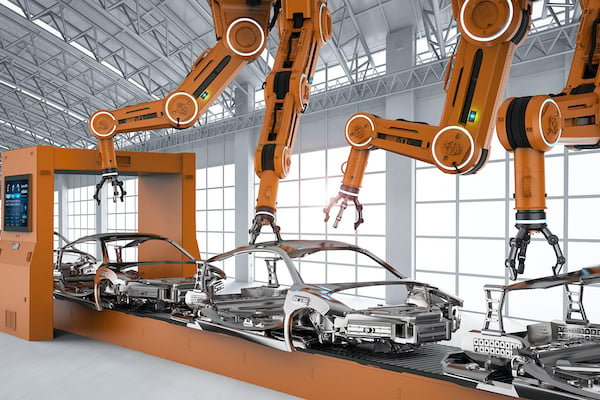
Many experts believe that the world is in the midst of a fourth industrial revolution - “Industry 4.0.”- which will bring increasing automation and connectivity of modern industrial factories and manufacturing plants. That increased automation and connectivity, managed by increasingly intelligent processing, is helping all industries, and especially the automotive industry, make their products better while doing it faster and with less cost.
Better
5G is promising to rapidly increase the realization of Industry 4.0’s promises. The increased number of 5G connected edge sensors monitoring and adjusting both the supply chain and the manufacturing process will increase efficiency and reliability. Every part of the supply chain can be better monitored and controlled, every machine will run smoother and more efficiently, and every component that goes into a vehicle will be more precisely manufactured. 5G connections throughout the process will enable predictive maintenance, resulting in higher quality, more reliable vehicles.
Faster
In addition to 5G providing better control and product out of the manufacturing plant, it will also permit the whole manufacturing process to go faster. A faster manufacturing process saves time - and time is money! - but it also changes the entire manufacturing paradigm by providing flexibility. Plant managers can more quickly respond to changes in components or requirements and adapt to changing business needs.
Cheaper
And, finally, a better product means less scrap, lower warranty costs, and faster manufacturing. But more than that, the increased intelligence and flexibility of the manufacturing process also provide new opportunities for cost savings. The tremendous amount of additional information and controls of the process enable new designs and new techniques that serve to reduce the overall cost of an automobile, while also benefiting the environment by creating less scrap and less waste.
Transformation #4: Traffic Flow Coordination

Optimizing traffic flow on public roads is an enormous challenge for communities and local governments. Traditionally, this has been done by monitoring traffic flow in “problem” areas, collecting a lot of data, and then developing a construction plan to add or remove signage (stop signs, stop lights, etc.), build new or reconfigured lanes, or take other action. And then, months or years later when the construction is done, experts monitor the traffic flow again to see if it worked. One key goal here is to make traffic jams a thing of the past.
There are invaluable engineers who specialize in this process and are quite good at it, but this process is not quick and does not adapt easily to real-life changes. 5G offers new possibilities for traffic flow monitoring and management.
5G connectivity between vehicles and traffic control infrastructure will permit real-time opportunities to adjust traffic light timing to the needs of the traffic. It will help prevent congestion, and it will even help prevent traffic accidents as vehicles are able to actively avoid each other during traffic merging.
Transformation #3: Real Time Sensor Sharing
The increases in data speeds and bandwidth of 5G are interesting and useful, but the big reduction in latency is something that excites engineers even more. The opportunity for near real-time data sharing between vehicles and their surroundings means that sensors in other automobiles and surroundings can be used anywhere, including in your vehicle.
There are many use cases for this kind of automotive sensor sharing. Many automobiles today already have smart sensors that detect slowed or stop traffic in front or behind, or can detect vehicles in blind spots. Imagine if a car could also see that same data from surrounding vehicles. The implications for accident avoidance and more efficient traffic flow are astounding, presuming there is enough processing intelligence to make use of it. Imagine a navigation system that can show the cars in the vicinity with high definition precision. Or imagine a vehicle being able to detect a tire blow-out from the car next to it and respond in real-time to avoid an accident. 5G makes these possible.
Transformation #2: Self-Driving Vehicles

Perhaps by this point, you are already thinking about self-driving vehicles. The potential benefits of self-driving vehicles are obvious - efficiency, convenience, time savings. It would be like having a driver take you wherever you wanted, while you could work, play, or even rest while commuting.
5G speeds and latencies make self-driving vehicles a reality by keeping them connected, in real-time, to highway infrastructure. Fully autonomous self-driving vehicles have been around for a while, but they have yet to gain mass acceptance due, in part, to the fear of failure. What happens when a self-driving vehicle suffers a component failure? What if it suffers a computer glitch?
Continuous, real-time connections enabled by 5G offer a solution. Self-driving vehicles that are able to share all of their sensor information, real-time, with remote safety authorities would be radically safer. Human or AI monitors would be able to drop in on a self-driving vehicle and gain full situational awareness information. And as discussed previously, self-driving vehicles could share data and sensor information with other vehicles and the road infrastructure to maximize traffic flow efficiency and safety.
Transformation #1: Pedestrian Safety

This all brings us to the number one transformation of the auto industry that will be enabled by 5G: pedestrian safety. Also known as vulnerable road users, pedestrians include people on foot, skateboards, bikes, scooters, or others. These are people you might find on a roadway, crossing it, or sharing it, who would be very vulnerable to injury or death from a vehicle.
From 2009 to 2018 pedestrian deaths increased by 53%, while all other traffic-related deaths increased by only 2%. Cars are getting safer and smarter, but their ability to detect and avoid pedestrians is lagging at the same time drivers appear to be getting more distracted.
5G connectivity can enable vehicles to protect the most vulnerable people on the roads by enabling more sensors and more communication between them and multiple vehicles. Sensors that detect vulnerable users can share their data with multiple vehicles in an area, creating a virtual bubble of protection around them. Rather than needing to detect and react to a vulnerable person on the roadway in milliseconds, a vehicle might be able to know seconds or minutes ahead of time that a vulnerable person is on the roadway.
Beyond that, 5G can also improve safety by allowing connections between vehicles and pedestrians themselves. Pedestrians carrying 5G devices could essentially create a virtual bubble around themselves, that 5G enabled vehicles could work together to protect.
Yageo Group’s Components are Bringing the Potential of 5G into the Present
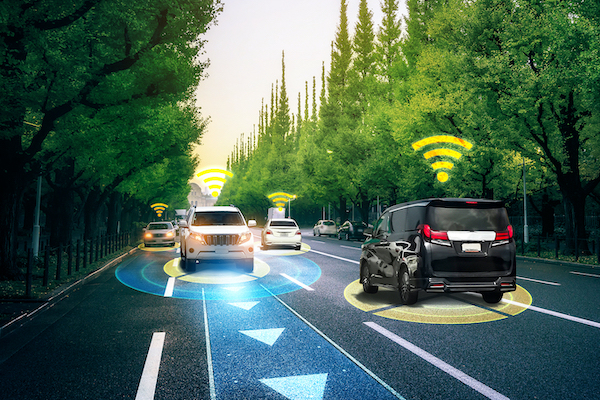
Yageo Group offers a complete array of passive electronic components that are ideal for 5G base stations and automotive systems. Yageo chip resistors, KEMET capacitors (R76 series film, T59x series tantalum, EFS FLEX SUPPRESSOR®, METCOM MPXV series Automotive Power Inductors), and Pulse antennas are just some of the brands that are helping to make 5G a reality, and they are helping to transform the automotive industry for the future.
To learn more on how 5G is transforming automotive, please visit KEMET's Engineering Center.
New Industry Products are a form of content that allows industry partners to share useful news, messages, and technology with All About Circuits readers in a way editorial content is not well suited to. All New Industry Products are subject to strict editorial guidelines with the intention of offering readers useful news, technical expertise, or stories. The viewpoints and opinions expressed in New Industry Products are those of the partner and not necessarily those of All About Circuits or its writers.
Related Content