Facebook
 Google
 GitHub
 Linkedin
5 Industry Partnerships Driving AI and Computing Innovations
The applications for AI are diverse and manifold: Battery management, airline operations, networking, and beyond. Here are a few partnerships advancing its reach across industries.
In the past few weeks, several companies have announced partnerships and collaborations to further develop AI infrastructure. These partnerships focus on optimizing hardware, enhancing AI-driven systems, and improving an industry framework to support growing demands. From low-power AI accelerators to high-performance networking, here are five collaborative efforts to keep an eye on.
1. Riyadh Air and IBM Set Their Sights on a Digital Airline
Airlines are using AI to improve efficiency, customer service, and operations. Riyadh Air, a digital-native airline backed by Saudi Arabia’s Public Investment Fund, is working with IBM to integrate AI and hybrid cloud technologies from the start. This may help them avoid legacy system limitations and scale quickly. IBM is providing its Watsonx AI suite, hybrid cloud solutions, and consulting expertise to automate customer interactions, optimize operations, and improve maintenance.
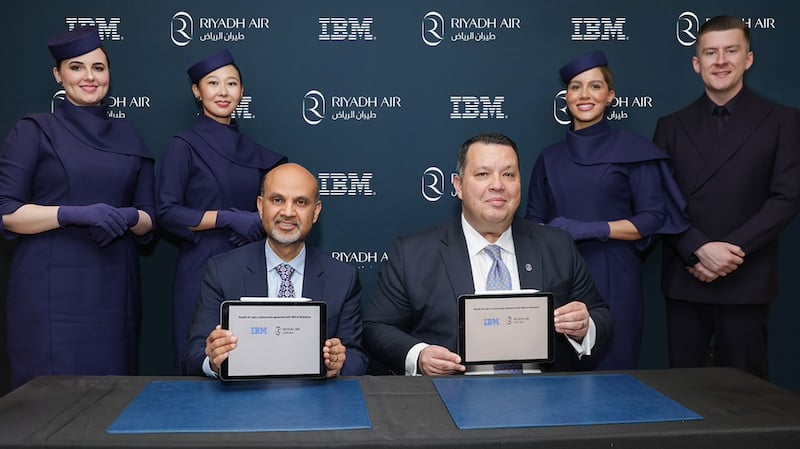
Adam Boukadida, Riyadh Air CFO, and Mohamad Ali, SVP and head of IBM Consulting, at FII Priority Miami 2025 Summit. Image used courtesy of IBM
IBM’s Granite large language models will power AI assistants, predictive maintenance, and autonomous systems for baggage tracking and flight rerouting. A hybrid cloud infrastructure built on IBM CloudPak connects over 50 airline applications while meeting data governance requirements. The technology developed for this partnership also applies to healthcare and supply chain management. By focusing on AI-driven operations and personalized experiences, Riyadh Air hopes to establish a scalable, data-driven airline.
2. SureCore and KU Leuven Partner for Energy-Efficient Accelerators
As AI expands into power-sensitive applications like edge computing, wearables, and industrial automation, the need for energy-efficient hardware has become critical. Traditional AI accelerators consume significant power, limiting their feasibility in constrained environments. SureCore, known for its ultra-low-power memory solutions, has partnered with KU Leuven, a leader in neural processing research, to develop AI hardware optimized for such efficiency.
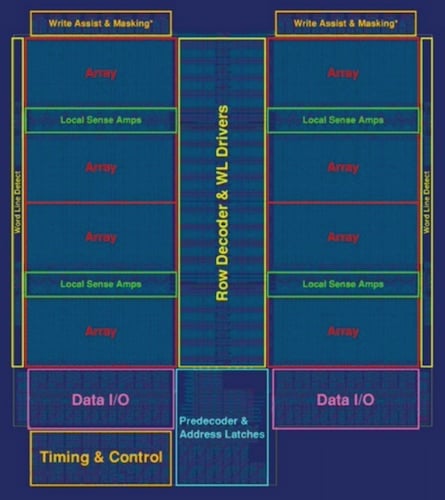
SureCore's PowerMiser architecture. Image used courtesy of SureCore
Their collaboration integrates sureCore’s PowerMiser SRAM IP, which reduces dynamic power consumption by over 40%, with KU Leuven’s neural accelerator, designed to minimize data movement and support dynamic voltage scaling. This combination enables AI inference at ultra-low voltages, making it well-suited for compact, battery-powered devices. By pushing power efficiency at 16 nm and paving the way for a future 7-nm variant, this work signals a shift in AI hardware design toward greater energy optimization with emerging memory technologies.
3. Baya and Semidynamics Advance RISC-V SoCs for AI
Baya Systems and Semidynamics are partnering to improve data transport efficiency and scalability in AI, machine learning, and high-performance computing (HPC) systems. Semidynamics provides customizable 64-bit RISC-V processor cores with Gazzillion Misses, a technology that handles up to 128 simultaneous cache misses, keeping cores active during memory access delays. Semidynamics' processors also integrate RISC-V Vector and Tensor Units to optimize AI workloads.
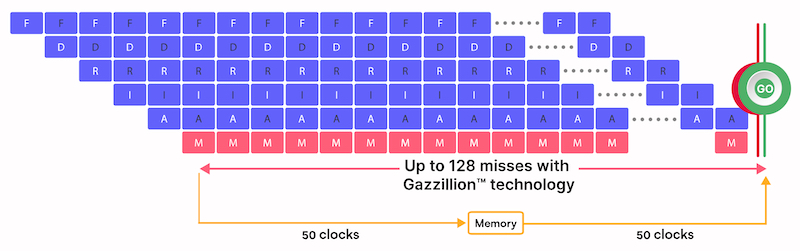
A Semidynamics' core with Gazzillion Misses. Image used courtesy of Semidynamics
Baya Systems contributes WeaveIP, a chiplet-ready network-on-chip (NoC) capable of over 4 TB/s per die, ensuring high-bandwidth, low-latency connectivity across compute elements. Its WeaverPro software platform enables system-level tuning, reducing development time by 40%. Together, the companies offer a pre-validated SoC solution that supports large-scale AI inference, recommendation systems, and real-time edge computing. By integrating high-bandwidth processing with an advanced NoC, this collaboration may help engineers build scalable, power-efficient AI and HPC architectures.
4. Cisco and Nvidia to Improve AI Networking
Cisco and Nvidia have expanded their partnership to improve AI networking infrastructure, combining Cisco’s expertise in high-performance networking with Nvidia’s accelerated computing capabilities. The collaboration addresses AI workload bottlenecks by integrating Cisco Silicon One’s 51.2 Tbps switching capacity with Nvidia’s Spectrum-X networking platform, which enhances Ethernet-based AI clusters with RDMA over Converged Ethernet (RoCE) and congestion management.
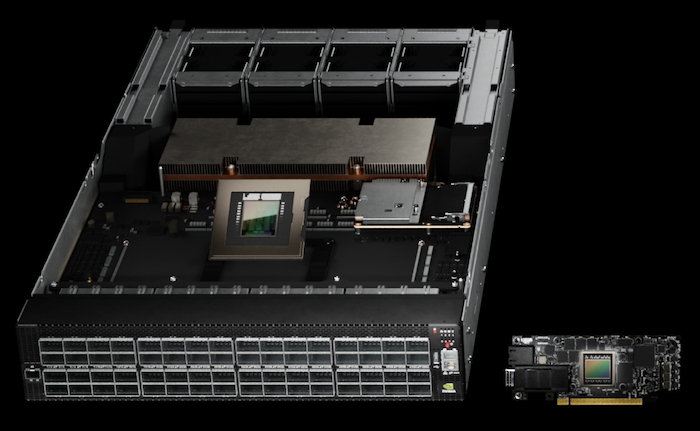
Nvidia’s Spectrum-X networking platform. Image used courtesy of Nvidia
Cisco’s Nexus Hyperfabric, paired with Nvidia’s BlueField-3 DPUs and SuperNICs, improves GPU-to-GPU communication and reduces latency in AI training and inference. The partnership also supports large-scale AI deployments, including enterprise AI pods and hyperscale data centers, with cross-platform programmability and real-time telemetry integration. By improving network efficiency and scalability, the collaboration enables AI adoption across industries like telecommunications, healthcare, and financial services while reducing power consumption through adaptive routing and liquid cooling.
5. Infineon and Eatron Tackle Next-Gen BMS Solutions
Infineon Technologies and Eatron Technologies have expanded their collaboration to develop AI-powered battery management systems (BMS), integrating Infineon’s semiconductor expertise with Eatron’s advanced machine learning algorithms. Their partnership targets automotive, industrial, and consumer applications, addressing key challenges in battery monitoring, predictive maintenance, and real-time energy optimization.
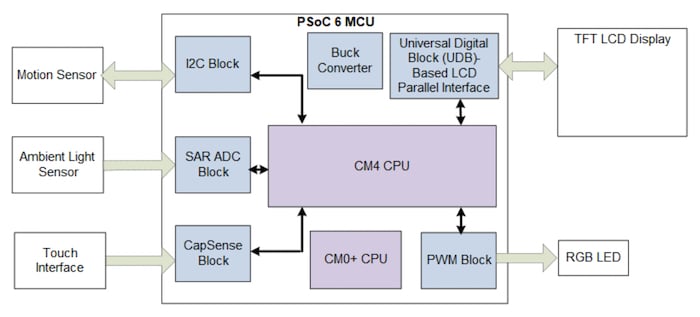
Application block diagram implementing the PSoC 6 MCU. Image used courtesy of Infineon
Infineon contributes its PSoC 6 microcontrollers, which support AI-based edge processing for battery analytics, alongside power management ICs and MOSFETs that enhance safety and reliability. Eatron complements these offerings with its Intelligent Software Layer (ISL), an AI-driven BMS platform that predicts battery state, detects faults within milliseconds, and extends battery life through model predictive control. This enables fast, accurate diagnostics and adaptive energy management, optimizing performance across electric vehicles, industrial automation, and renewable energy storage.