Facebook
 Google
 GitHub
 Linkedin
Nvidia First to Roll Out Full-Stack Safety System for Physical AI in Robotics
The full-stack platform pairs the IGX Thor compute module with a safety-certified software stack and an accredited inspection lab, with humanoid maker Agility as the first adopter.
Nvidia has introduced Halos for Robotics, describing it as the first full-stack safety system for robotics and physical AI, the term it uses for machines that perceive and act in the physical world alongside people.
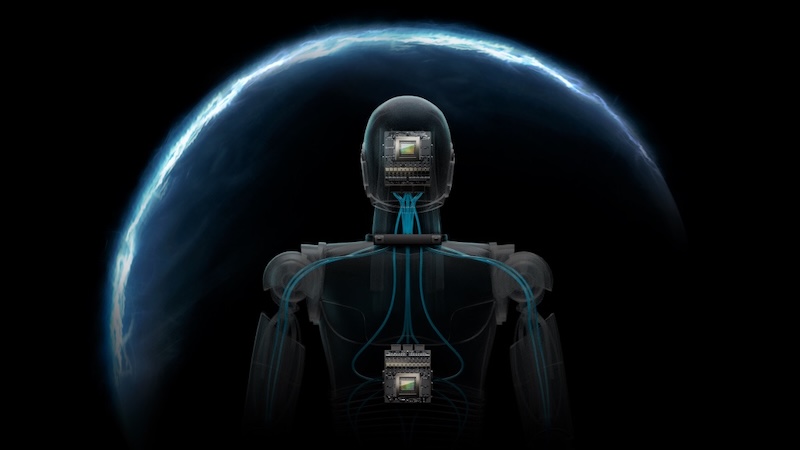
Halos for Robotics is touted by Nvidia as the first full-stack safety system for robotics and physical AI.
The platform unifies AI compute, system software, sensor data, safety applications, and third-party inspection into a single architecture so that developers building industrial robots, autonomous mobile robots, and humanoids no longer have to assemble a functional-safety case from scratch.
It extends a system Nvidia first launched for autonomous vehicles last year, reusing that work for factories, warehouses, and logistics sites where robots increasingly share floor space with workers.
Nvidia says that Physical AI is transforming the way that factories, warehouses, and logistics operations work. With that in mind, robotics teams need a unified safety architecture to scale autonomous systems into these environments. According to the company, developers can leverage Nvidia's autonomous vehicle safety foundation to develop safer robots faster suited for industrial operations alongside workers.
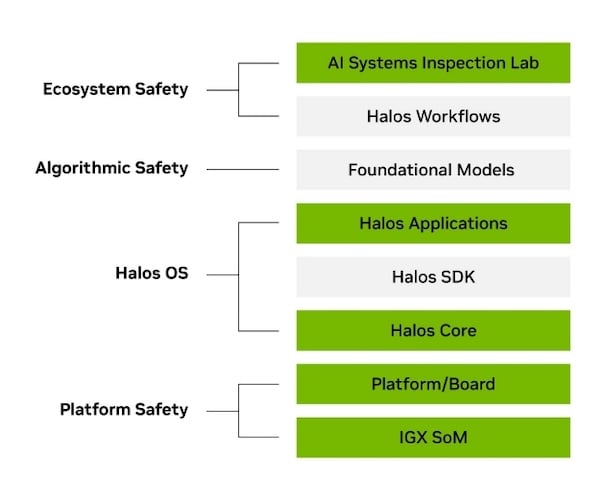
Nvidia Halos layered architecture
Safety Built Into the Hardware
At the base of the Halos for Robotics platform is the Nvidia IGX Thor compute module, which combines high-performance AI processing with functional-safety hardware on one board. Nvidia rates it at up to 2,070 FP4 TFLOPs, with 14 Arm Neoverse CPU cores and 128 GB of memory running at 273 GB/s.
The safety logic lives in a dedicated Functional Safety Island, a region certified to the IEC 61508 SIL 3 capability level that runs on its own power, clocks, and I/O so it stays isolated from the main compute domain. Nvidia says the chip carries more than 22,000 safety mechanisms to catch faults across the device, supported by built-in self-test for logic and memory.
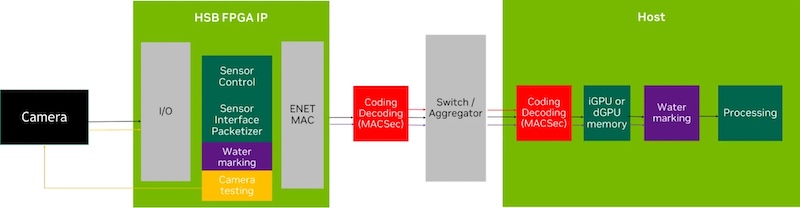
Nvidia Holoscan Sensor Bridge data flow from the camera through FPGA IP to host GPU processing.
The safety chain reaches past the processor to the sensors, with the Holoscan Sensor Bridge linking cameras, lidar, and actuators to IGX over Ethernet, scaling to hundreds of sensors while applying an end-to-end IEC 61508 SIL 2 protocol so that data integrity is protected from the sensor edge inward.
Running on top of that hardware is Halos OS, a safety operating system Nvidia describes as the next generation of its automotive DriveOS. It ships in two forms: a Linux configuration and a Linux-plus-QNX configuration that uses a hypervisor to partition the module into isolated virtual machines, keeping safety-critical functions separate from general AI workloads for higher-integrity use cases. More information can be found in Nvidia’s Halos for Robotics technical blog.
From DriveOS to an Accredited Inspection Lab
Much of what makes the robotics version possible is that Nvidia isn’t starting over. The company says its automotive safety effort represents more than 18,000 engineering years of work, with billions of safety transistors and millions of lines of safety-assessed code already evaluated, and that the same development processes and tools carry across to robotics.
Third-party assessors TÜV SÜD and TÜV Rheinland have reviewed the platform against standards including IEC 61508 and ISO 13849, the machinery-safety standard that governs industrial robots much as ISO 26262 governs cars.
The third layer is certification itself: Nvidia is opening the Halos AI Systems Inspection Lab to robotics, an ISO/IEC 17020 inspection body accredited by the ANSI National Accreditation Board. Because the lab pre-assesses Halos elements such as the IGX module and Halos Core, a manufacturer can have its integration inspected and then carry that certificate to a certification body for final sign-off, cutting the time and cost of reaching a certified product.
More than 40 companies now participate across the automotive and robotics programs, including Boston Dynamics, KION Group, Infineon, Texas Instruments, and NXP Semiconductors.
Humanoid developer Agility is the first to adopt the robotics platform, integrating IGX Thor and Halos Core into the safety system for its Digit robot, which already works on logistics lines for customers including Amazon and Toyota. Halos Core for IGX is available now in early access for registered developers in both Linux and Linux-plus-QNX configurations.
The open-source Halos Outside-In Safety Blueprint, which extends a robot's perception beyond its onboard sensors using fixed worksite cameras and AI agents to adjust behavior as people move through a space, is available on GitHub.
All images used courtesy of Nvidia.
Related Content