Facebook
 Google
 GitHub
 Linkedin
Arm Opens Access to Chiplet Architectures and AI Platforms
Arm is lowering the barrier to entry for chiplet-based SoCs and Armv9-powered AI devices across data centers, cars, and the edge.
Arm has made a series of announcements aimed at making its silicon platforms more accessible to developers, spanning high-performance compute, automotive, and embedded AI. The company recently contributed a vendor-neutral chiplet spec to the Open Compute Project (OCP), extended that architecture to automotive platforms, and opened its Armv9 Edge AI platform to Flexible Access, a licensing program for early prototyping.
Arm has been upping its participation in the Open Compute Project.
These announcements come at a time when openness—both architectural and ecosystem-level—has become a differentiator. With RISC-V gaining traction on the back of its permissive licensing, Arm’s latest efforts signal an intent to remain the default option not only for production silicon, but also for startups and teams building with limited budgets and fast turnarounds.
A Common Chiplet Language for Data Center and Automotive
At the core of Arm’s chiplet push is a new spec called the Foundation Chiplet System Architecture (FCSA), designed to enable interoperability between chiplets from different vendors. The company announced that it has donated FCSA to the Open Compute Project, positioning it alongside other OCP initiatives aimed at reducing system complexity and speeding up deployment in the data center.
Arm also joined the OCP board of directors, where it now sits alongside AMD, Nvidia, and other hyperscaler-aligned members. According to Arm, the goal is to set the standard for open, converged AI data centers, where disaggregated compute tiles can be mixed and matched without requiring monolithic SoCs or tightly coupled vertical stacks.
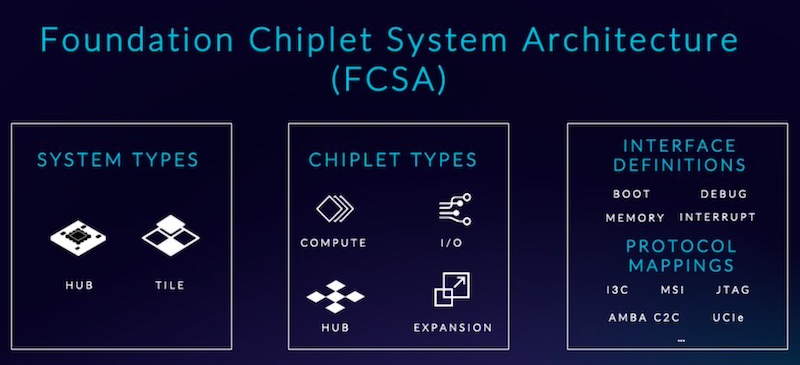
The FCSA architecture.
FCSA provides a shared vocabulary for defining interfaces between chiplets and complements existing standards, such as UCIe or BoW, by specifying how chiplets interoperate at the system level. It’s also backed by Arm’s Total Design ecosystem, which has expanded from 20 to over 50 partners in the past year.
Notably, the company is also extending FCSA into the automotive space. Arm argues that cars stand to benefit from the same reuse and modularity that chiplets offer in data centers. By applying the same standard to automotive platforms, OEMs and Tier-1s could theoretically combine safety-certified chiplets from different vendors while meeting performance, cost, and qualification targets.
Flexible Access Adds Armv9 Edge AI Platform
While FCSA targets system integrators and chiplet designers, Arm also made a move aimed squarely at developers. In another announcement, the company added its Armv9 Edge AI platform to Flexible Access, a licensing model that allows early-stage customers to explore and prototype with Arm IP at low or no upfront cost.
The platform includes IP blocks like the Cortex-A320 and the Ethos-U family of NPUs, and is designed for on-device AI use cases at the edge, from industrial sensors to smart cameras and consumer health devices. Until now, this platform was largely accessible through traditional licensing channels, which could be out of reach for startups or smaller hardware teams.
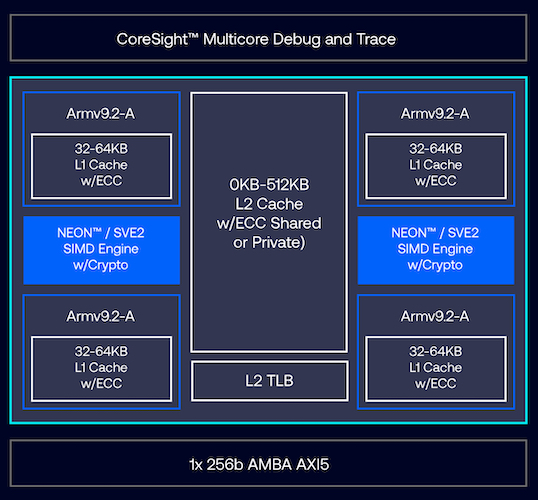
Diagram of the Arm Cortex-A320.
By moving it under Flexible Access, Arm gives developers the ability to simulate and evaluate the platform before committing to full design and manufacturing cycles. This includes running RTL simulations, power/performance estimation, and software development using production-grade toolchains. It also simplifies the path to building ML-optimized endpoints that rely on Arm’s software stack, including Core ML, ML Commons, and the company’s newer toolchain integrations like ExecuTorch.
A More Open Arm?
While Arm’s business model remains license-based, these announcements suggest a growing appetite for openness at the system and ecosystem level. By contributing FCSA to OCP, the company is betting that interoperability (not just IP dominance) will shape the next wave of system design, especially as chiplets and multi-die packaging go mainstream.
In the same breath, Flexible Access and platform-level initiatives like Armv9 Edge AI show how Arm is adjusting to the needs of smaller developers and product teams who don’t have the time or capital to navigate a full licensing engagement before prototyping.
Related Content