Facebook
 Google
 GitHub
 Linkedin
Why Supply Chain Visibility Is Becoming an Engineering Requirement
Hidden upstream dependencies can turn great product designs into costly delays. Discover why component sourcing risk must now be factored into early product decisions.
For decades, engineering teams could focus primarily on designing products that met performance, cost, and manufacturability requirements. Once components were selected and approved, supply chain teams were expected to keep those parts available throughout production.
That assumption no longer holds—a component that meets every technical requirement but fails in the supply chain is still a design failure.
The underlying risks are not theoretical. Product recalls reached a six-year high in 2024, up 10% year over year, and supply chain issues are reported to affect 2-5% of total revenue, making them a major driver of margin erosion. At the same time, according to Gartner, 92% of executives cite increased costs as a top risk from supply chain disruption and tariffs. In other words, volatility is no longer a background condition, but rather a material design constraint.
For electronics manufacturers, this matters because the pressures reshaping supply chains are also reshaping engineering trade-offs. Surging investment in AI infrastructure is consuming semiconductor manufacturing capacity. Demand for advanced-node production continues to outpace supply, while many industries still depend on mature-node components such as microcontrollers, sensors, power devices, and analog semiconductors. These components may appear less often in headlines, but they remain essential to industrial systems, automotive platforms, medical devices, and consumer electronics.
Supply Chain Risk Is Now a Design Constraint
The semiconductor shortages of recent years did not expose poor engineering. Rather, they revealed a visibility gap. Most organizations knew their direct suppliers, but far fewer understood the upstream network behind them: foundries, packaging facilities, specialty materials providers, and sub-tier manufacturers that ultimately determine whether a component remains available. When disruptions hit, companies often discovered hidden dependencies only after lead times lengthened, inventories tightened, or production schedules slipped.
That is why visibility is moving upstream into the design process, because what appears diversified on paper can be fragile in practice. Engineering teams may not own the supplier relationship, but they do influence supplier dependency every time they specify a component. A design that appears to have multiple approved sources may still carry concentration risk if all distributors ultimately depend on the same fab, packaging house, or constrained material.
Looking Beyond the Approved Vendor List
Traditional supplier risk assessments often focus on Tier 1 relationships, but the most consequential vulnerabilities often lie deeper in the network.
A microcontroller may be available from several authorized distributors yet still depend on a single upstream manufacturing path. Alternatively, a sensor may appear low-risk because it can be purchased through multiple channels, yet remain exposed to a single shared packaging provider. In both cases, the engineering team may believe it has flexibility when, in reality, it has simply created the illusion of resilience.
That matters because the cost of discovering this too late is high. When parts become constrained, engineering is forced into reactive work: alternate part identification, redesign, qualification, testing, documentation updates, and, in some cases, launch delays. These are not just procurement problems. They are schedule, cost, and customer-commitment problems.
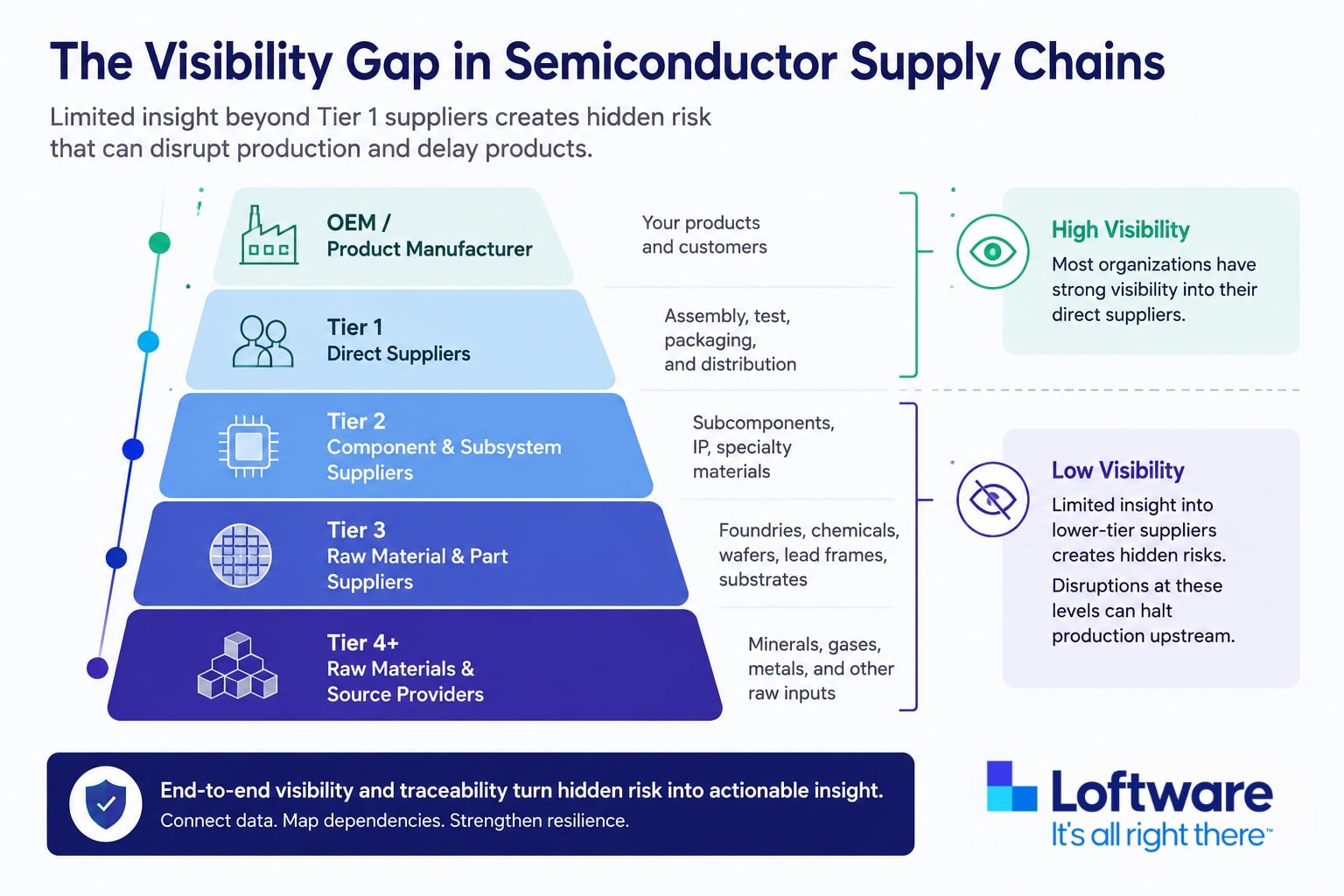
Visibility often weakens beyond Tier 1 suppliers, leaving electronics manufacturers exposed to hidden dependencies across components, materials, and source providers. (Click on image to enlarge).
AI Demand Is Reshaping the Semiconductor Landscape
The industry’s attention has understandably focused on advanced processors and the data-center buildout that supports them. Yet most real-world products still run on mature-node semiconductors. As investment and capacity increasingly shift toward AI-driven demand, the components that power everyday systems may face greater competition for manufacturing attention.
That makes design-stage visibility more important, not less. Engineering teams now need to evaluate not only whether a component meets functional requirements but also whether its sourcing profile introduces avoidable business risk. In many environments, the question is no longer just “Will this part work?” It is also “How exposed are we if the upstream network tightens?”
Traceability Enables Faster, Better Decisions
This is where traceability becomes critical. As stakeholders across the ecosystem demand verifiable product data, 88% of respondents in a 2026 industry survey report that cloud-based product identification platforms provide a single source of truth for tracking, traceability, and authenticity. The impact of this shift is tangible: improved compliance (43%), greater end-to-end visibility (40%), stronger audit readiness (34%), and reduced exposure to counterfeiting (27%). In this environment, traceability is no longer just about operational tracking. It is increasingly a foundation for regulatory compliance, risk management, and supply chain responsiveness.
In semiconductor manufacturing, this discipline already appears in operational detail. Qorvo, a global manufacturer operating across more than 40 sites and producing over 2 million labels annually, underscores the scale of modern labeling environments. In such contexts, uninterrupted operations depend on tightly integrated systems that link design, approval workflows, and production. Customer-specific product identification, barcode formats, serialization rules, and ERP data must remain continuously synchronized across manufacturing and logistics. The key takeaway is that labeling is no longer a standalone function but part of end-to-end supply chain execution, where accuracy and consistency are critical.
That example matters because the lesson extends beyond labeling. When product identity is managed as structured, connected data, updates can be applied consistently across sites and partners without teams rekeying the same information into multiple systems. This reduces inconsistency, accelerates responses to customer and compliance requirements, and helps products keep moving when conditions change.
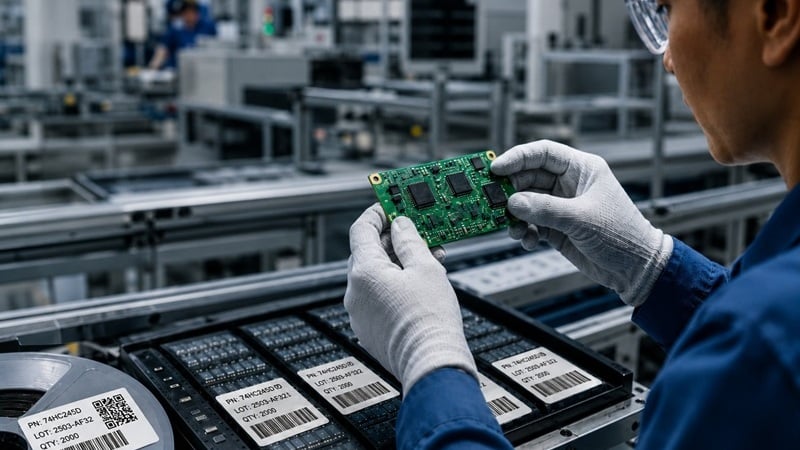
Accurate product identification helps electronics manufacturers connect components, production data, and traceability records across complex manufacturing environments.
Building Resilience Earlier in the Product Lifecycle
The most resilient organizations no longer treat supply chain management as a downstream function. They bring engineering, sourcing, manufacturing, and supply chain teams together earlier in the lifecycle to evaluate risk before products enter production.
That includes assessing supply chain resilience during component selection, identifying single-source dependencies earlier, improving visibility beyond Tier 1 suppliers, and embedding traceability into product and component management processes.
It also means recognizing that connected execution matters. According to the same industry research, 90% of respondents believe there is a growing need for connection and collaboration across global supply chains. That is a useful signal for engineering leaders: resilience is not created by analysis alone. It depends on how quickly an organization can align systems, partners, and decisions when conditions change.
The Next Design Constraint
Historically, engineers have balanced performance, cost, power consumption, reliability, and manufacturability. Increasingly, they must also design for visibility.
The next major disruption is unlikely to originate in the lab. It will emerge deeper in the supplier network, where hidden dependencies lead to production delays, redesign cycles, or missed commitments. Organizations that can identify those risks earlier and respond more quickly will be better positioned to protect margins, maintain output, and bring products to market with fewer surprises.
For engineering teams, the implication is clear: supply chain visibility can no longer be treated as someone else’s problem downstream. It has become part of the design decision itself.
All images used courtesy of Loftware.