Facebook
 Google
 GitHub
 Linkedin
Toshiba’s Quantum-Inspired Computer 100x Faster With New Algorithm
The company's third-generation algorithm may speed up the performance of its Simulated Bifurcation Machine (SBM), allowing it to find solutions for drug discovery, finance, and beyond.
Toshiba has announced a breakthrough third-generation algorithm for its Simulated Bifurcation Machine (SBM), achieving approximately 100 times faster Time to Solution (TTS) compared to its second-generation predecessor. The research, published in Physical Review Applied, demonstrates how harnessing chaos at the boundary between order and disorder can dramatically accelerate solutions to large-scale combinatorial optimization problems.
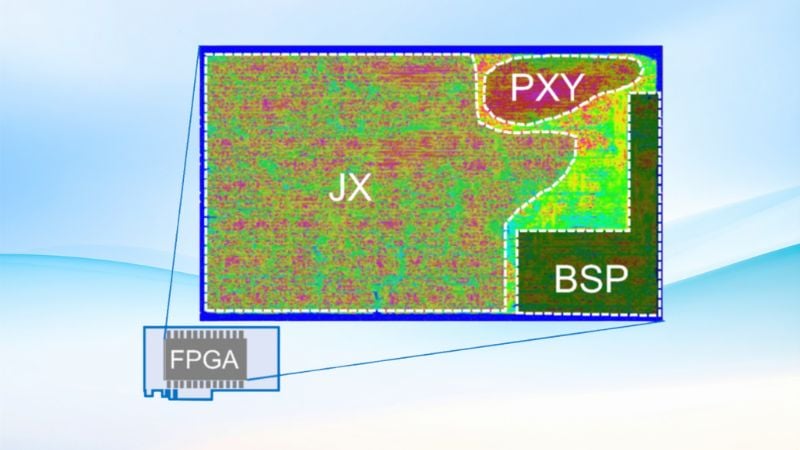
The layout of the circuit modules in the FPGA. The heatmap shows routing congestion while the dotted lines indicate modules. Image used courtesy of Physical Review Applied
The SBM is Toshiba's proprietary quantum-inspired architecture designed to tackle NP-hard problems across drug discovery, delivery route optimization, investment portfolio design, and other computationally intensive domains. Traditional classical computers and even quantum systems often struggle with the exponential explosion of possibilities in these problem spaces. Toshiba's approach avoids the infrastructure challenges of quantum hardware while delivering significant speedups through algorithmic innovation.
From Global Control to Individual Parameters
The innovation centers on restructuring how the algorithm controls bifurcation dynamics. Previous versions used a single global bifurcation parameter applied uniformly across all position variables. The new architecture assigns individual bifurcation parameters to each position variable, with independent control based on the values of corresponding variables.
By decoupling parameter control, the algorithm gains finer-grained influence over the dynamics of each computational element. Variables can smoothly transition from regular, predictable behavior to chaotic motion, or maintain states suited to their specific roles in optimization. The third-generation SBM autonomously adjusts these parameters, enabling the system to allocate computational resources where exploration is most needed.
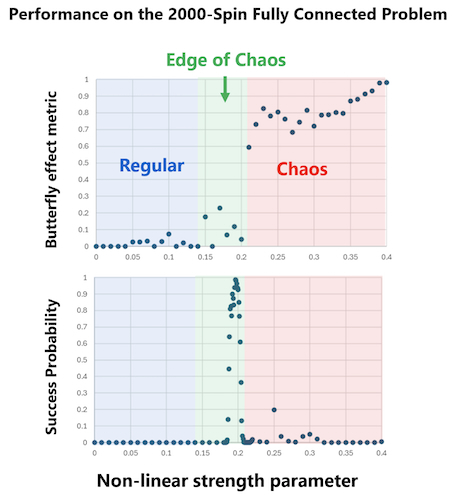
The new SB algorithm can find the optimal solution with nearly 100% probability at the edge of chaos for a fully connected 2,000‑spin Ising problem. Image used courtesy of Toshiba
The result is that the algorithm can exhibit either regular dynamics (which converge steadily toward solutions) or chaotic behavior (which explores the space more broadly), depending on the problem structure and the current state. This adaptability eliminates the rigidity of prior approaches, where a fixed global parameter determined the entire system's behavior.
Chaos as a Computational Asset
The breakthrough relies on the "edge of chaos," the narrow boundary between orderly, repeating dynamics and fully chaotic motion. At this edge, systems display unusual properties: they are sensitive enough to explore widely but structured enough to recognize patterns and opportunities for improvement.
For combinatorial optimization, this principle solves a critical problem of escape from local optima: a solution that’s locally superior but globally suboptimal. The system has found a local peak in the fitness landscape but remains trapped below the true global maximum. Classical optimization algorithms often become stuck at these peaks, but chaotic dynamics introduce unpredictability that allows the system to "jump" away from false local peaks, continuing the search for better solutions.
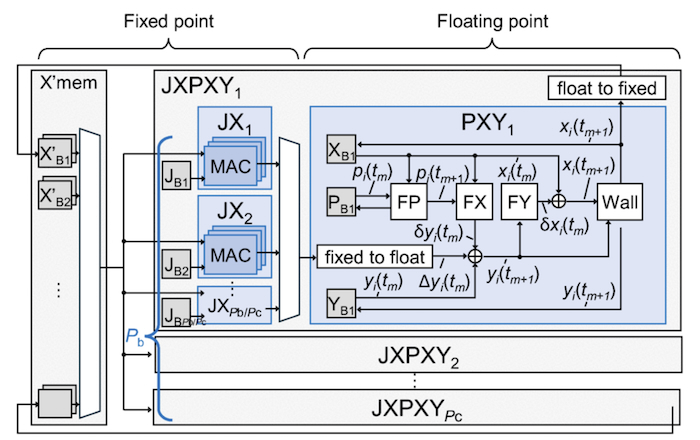
Block diagram of the GbSB-based machine. Image used courtesy of Physical Review Applied
Toshiba's algorithm harnesses chaos intentionally by operating at the edge, avoiding full chaos (which yields noise without structure) while leveraging the edge's tendency to escape entrapment in local optima. Success probability—a key benchmark for optimization algorithms—approaches 100% for reaching global optima, substantially improving reliability compared to earlier versions.
A Shift in Feasibility
The 100x TTS improvement shifts what is computationally feasible, enabling problems that previously required hours to be solved in minutes. For drug discovery, where researchers evaluate millions of molecular configurations to identify candidates with desired properties and minimal toxicity, this speedup accelerates the transition from computational screening to laboratory validation. Meanwhile, in logistics, companies can compute delivery routes across hundreds of locations in seconds rather than hours. Financial institutions can rebalance large-scale investment portfolios far more frequently and with greater precision.
Toshiba has published three generations of the Simulated Bifurcation algorithm. The first version appeared in April 2019, establishing the core mathematical approach. A refined second generation followed in February 2021 with improved convergence properties. This third-generation achievement, confirmed through peer review in Physical Review Applied, marks a substantial algorithmic milestone and the largest single-generation performance gain in the SBM's history.
The results suggest that quantum-inspired classical systems, when designed according to principles from physics and chaos theory, can address optimization problems at scale without requiring the extreme cryogenic isolation and the error-correction overhead of gate-based quantum computers.
For enterprises seeking immediate, practical improvements to optimization-limited workflows, systems like the SBM built on this new algorithm represent a bridge technology: more capable than traditional classical approaches, deployable now, and architected on proven mathematical principles rather than speculative future quantum hardware.