
 Facebook
 Google
 GitHub
 Linkedin
AtlasBase Debuts Bio-Silicon Chip for Breaking Data Center Storage Bottlenecks
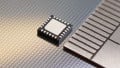
Announced today by AtlasBase, Thalia is a 5.6B-well bio-silicon chip that uses synthetic DNA to break power and density bottlenecks in AI data center storage and molecular computing.
Today, AtlasBase unveiled its new molecular computing platform. At the heart of this platform is "Thalia," a massive bio-silicon chip that merges standard CMOS semiconductor technology with electrochemical synthesis to create synthetic DNA at an IT-viable scale.
As AI workloads push traditional silicon, solid-state, and magnetic storage to their physical limits, AtlasBase has introduced a highly scalable bio-silicon chip designed to bring synthetic DNA storage and molecular computing to the enterprise data center.
The explosive growth of artificial intelligence has exposed a fundamental bottleneck in modern data centers: power and data density. Traditional storage media—like hard disk drives (HDDs), magnetic tape, and solid-state drives (SSDs)—are struggling to keep pace with the sheer volume of data generated by AI agents, while the energy required to move that data between storage and processors continues to skyrocket. The Thalia chip was designed to break this bottleneck.
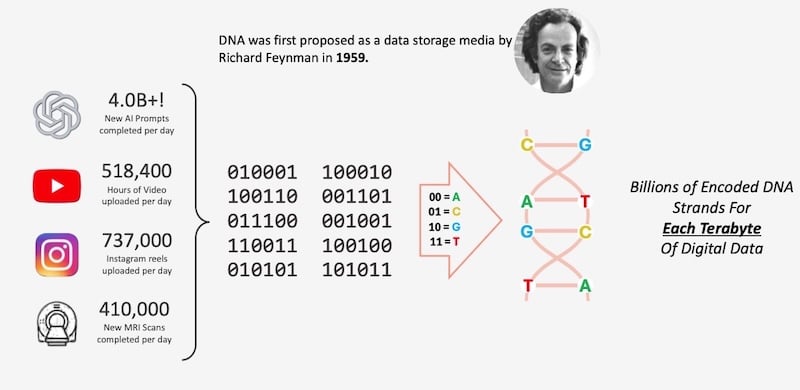
Syntentic DNA can be used to represent digital data.
The Thalia chip represents a 700x increase in synthesis scale over previously available technologies, providing a new substrate for zero-power, ultra-dense data storage and natively parallel "in-memory" compute.
To learn more about the new device, and the technology behind it, we were pleased to speak with Jeff Treuhaft, CEO of AtlasBase.
The AI Era’s Power and Density Wall
In standard data center architectures, the energy cost of storing and shuffling data is immense. While SSDs provide rapid access for immediate processing, they are incredibly expensive to fabricate at scale and suffer from a fatal flaw for deep, long-term archiving: they require constant power.
"The trick about flash memory is that it's a silicon storage mechanism, and it has to be charged, it has to be powered," explained AtlasBase CEO Jeff Treuhaft during a recent technical briefing. "If you remove the power from an SSD, it very quickly starts to lose the charge that it's employing to keep the data encoded."
Conversely, older magnetic media like HDDs and tape drives are running into superparamagnetic limits. To squeeze more bits into these formats, manufacturers have resorted to exotic and mechanically complex architectures—like heat-assisted magnetic recording (HAMR) or shingled magnetic recording (SMR)—which often yield challenging failure rates. Furthermore, moving this data continuously back and forth to compute nodes (east-west traffic) drains the limited power budgets of modern campuses.
Meet Thalia: A 5.6 Billion-Well Bio-Silicon Chip
To solve this, AtlasBase turned to a storage medium optimized by billions of years of evolution: DNA. Digital data can be translated from binary code (0s and 1s) into the base-four language of DNA: Adenine (A), Cytosine (C), Guanine (G), and Thymine (T). Specifically, 00 corresponds to A, 01 to C, 10 to G, and 11 to T.
Historically, writing synthetic DNA was a slow, lab-based process utilizing 96-well plates or inkjet-style printhead nozzles on passive plates, yielding around 1 million to 8 million strands. AtlasBase has exponentially scaled this up by moving to an active, electro-chemical synthesis process on a dense silicon substrate.
The Thalia chip features 5.6 billion individual synthesis sites. To achieve this density, AtlasBase utilized a stacked, multi-layer chip architecture manufactured in partnership with TSMC and imec.
"Underneath the chip... is a CMOS control and sensing layer. It's a standard 16-nanometer node process," Treuhaft detailed. "And then on top of that, we mask and apply a device layer, and this is a wet layer that allows us to flow chemistry across the top of the chip."
Specifically, Layer 1 provides CMOS Control and Sensing on a 16nm node, Layer 2 houses bio-compatible devices at a 250nm critical dimension, and Layer 3 contains the fluidic enzymatic bio-chemistry.
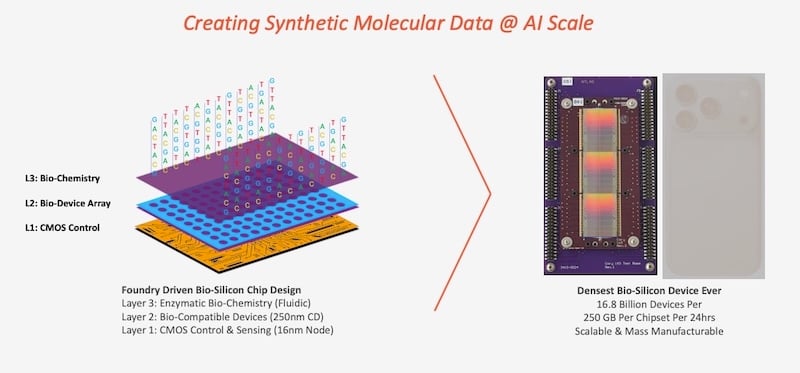
The Thaila chip uses a multi-layer approach, combining CMOS and wet layer that enables chemistry to flow across the top of the chip.
Each of the 5.6 billion microfluidic wells contains an active anode and cathode. By sending precise electrical pulses to targeted wells through the 16nm CMOS control layer, the chip triggers a localized electrochemical reaction. This reaction precisely attaches a specific biological base (A, C, G, or T) to the top of a growing synthetic DNA strand. By repeating this cycle, the chip "prints" digital data directly into dense, 5.6 billion-strand batches of molecular memory.
Molecular Storage and Natively Parallel Compute
Once the data is encoded into a DNA strand, the power benefits become immediate. The synthesized DNA is placed into a small capsule—roughly the footprint of a standard LTO tape cartridge—that can hold anywhere from 1 Terabyte to 50 Petabytes of data per capsule, scaling up to 5 Exabytes per LTO footprint.
Because the storage medium is biological, it does not require a constant electrical charge, cooling, or active physical rotation to maintain its state.
"The beauty of DNA is that once you are able to create a strand of DNA that has some digital data encoded in it, it can last for an extremely long time," Treuhaft noted. "Thousands of years, if not tens of thousands of years. And it's one of the things DNA is good at."
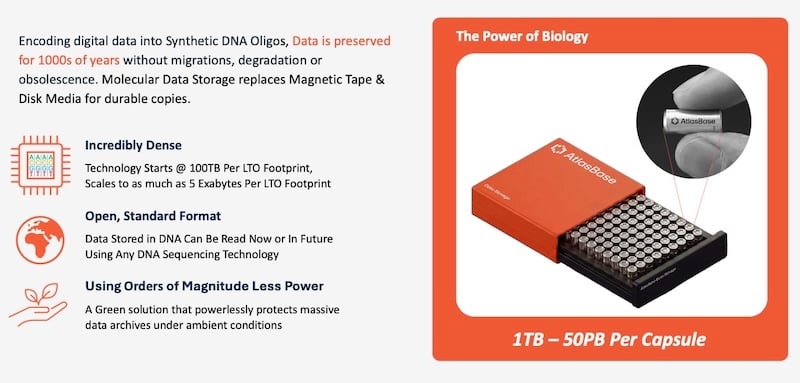
Molecular data storage offers advantages in density, longevity, and low power.
Beyond cold storage, AtlasBase is pioneering the use of these strands for molecular computing. Because DNA naturally facilitates biological reactions, computational algorithms can be executed directly on the data where it sits, completely eliminating the "memory wall" of transferring data to a CPU or GPU. In biology, trillions of permutations happen simultaneously; therefore, molecular computers are naturally suited to solve massively parallel optimization problems running trillions of candidate states at once.
Bridging the Silicon-Carbon Gap
AtlasBase says it is currently launching Early Access Programs for its molecular compute and storage services. By combining standard CMOS foundry processing with advanced bio-chemistry, the company aims to rack and stack their bio-silicon units into OCP-style racks, ultimately paving the way for petabyte and exabyte-scale molecular clouds that do not break the strict power limitations of tomorrow's AI data centers.
All images used courtesy of AtlasBase.





Jeff,
This kind of misleading clickbait is why I rarely use this site anymore. That was a completely and deliberately misleading headline. This technology has little or nothing to do with data centre storage; it’s a purely *offline* data archiving technology. Bringing data centres into it suggests very strongly that this is a breakthrough in *online* storage. So why mislead us?
This is a sufficiently interesting and useful technology that you could just be honest about it from the start. Just because their press release says something doesn’t mean you should parrot it verbatim.
Every engineer reading this will now want to know:
- What is the long term stability of the storage medium?
- How is it sealed?
- How is it read back?
- How thermally sensitive is it, and how sensitive is it to ozone?
- What is the error correction regime?
Why is none of that in the press release? Who do they think the audience is? It’s literally only engineers who would be commissioning this, and we won’t commit hundred of petabytes to something until we know those things.
Sorry. Just getting really sick of hype.
When you interviewed Jeff Treuhaft, did he really say that SSDs quickly start to lose charge when they are unpowered? That’s an oversimplification of the data rewriting and wear compensation process. They lose data a lot quicker when worn and off. AFAIK.