Facebook
 Google
 GitHub
 Linkedin
Market Forecasts Stack Up Favorably for Chiplet Technology
Chiplet technology may transform the semiconductor industry to the tune of $411B.
Chiplet technology is expected to expand significantly over the next decade, according to an IDTechEx report. The authors of this report, Dr. Xiaoxi He and Dr. Yu-Han Chang, claim that the chiplet market could approach $411 billion in opportunities and that appropriate investments in this market will fundamentally shift future development in the semiconductor industry.
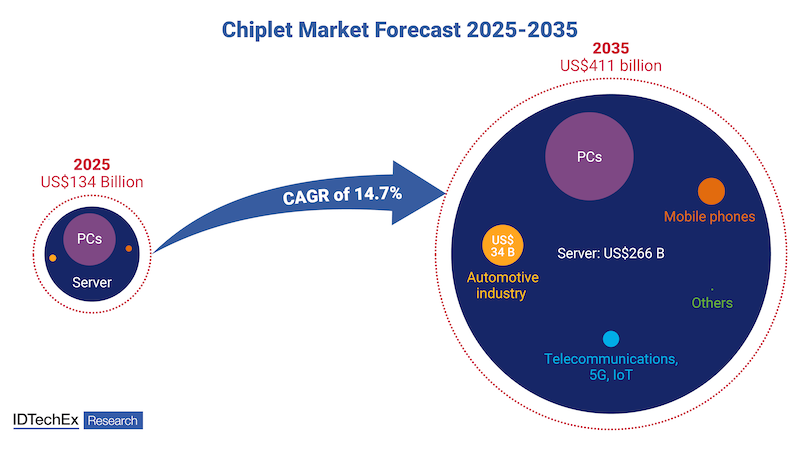
Chiplet market forecasted to grow to $411 biilion by 2025.
The IDTechEx report predicts that the chiplet market will play a vital role in several key sectors, including automotive, PCs, and servers.
What Is a Chiplet?
Many of you All About Circuits readers are familiar with chiplets. But, for those who are not, here are the basics.
Chiplets refer to a chip architecture that more effectively uses the real estate on silicon wafers. Engineers and physicists have been saying for years that Moore’s Law must end…and well, it must. At some point, there is no way to cram any more transistors into the same space, let alone remove the heat that is generated and other physical limitations.
Instead of simply cramming more transistors onto a chip, chiplets organize transistors into groups that promote better functional density. Functional density, rather than physical density alone, affords more flexibility in the final product.
In the early days of processors, chipmakers combined many functions onto a single chip instead of using discrete components with traces and lots of physical separation between components. Chiplets modify this idea, where individual chiplets are combined to form one single package, but each chiplet is mounted in a single package using high-speed, low-latency contacts.
Advantages of Chiplet Manufacturing
System on chips (SoCs) are chiplets' biggest competing technology. In both technologies, tasks and their associated silicon are segregated into functional groups. GPUs perform graphics processing, communication modules handle communication, silicon-based sensors group together, and so on. That is where the similarities end.
SoCs are limited in several ways. First, the entire chip must be built at the highest resolution. In the image below, for example, the entire SoC is built on 5-nm technology, which is more expensive to fabricate due to its high complexity. If one component is defective, say the I/O module, the entire SoC will fail, leading to low yield rates.
_versus_chiplet_technology.jpg)
System on a chip (SoC) versus chiplet technology.
Chiplet technology, on the other hand, is first built as separate modules and assembled later. This means an entire lot of wafers can be dedicated to CPU production at 5 nm, and a separate lot of wafers at 28 nm can produce MEMS. The chiplets are connected after each lot is produced. Since only certain components are produced at the highest resolution and at the largest expense, chipmakers can reap significant cost savings from the chiplet architecture.
It also leads to simpler reticle design, such that each wafer can be patterned with one module repeatedly, increasing the overall yield rate. The complicated assembly step of chiplet construction is performed after wafer sort, ensuring only good chiplets are connected in the final stages of production.
In SoCs, the wafer substrate is fixed. In chiplets, both transistor resolution levels and wafer chemistries can be combined. In hetero-material chiplet technology, the chiplets can be based on different chemistries and combined into a single chip.
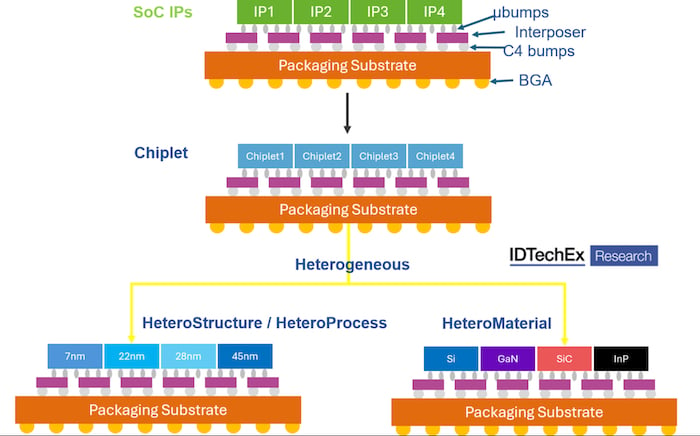
Different structures and materials can be combined on the same chip using chiplet technology.
The Future of Chiplets
Chiplet technology has notable financial advantages over SoCs and will likely see high growth potential over the next decade. Chipmakers can customize the final chip with components at different technology and resolution levels, driving higher yield rates and lower costs.
For more information, reach out to IDTechEx to purchase a copy of their report.
All images used courtesy of IDTechEx.
Related Content