Facebook
 Google
 GitHub
 Linkedin
AWS Touts Its ‘Most Powerful and Efficient’ CPU Yet
New Graviton5-based EC2 M9g instances push performance, core density, and security design to the next level.
AWS recently announced its fifth-generation Graviton processor, hailing it as “the most advanced custom chip to date” for EC2 workloads. With a claimed 25% higher compute performance for Graviton5-based M9g instances compared with the previous generation, and significantly expanded memory and I/O architectures, AWS believes the new CPU can efficiently support complex cloud workloads.

AWS Graviton5. Image used courtesy of Amazon
The Architecture of Graviton5
Graviton5 introduces several quantifiable improvements over the previous generation.
First, the processor integrates 192 cores in a single package, giving EC2 customers access to the highest CPU core density currently available in its fleet. According to AWS, this arrangement reduces inter-core communication distance and cuts latency by up to 33%, directly benefiting workloads such as high-performance databases and application servers.
AWS also redesigned the memory hierarchy to accompany the core expansion. Specifically, Graviton5 incorporates a 5x larger L3 cache, and each core receives 2.6x more L3 cache than Graviton4. This approach directly reduces throughput losses typically associated with off-chip memory access, enabling applications to more frequently and quickly access data to process larger datasets without incurring the same latency penalties. Memory subsystem improvements also include higher DRAM speeds, though AWS does not provide explicit numerical values.
Network and storage paths also receive notable upgrades. Graviton5-based EC2 instances report up to 15% higher network bandwidth and 20% higher EBS bandwidth on average across instance sizes, while the largest configurations can deliver 2x the network bandwidth of their predecessors.
AWS attributes a portion of Graviton5’s efficiency gains to its move to 3-nm fabrication technology, as well as to system-level optimizations, such as bare-die cooling, that shift heat away from the compute fabric more effectively. The company links these improvements to lower energy consumption per unit of work.
How Core Density Shapes Modern Cloud Compute
In high-scale cloud environments, CPU core density directly determines performance, efficiency, and workload consolidation.
Cloud applications frequently distribute tasks across many concurrent threads, and every additional nanosecond spent coordinating data between cores quickly compounds across billions of operations. A dense multi-core architecture solves this slowdown by reducing the physical distance across the compute fabric, which lowers inter-core communication latency. Higher-density cores, however, can also pose several engineering challenges.
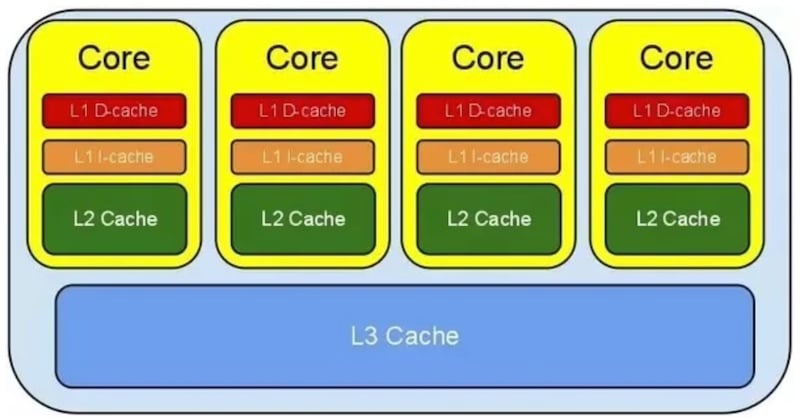
A higher core density requires more cache resources. Image used courtesy of SoftwareG
For example, in large multi-core systems, insufficient shared cache capacity will force frequent off-chip memory access and introduce latency orders of magnitude longer. Therefore, these designs need to expand cache systems that reduce penalties by keeping high-reuse data close to the compute units. A large L3 cache also prevents cache thrashing, a condition in which competing threads evict one another’s data due to limited cache space.
Core-dense design also affects thermal behavior and power distribution. As transistor counts increase within a confined footprint, thermal gradients intensify. To support high density, vendors need to implement advanced cooling strategies and power-delivery networks to help maintain stable frequency targets.
The Direction of Custom Cloud Silicon
AWS’ announcement is part of a larger industry trend in which cloud operators are moving away from general-purpose CPU roadmaps toward domain-specific compute optimized for hyperscale infrastructure. AWS notes that M9g instances are now available in preview, with compute-optimized (C9g) and memory-optimized (R9g) variants scheduled for 2026.