Facebook
 Google
 GitHub
 Linkedin
Blecon’s $4.6M Funding to Fuel No-Pairing Bluetooth Cloud Connectivity
The startup is taking a unique approach to existing cloud and IoT challenges.
U.K.-based IoT startup Blecon announced last week a $4.6 million seed funding round to advance its unique Bluetooth Low Energy (BLE) technology. Founded by industry veterans from Arm, AWS, and Microsoft, Blecon aims to revolutionize the use of Bluetooth technology for commercial IoT deployments by eliminating traditional barriers such as device pairing and connectivity limitations.
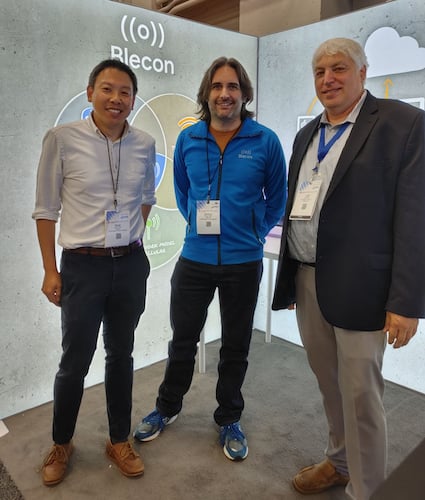
From left to right: Nick Chen, Principal Software Engineer at Blecon, Simon Ford, CEO of Blecon, and Jeff Child, All About Circuits Editor-in-Chief
With its unique architecture, Blecon offers a scalable, low-power alternative to cellular and Wi-Fi, positioning itself as a leader in the growing IoT sector. All About Circuits had the chance to meet Simon Ford, CEO of Blecon, to learn more about the company's mission to enable physical products to communicate with cloud applications using BLE.
Leveraging Bluetooth for Cloud Connectivity
Bluetooth Low Energy (BLE) is ubiquitous in consumer devices because of its energy efficiency and low cost. However, commercial IoT deployments have historically struggled to use BLE to its full potential due to range and pairing limitations. Traditional Bluetooth operates well for personal area networks but lacks the scalability and connectivity needed for cloud-based IoT applications.
“In the use case where our customers are trying to communicate with a cloud back-end, they want to use Bluetooth Low Energy because it’s low power, low cost, tiny, and ubiquitous,” Ford said. “But the architecture in the use case, the model, is not really fitting for that cloud connectivity.”
Blecon addresses these challenges with a solution that repurposes BLE for cloud connectivity. By eliminating the need for device pairing, Blecon allows Bluetooth devices to connect directly and securely to the cloud using any available hotspot. This architecture combines BLE’s efficiency with a more scalable network model, providing businesses with a flexible and low-cost option for large-scale IoT deployments.
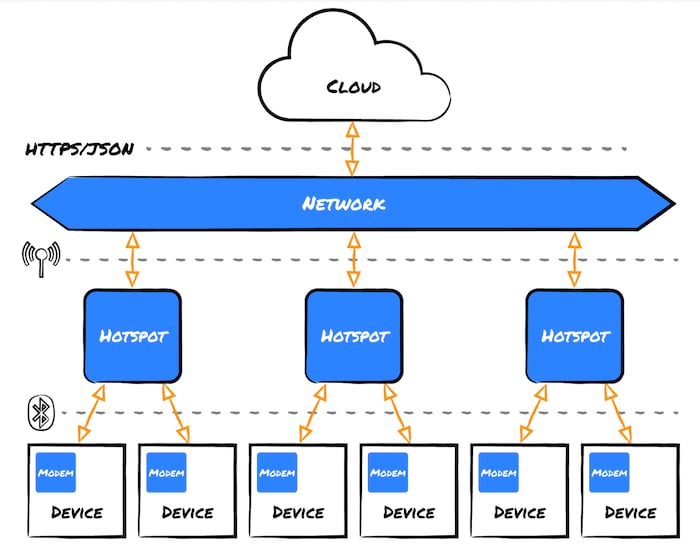
Diagram of a Blecon network. Image used courtesy of Blecon
This approach enables existing smartphones and laptops to act as BLE hubs, removing the need for additional infrastructure or complex configuration. By transforming Bluetooth’s inherent limitations into scalable connectivity, Blecon offers a viable alternative to more energy-intensive cellular and Wi-Fi systems, significantly reducing the operational costs associated with IoT applications.
The Architecture Behind Blecon’s Success
Blecon designed its platform to replicate the flexibility of cellular networks while maintaining the low energy demands of BLE. The key innovation lies in using BLE-enabled devices as roaming nodes, connecting through a network of available hotspots, including smartphones, laptops, and dedicated BLE hubs. These devices can route data bi-directionally, allowing continuous communication with cloud services even in dynamic environments.
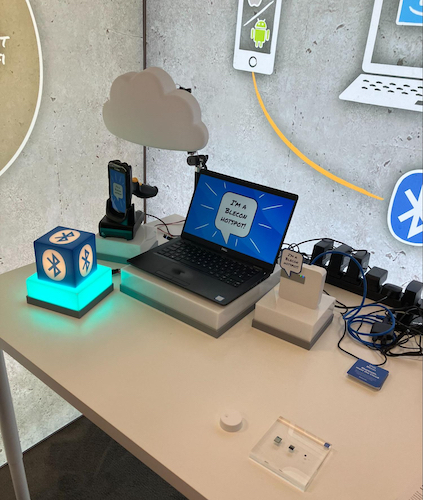
A demo of Blecon's technology at the company's Embedded World North America booth.
Unlike traditional Bluetooth implementations, which require one-to-one pairing and have limited range, Blecon’s architecture allows devices to connect through any available hotspot within range. This provides BLE devices with broader coverage and more robust connectivity, particularly in environments such as warehouses or logistics hubs, where devices must remain connected while moving between zones.
“Companies want to use Bluetooth in more of a cellular model, but the cost and power profile of cellular just aren’t applicable for many use cases,” Ford explained. “We’re leveraging Bluetooth’s ubiquity with a cloud-connectivity model that allows devices to communicate without pairing, offering the scalability of a cellular network but with the efficiency and simplicity of BLE.”
The system’s bidirectional communication also enables real-time data routing, which elevates applications such as supply chain management and industrial automation, where constant data flow to and from the cloud is necessary for operational efficiency. Additionally, Blecon’s architecture includes secure encryption protocols to protect all data transmitted between devices and the cloud.
Addressing IoT Deployment Roadblocks
Traditional IoT deployments face two significant challenges: high power consumption and expensive infrastructure. Cellular networks, while robust, are costly to deploy at scale and consume considerable energy. Wi-Fi offers an alternative but comes with similar power and infrastructure demands that are prohibitive for battery-powered IoT devices.
Blecon solves these problems using BLE to enable cloud connectivity without requiring the high costs or power profiles of cellular and Wi-Fi systems. BLE’s global adoption makes it a widely recognized and trusted standard, and Blecon’s unique architecture transforms it into a network that can handle large-scale IoT deployments.
Blecon significantly reduces the time and effort to configure devices by eliminating device pairing, making the platform more accessible for integration into existing ecosystems. This plug-and-play architecture allows BLE devices to connect automatically to any available hotspot, facilitating real-time communication with the cloud without constant reconfiguration. As a result, businesses can deploy thousands of devices with minimal setup and low operational overhead.
$4.6M Funding to Accelerate Development and Expansion
Blecon plans to use the $4.6 million seed funding round, led by MMC Ventures, to expand its market reach. The investment will also enable Blecon to accelerate product development and increase customer engagement across industries. In addition to improving the platform’s scalability and security, the company sees the funding as a way to forge new partnerships with device manufacturers and further embed its technology into the IoT ecosystem.