Facebook
 Google
 GitHub
 Linkedin
Broadcom Reveals Ethernet Fabric Router IC for Distributed AI Computing
Announced today, the new solution is said to introduce levels of compute scalability that extend beyond the physical limits of a single facility.
Today, Broadcom announced the commercial availability of a new, high-capacity interconnect device for supporting distributed AI workloads at multi-datacenter scale. Dubbed the Jericho4 Ethernet fabric router, the device is part of the company’s DNX product line and is said to unlock disaggregated compute clusters that can span 100 kilometers or more. Broadcom designed the device for AI training and inference workloads to enable otherwise disparate systems to operate as unified systems across regional data center footprints.

The Jericho4 Ethernet fabric router.
All About Circuits spoke with Amir Sheffer, associate product line director at Broadcom, and Hasan Siraj, head of software products/ecosystem, to learn more about the new solution.
HyperPort High-Speed Interconnects
Broadcom built Jericho4 to securely interconnect over one million XPUs across geographically distributed data centers to extend the AI compute fabric beyond the physical and power limits of a single facility.
“Our customers are talking about millions of GPUs,” Sheffer said. “This is the problem that we are helping them to solve.”
Each system supports up to 36,000 ports, with every port delivering 3.2 Tbps of bandwidth through Broadcom’s proprietary HyperPort interface, a new architecture built for long-distance, high-throughput AI data movement.
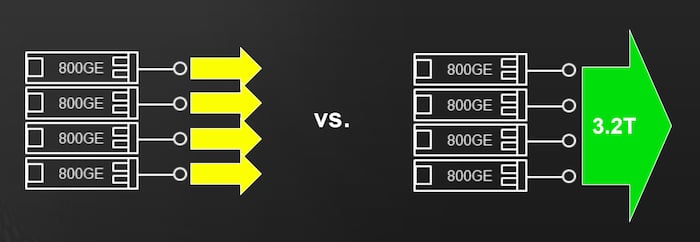
HyperPort achieves a 70% improvement in link utilization.
Built on Broadcom’s 200-G PAM4 SerDes operating in a 3-nm process node, HyperPort is a 3.2-Tbps Ethernet port that aggregates four 800-G lanes into a single logical link. While the design is not yet standardized under IEEE or MSA definitions, each HyperPort maintains full Ethernet packet compatibility while providing measurable gains in bandwidth efficiency and congestion reduction.
The technology responds to the shortcomings of conventional ECMP load balancing methods across multiple 800-G ports, which introduce inefficiencies due to hash collisions and flow misdistribution. The problem is particularly pronounced under AI workloads where “elephant flows” dominate. HyperPort mitigates these issues by increasing the effective flow width and improving port-level link utilization. Broadcom reports bandwidth utilization gains of up to 70% over 800GE implementations, translating to faster data movement between facilities, improved job completion times, and better overall system performance without requiring changes to existing optics or physical infrastructure.
Distributed RoCE With Deep Buffering and Line-Rate Security
A notable feature of Jericho4 is that it extends support for RDMA Over Converged Ethernet (RoCE) across distances exceeding 100 kilometers.
Maintaining lossless transport over long-haul Ethernet links poses challenges not addressed by standard data center switch designs.
“RoCE must be lossless, otherwise it doesn’t work,” Sheffer said. “And it’s not RoCE anymore. Supporting long distance can be a deal breaker if you don’t use a solution like Jericho.”
Broadcom addresses this with integrated deep buffering based on high-bandwidth memory (HBM), allowing the router to absorb congestion without propagating Priority Flow Control (PFC) events into adjacent data center domains. In this way, Jericho4 isolates long-distance congestion effects from local compute fabrics to preserve stability and throughput under bursty AI workloads.

Jericho4 unlocks RoCE deployments greater than 100 kilometers.
In addition to buffering and congestion management, Jericho4 also includes integrated MACsec encryption at line rates on every port to secure traffic between facilities. Notably, MACsec is implemented in hardware with no performance penalty, so throughput is consistent whether encryption is active or not.
Ethernet Compatibility
In contrast to proprietary interconnects, Jericho4 adheres to specifications outlined by the Ultra Ethernet Consortium (UEC) to guarantee compatibility with a growing ecosystem of UEC-compliant NICs, switches, and software stacks. Broadcom retained the Ethernet packet structure in the HyperPort interface to streamline integration into existing software-defined networking stacks and monitoring tools. This provides operators with a unified, standards-based fabric across both local and regional domains.
The standards-compliant approach also makes Broadcom’s technology a scalable foundation for future open architectures, especially as hyperscalers seek to unify disaggregated infrastructure under common programming and management frameworks.
“Anybody who is building an accelerator can now take that spec and have a chiplet in their accelerator, which is based on Ethernet, that can connect to any Ethernet switch,” Siraj said.
Interoperability simplifies procurement and deployment while mitigating vendor lock-in, giving Jericho4 appeal for customers building long-term AI infrastructure roadmaps.
Jericho4's Position in Broadcom’s Portfolio
According to Broadcom, Jericho4 complements the company’s Tomahawk and Trident platforms by filling the role of wide-area, scale-out interconnect. While Tomahawk Ultra and Tomahawk 6 serve intra-rack and intra-facility interconnect needs with emphasis on ultra-low latency and large switch radix, Jericho4 enables facility-to-facility connectivity while preserving the same management model and routing policies. A full Jericho4-based fabric can function as a single logical router, abstracting away the complexity of managing distributed systems.
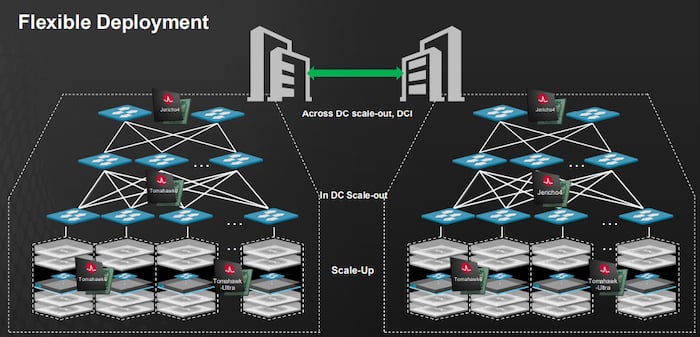
A flexible deployment combining Jericho4, Tomahawk6, and Tomahawk-Ultra.
This unified architectural philosophy allows system designers to combine Tomahawk and Jericho elements depending on latency, scale, and geographical constraints. According to Broadcom, Jericho4 enables the construction of fixed-form-factor or chassis-based routers with up to 51.2 Tbps capacity using the same foundational silicon. The platform also supports flexible topologies for central switching planes, modular fabric elements, or disaggregated compute-node interconnects.
Infrastructure for the Post-Monolithic Era of AI
Broadcom sees Jericho4 as a maturation of Ethernet into a fully viable transport for the most demanding classes of AI workloads. Where once Infiniband or proprietary fabrics dominated scale-out discussions, Broadcom’s Ethernet-first strategy offers a path to unified infrastructure across AI and non-AI domains.
All images used courtesy of Broadcom.