Facebook
 Google
 GitHub
 Linkedin
The Cooling Problem That Could Bottleneck AI
A South Korean startup, KoolMicro, is betting that liquid cooling built into the chip package itself is the only way to handle the next generation of GPU heat loads.
The numbers are stark. In 2022, NVIDIA's H100 GPU had a thermal design power (TDP)—the maximum heat a processor is expected to generate—of 700 watts. By 2024, the GB200 had pushed that figure to 1,200 watts.
NVIDIA's forthcoming Rubin Ultra system, expected in the second half of 2027, is projected at 3,600 watts per chip, with full rack configurations anticipated to reach 600 kilowatts. To put that in perspective, a single 2027 AI server rack could consume as much electricity as roughly 20 average American homes.
This escalating heat load is not an incidental engineering problem. It is, increasingly, the central constraint on how fast AI hardware can advance. Chip designers can only push transistor density and clock speeds so far before thermal throttling—the automatic reduction of performance to prevent overheating—negates the gains. How the industry cools its semiconductors will, in large part, determine how much computing power it can deploy.
Into this context arrives KoolMicro—a startup founded in February 2022 and headquartered in Daejeon, South Korea, with an R&D center in Dongtan. The company is developing what it calls Integrated Manifold MicroChannel cooling, or IMMC—a liquid cooling architecture that routes coolant directly through microscopic channels etched into or affixed to the chip package, rather than applying cooling to the outside of a finished module
Conventional Cooling Methods
To understand what KoolMicro proposes, it helps to understand how existing approaches work—and where they fall short.
Conventional air cooling relies on heatsinks and fans to dissipate heat from the top surface of a chip package. It is cheap, reliable, and increasingly inadequate for chips above a few hundred watts. Cold plate cooling, the current industry standard for high-performance data centers, circulates water through a metal plate pressed against the chip's external lid.
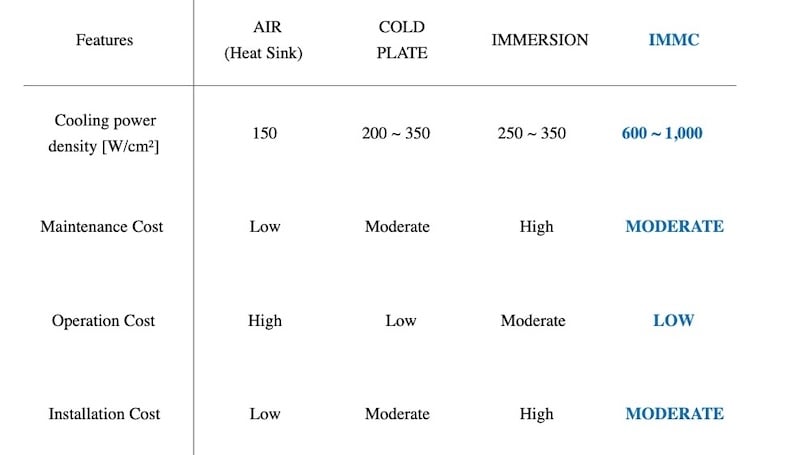
Table compares IMMC versus other cooling methods.
Companies such as Jetcool, Zutacore, and Asetek sell variants of this approach. Immersion cooling submerges entire servers in dielectric fluid, which handles heat more aggressively but introduces significant infrastructure and maintenance costs.
The IMMC Approach
The IMMC approach is categorically different. Rather than cooling the outside of a finished package, it places the cooling structure between the chip die and the rest of the package, or in more advanced versions, integrates it directly into the wafer itself.
Coolant—water, in KoolMicro's current design—is sprayed vertically downward through a manifold structure, passes through channels approximately the width of a human hair, absorbs heat from the die surface, and drains back up through adjacent manifold outlets. The manifold design keeps flow paths short, which reduces pressure drop and allows uniform temperature distribution across a larger die area.

KoolMicro’s IMMC features a patented liquid cooling system.
The company's internal test data, measured against a heating block under controlled conditions with an inlet temperature of 25°C and a chip temperature limit of 95°C, shows heat flux handling exceeding 500 W/cm². KoolMicro's competitive analysis, benchmarked against published data from TSMC, Purdue University, Jetcool, Liquidstack, and Zutacore, claims the highest cooling capability of any single-phase liquid cooling solution at 4.8 kilowatts per GPU—with a chip junction temperature of 83°C at 4 kilowatts of load.
For comparison, Jetcool's published figure at that load is 117°C, and TSMC's research prototype reaches 150°C. The company reports its coefficient of performance—the ratio of heat removed to pumping power consumed—is approximately ten times better than a conventional microchannel cold plate.
These figures come from early prototypes, and independent third-party validation has not yet been published. The company acknowledges its current hardware is not a final production design, and notes room for further improvement.
Kool Micro Background
KoolMicro was founded by Yunhyeok Im, who holds a Ph.D. in mechanical engineering from KAIST (Korea Advanced Institute of Science and Technology). He spent time as a research faculty member at Georgia Tech. Im previously worked as a principal engineer at Samsung Electronics, where his focus was semiconductor thermal design. His co-founder and chief strategy officer, Wonyoung Maeng, has a background in industrial engineering and strategic planning, also with Samsung.
The company is three years old and has raised $1.1 million USD in seed funding. It holds 17 patents across the United States and South Korea—two U.S. patent applications and one granted Korean patent covering the internal manifold structure, chip and package-level integration methods, and flow control techniques, with additional U.S. applications pending.
In terms of demonstrated output, KoolMicro has built three successive prototypes handling 1,100, 1,500, and 2,000 W/cm² respectively. In a publicly verifiable benchmark, an IMMC-1 cooler applied to an Intel Core i9-14900KS CPU produced a CINEBENCH R23 multi-core score of 40,084 points—placing it in the top 1% of results for that processor model on the CINEBENCH global leaderboard at the time of testing.
Three Product Tiers
KoolMicro structures its product line in three tiers of increasing integration.
IMMC-1, its current and most near-term product, is a discrete cooler: a standalone module that replaces a conventional cold plate on an existing server motherboard. It requires no changes to chip packaging or wafer fabrication and is therefore the most straightforward to bring to market. Target customers include server OEMs (Dell, HP, Lenovo, Supermicro), hyperscale cloud operators (AWS, Google, Meta, Microsoft), and AI chip vendors (NVIDIA, Broadcom, Marvell).
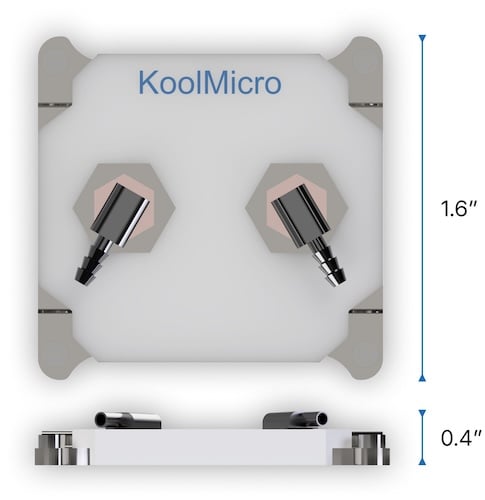
The IMMC features a slim design that saves space, enabling more GPUs to fit in a server rack.
IMMC-2 is a package-integrated cooler, where the manifold microchannel structure is incorporated into the chip package itself during assembly. This tier is aimed at package assembly houses such as ASE and JCET, as well as advanced packaging customers.
IMMC-3 represents full wafer-level integration, where cooling structures are fabricated directly into the silicon wafer during the manufacturing process. This would require collaboration with wafer fabs such as TSMC, Intel Foundry, Samsung, and Micron. It is the furthest from commercialization but also potentially the most thermally efficient.
$4.3 Billion Market by 2030
KoolMicro estimates the total addressable market for high-performance semiconductor cooling modules at $4.3 billion by 2030, with the liquid cooling subset at $1.2 billion. Its stated revenue goal is $441 million by 2030, implying a 36% share of the liquid cooling segment—an aggressive target for a company that has not yet shipped a commercial product.
The thermal management market for AI hardware is crowded but largely still anchored to cold plate and immersion approaches. What differentiates the IMMC architecture, if the performance data holds up at scale, is the combination of high heat flux handling and relatively conventional infrastructure requirements.
Unlike immersion cooling, it does not require tanks, specialized dielectric fluids, or major data center retrofits. Unlike conventional cold plates, it is designed to scale to the heat densities projected for 3D-stacked logic and memory packages, where hotspot power density is expected to exceed 1,000 W/cm² by the mid-2020s according to the IEEE Heterogeneous Integration Roadmap.
The company has established a U.S. presence through two offices: a research center in Atlanta (KARC) and a customer-facing sales and support hub planned for San Jose (KSCC, targeted for 2025). It has exhibited at CES in Las Vegas and presented technical work at Supercomputing 2025 in St. Louis.
From Prototype to Volume Production
KoolMicro's technical claims are plausible—the underlying physics of manifold microchannel cooling are well-established in academic literature, and the company's founders have relevant credentials. But there is a significant distance between a working prototype and a product that ships in volume into data centers operated by hyperscalers with demanding qualification requirements.
The gap between IMMC-1's discrete cooler and IMMC-3's wafer-level integration represents not just an engineering challenge but a business development challenge: each tier requires a different set of manufacturing partners, customer relationships, and integration certifications. None of those relationships appear confirmed in KoolMicro's public materials.
The company's revenue projections—zero in 2024, growing to KRW 346.6 billion (approximately $250 million USD) by 2029—are optimistic for a firm that has raised just over one million dollars. Achieving them would require both flawless technical execution and successful penetration of procurement cycles at organizations that qualify suppliers over years, not months.
Next Couple Years Will Tell
At this stage, what KoolMicro has to offer is a technically credible approach to a real and growing problem, a founding team with relevant industrial experience, and early prototype data that compares favorably against published competitors. Whether that is enough to build a viable business in a market that will attract well-capitalized incumbents is a question the next two to three years will begin to answer.
All images used courtesy of KoolMicro.