Facebook
 Google
 GitHub
 Linkedin
4 Standout Microcontrollers From Embedded World 2026
These devices are redefining what an MCU can do in the age of edge AI, advanced connectivity, and software-defined vehicles.
Microcontrollers often steal the stage at Embedded World, and this year's event was no different. In this roundup, however, we spotlight just a few standout MCUs announced at the show from Texas Instruments, STMicroelectronics, Infineon, and SiliconAuto. These new devices spanned a wide range of applications, including edge AI, USB-C power delivery, software-defined vehicles, and beyond.
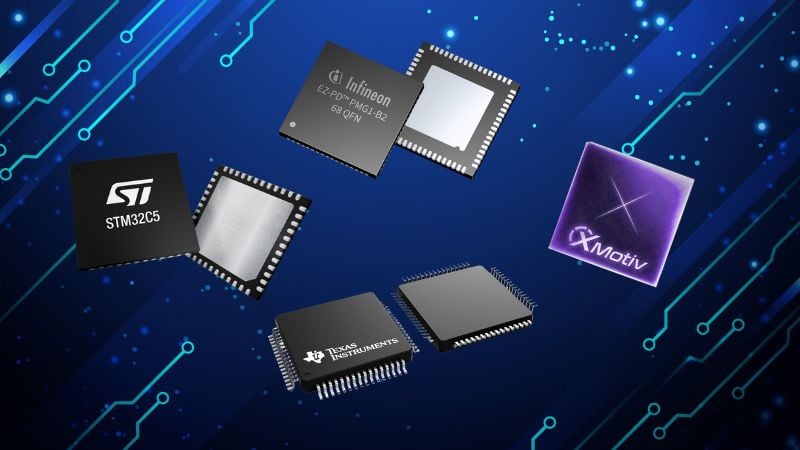
These announcements illustrate how the microcontroller industry has evolved from small, discrete general-purpose devices to high-performance processors. What's more, they still check the boxes for simplicity, low power, and low cost while delivering the AI, safety, security, and performance necessary to meet both general-purpose applications and mission-specific requirements.
TI Adds to Edge AI Ecosystem With Integrated NPU
Texas Instruments introduced two microcontrollers with the company's integrated TinyEngine neural processing unit (NPU) for edge AI.
The TinyEngine NPU is a dedicated hardware accelerator that runs AI models with up to 90 times lower latency and 120 times lower energy per inference than non-accelerated MCUs. The NPU features 2.56 GOPS of computation performance for real-time edge AI inference. It is available in 8, 4, and 2-bit options, as well as mixed-precision configurations. The NPU supports convolutional, fully connected, and pooling layers.
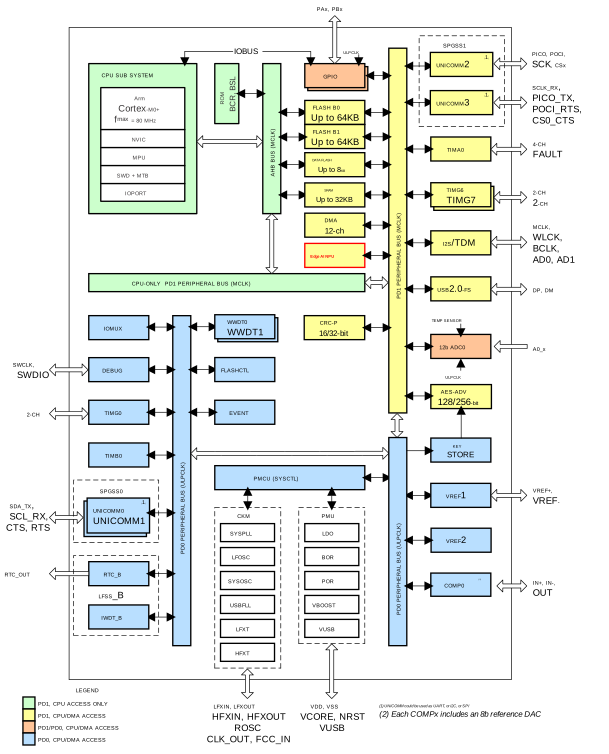
Block diagram of the MSPM0G5187 (Click to enlarge). Image used courtesy of Texas Instruments
The two MCUs, the MSPM0G5187 and AM13Ex microcontrollers (datasheets linked), are designed for real-time and general-purpose edge applications that require non-server-bound AI capabilities. The MSPM0G5187 includes an Arm Cortex-M0+ running at 80 MHz, with 128 kB of flash and 32 kB of RAM. For security and connectivity, TI baked in AES encryption, a comparator, a DAC, DMA, MATHACL, an NPU, an RTC, and USB 2.0. The AM13Ex family is anchored by an Arm Cortex-M33 running at 200 MHz, with 512 kB of flash and 128 kB of RAM. It, too, includes AES encryption, along with CAN FD, CRC, a comparator, DAC, DMA, and RTC.

Block diagram of the AM13E230x MCUs (View enlarged image on page 5 of the datasheet). Image used courtesy of Texas Instruments
TI offers developers generative AI support for the MCUs integrated with the CCStudio IDE. The code base includes more than 60 models and application examples. The MSPM0G5187 is available for purchase in production quantities, and the AM13E23019 MCU—the first in the AM13Ex family—is available in pre-production quantities.
ST Pumps Up Entry-Level MCU Performance Bar
STMicroelectronics showcased the STM32C5 microcontroller at the show, which represents the high-performance levels now available from entry-level MCUs. ST gained price and performance improvements by manufacturing the MCU on its 40-nm process line. The smaller geometry delivers an MCU that operates, according to ST, “noticeably faster than many entry-level chips used today.”
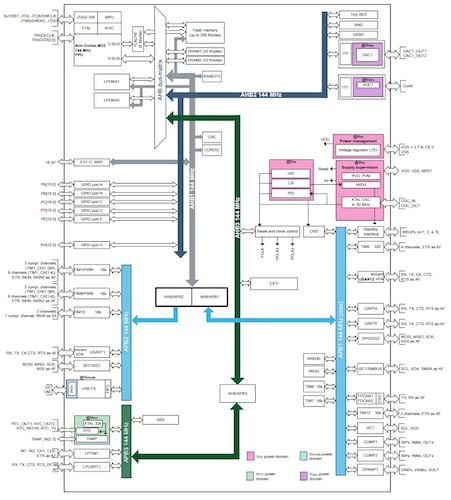
Block diagram of the STM32C5 MCU (View enlarged image on page 6 of the datasheet). Image used courtesy of STMicroelectronics
This microcontroller (datasheet linked) is built around an Arm Cortex-M33 core running at 144 MHz, enhanced with an FPU and DSP accelerators for efficient numeric and signal processing. It offers 1 MB of flash memory and up to 256 kB of RAM. The device includes a rich set of peripherals, including Ethernet, USB, I3C, FDCAN, and OCTOSPI interfaces, as well as analog capabilities, including up to three ADCs, two DACs, two comparators, and an operational amplifier. It is also designed with security in mind, targeting PSA Level 3 and SESIP Level 3 certification, and offers optional side-channel, attack-resistant hardware cryptography with secure key storage.
The new MCU delivers three times the performance of a typical entry-level Cortex M0+ based on a 593 CoreMark benchmark score. It offers low dynamic power consumption at <80 µA/MHz. The internal RC oscillator is calibrated to 1% within a -20°C to 105°C temperature range.
Infineon Adds Power With Single-Port USB Type-C PD MCU
Infineon launched the “industry’s first highly integrated single-port USB Type-C power delivery (PD) microcontroller.” The EZ-PD PMG1-B2 is an Arm Cortex-M0 processor that comes with an integrated 55-V buck-boost controller for charging 2- to 12-cell lithium-ion battery packs.
USB Type-C power delivery is an increasingly important feature in cordless products. The new chip targets applications, such as cordless home and garden power tools, cordless appliances, e-bikes, scooters, drones, robots, and more.
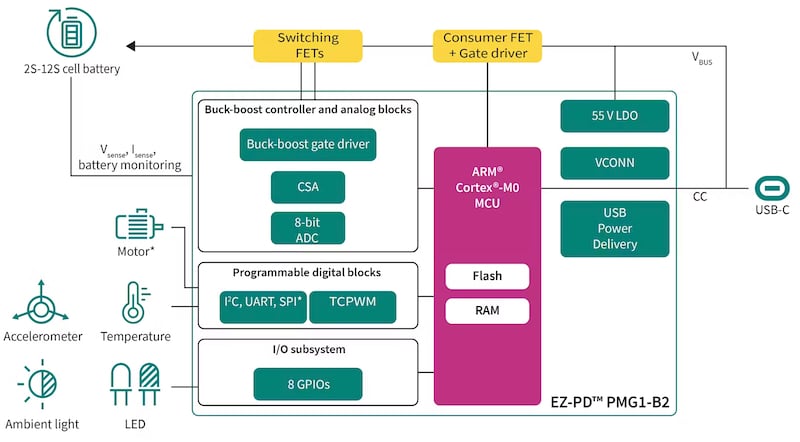
Block diagram of the EZ-PD PMG1-B2. Image used courtesy of Infineon
The MCU features 128 kB of flash memory and 8 kB of SRAM. It includes essential peripherals such as ADCs, PWMs, UARTs, I²Cs, and SPIs, along with timers for precise control and communication. The device also supports programmable power supply switching frequencies ranging from 200 kHz to 700 kHz, enabling flexible power management design. Additionally, it operates across a wide input voltage range of 4.5 V to 55 V, making it suitable for a variety of power environments.
The software stack includes USB PD stacks and proprietary software for application customization. Power supply bill of materials (BOM) count (and cost) is reduced by the high level of peripheral integration. The chip includes the MCU, USB PD, a high-voltage LDO, a buck-boost battery charger, and battery protection blocks in a 68-pin QFN package. To help developers utilize the chip, Infineon also announced a soon-to-be-available 240-W USB-C PD 3.2 reference design with Infineon’s PSOC C3 and 100-V CoolGaN G5 transistors.
SiliconAuto's Automotive- and Robotics-Capable MCU
SiliconAuto has added the XMotive M3 to its MCU portfolio. The chip is powered by an Arm Cortex-M33 core and is built for functional safety, cybersecurity, and real‑time control requirements in automotive and robotics applications. SiliconAuto designed the MCU to offload sensor data handling and pre‑processing from the central computing system of intelligent and software-defined vehicles (SDVs).
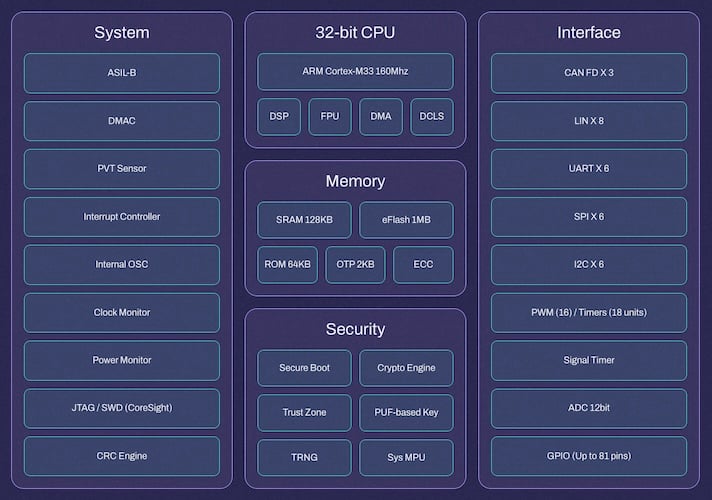
SiliconAuto's MCU targets automotive and robotics applications. Image used courtesy of SiliconAuto
This MCU is built around an Arm Cortex-M33 core running at 160 MHz, delivering strong performance for real-time embedded applications. It integrates 1 MB of embedded flash memory and 128 kB of SRAM. Designed for automotive use, it meets ISO 26262 ASIL-B safety standards, ensuring reliability in safety-critical systems. The device also supports real-time operation with fast boot capabilities, enabling immediate system readiness.
SiliconAuto is new to the industry, with the XMotive M3 being its first product. The MCU's target applications include adaptive driving beam (ADB) headlights, body control modules, and other automotive mission-critical applications. SiliconAuto is also targeting modern robotics applications with requirements similar to those of SDVs. The chip utilizes Siemens’ SiliconPilot with PAVE360 digital twin technology for software and systems development.
Related Content