Facebook
 Google
 GitHub
 Linkedin
Chipmakers and Research Power Houses Partner to Prep for AI Boom
In the next 10 years, the AI hardware market is projected to grow from $31 billion to $624 billion. Here's how companies and researchers are building resources to accommodate this new age of AI.
As the demand for AI-driven technologies surges, semiconductor companies and research institutions are forging powerful alliances to push the limits of chip innovation. Here, three such alliances highlight a growing emphasis on advancing semiconductor capabilities, sustainability, and AI hardware efficiency to lay the groundwork for the next generation of computing.
ASML and Imec to Drive Semiconductor Innovation in Europe
ASML and Imec have entered a five-year strategic partnership aimed at advancing semiconductor research and sustainable innovation in Europe. The collaboration brings together ASML’s state-of-the-art semiconductor manufacturing equipment and Imec’s research infrastructure to push the boundaries of chip technology, particularly in sub-2nm processes. The partnership builds on a 30-year history of cooperation between the two organizations and aligns with Europe’s strategy to strengthen its semiconductor ecosystem.
ASML will provide key lithography technologies, including high-NA EUV systems, alongside significant funding for Imec’s research initiatives, emphasizing sustainability. Imec, in turn, will contribute its NanoIC pilot line and serve as a bridge between semiconductor innovation and the European industry, facilitating the prototyping and evaluation of advanced semiconductor solutions.
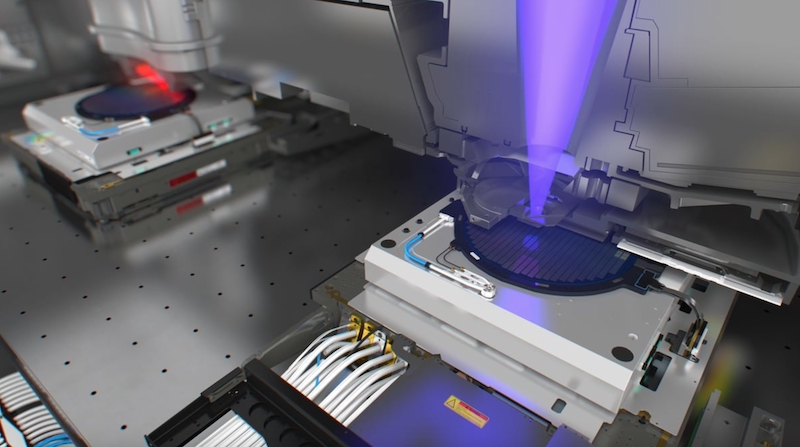
In a lithography machine, a chip wafer is exposed to deep ultraviolet (DUV) or extreme ultraviolet (EUV) light. Image used courtesy of ASML
The collaboration targets several key technologies, including sub-2nm semiconductor manufacturing, silicon photonics, advanced memory solutions, and packaging technologies for next-generation computing and AI applications. Notably, for the first time, Imec researchers will have direct access to high-NA EUV technology at their own facilities. The agreement, running from 2025 to 2030, is supported by multiple funding sources, including ASML’s direct investment, the EU Chips Act, and contributions from the Flemish and Dutch governments.
While immediate product commercialization is not the focus, the partnership lays the groundwork for future advancements in industries such as AI, telecommunications, and automotive.
Qualcomm Acquires Edge Impulse
At Embedded World 2025, Qualcomm Technologies announced its acquisition of Edge Impulse, marking a significant expansion of Qualcomm’s AI-powered IoT ecosystem. This acquisition supports Qualcomm’s Dragonwing initiative, which integrates hardware, software, and services to enhance edge AI development.
Edge Impulse, founded in 2019, is known for its no-code platform that enables developers to collect data, train machine learning models, and deploy them across various edge devices. With over 170,000 developers and strong industry partnerships, Edge Impulse is a leader in democratizing edge AI. The acquisition aims to streamline AI model deployment, expand Qualcomm’s presence in industrial IoT, and accelerate AI-powered applications across multiple sectors.
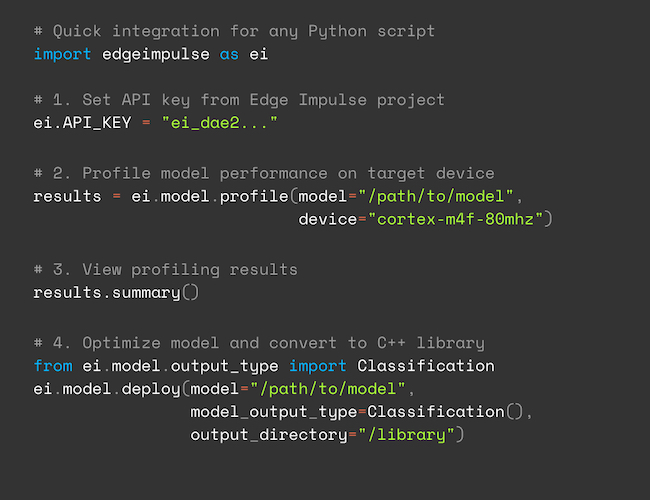
Edge Impulse's Edge AI platform can integrate with existing workflows and development tools. Image used courtesy of Edge Impulse
The partnership focuses on integrating Edge Impulse’s AI development tools with Qualcomm’s Dragonwing processors and AI Hub ecosystem, enhancing on-device intelligence for industrial automation, healthcare, smart retail, energy management, and security. Qualcomm contributes high-performance AI processors, ML optimization platforms, and an extensive developer ecosystem, while Edge Impulse brings its automated ML tools, broad device support, and expertise in resource-efficient AI models.
The roadmap includes early integration with Dragonwing processors (QCS6490 and QCS5430), followed by expanded hardware support, developer-focused initiatives, and enterprise adoption of scalable edge AI solutions.
GlobalFoundries and MIT Partner to Advance AI Chips
GlobalFoundries (GF) and the Massachusetts Institute of Technology have announced a partnership that focuses on advancing semiconductor technologies for artificial intelligence applications. This research agreement strengthens their longstanding collaboration with research efforts led by MIT’s Microsystems Technology Laboratories (MTL) and GF Labs.
The partnership aims to improve chip performance and efficiency, with initial projects leveraging GF’s silicon photonics technology for data center power efficiency and GF’s 22FDX platform for low-power AI computing at the edge. By combining MIT’s academic expertise with GF’s industry-leading semiconductor platforms, the collaboration is expected to accelerate innovation in AI chips while also contributing to workforce development in the semiconductor field.
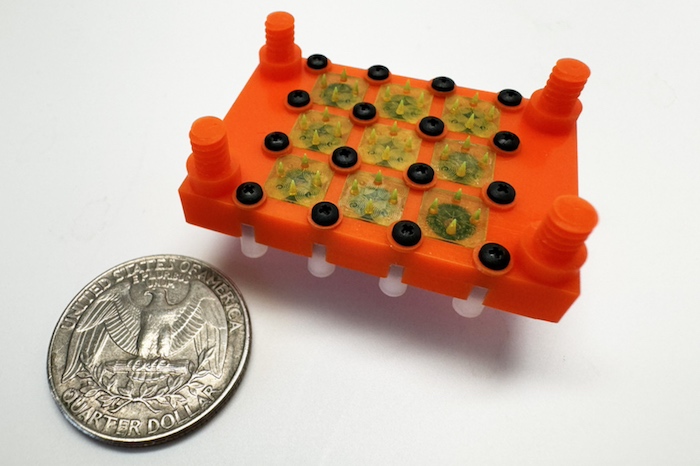
MIT’s Microsystems Technology Laboratories recently produced the first fully 3D-printed, droplet-emitting electrospray engine. Image used courtesy of MIT
The research focuses on power-efficient AI hardware solutions, targeting data centers, edge computing devices, and broader semiconductor applications such as mobile computing, automotive, energy, and cloud computing. GF’s silicon photonics technology will enable monolithic integration of RF SOI, CMOS, and optical features, improving efficiency in data centers, while its 22FDX platform will support low-power AI applications in mobile and IoT devices.
Related Content