Facebook
 Google
 GitHub
 Linkedin
Espressif Unwraps Open-Source Device-to-Cloud-to-Phone IoT Platform
The rebuilt platform puts the previously closed cloud backend under an Apache 2.0 license and runs on AWS serverless services in a customer's own account.
Espressif Systems has announced ESP RainMaker Neo, a ground-up rebuild of its IoT platform that, for the first time, open-sources the entire device-to-cloud-to-phone stack, including the cloud backend that had remained proprietary since the platform launched in 2020. The Shanghai-based chipmaker released the backend under the Apache 2.0 license and designed it to deploy on AWS serverless services inside a customer's own cloud account.
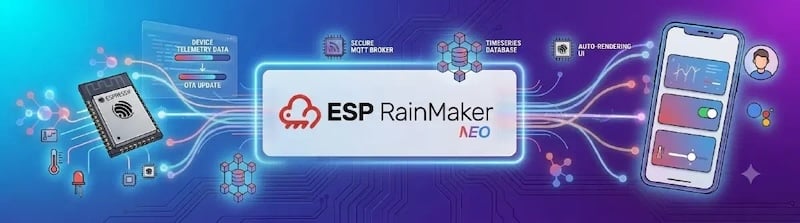
ESP RainMaker Neo is a new open source implementation of ESP RainMaker.
The existing platform continues as ESP RainMaker Classic and remains supported, but the two are not deployment-compatible. Espressif recommends Neo for new product development rather than as a migration path.
What's in the Stack?
The open-source release spans four main components on GitHub: the cloud backend and admin dashboard, written in Go; a device firmware SDK with examples for Espressif's ESP32-series SoCs; a TypeScript phone-app SDK; and ESP RainMaker Home, a reference mobile app available for iOS and Android.
Full HTTP and MQTT API references are published alongside the code. Device-side APIs remain largely similar to Classic's, and the hybrid mobile SDK is the same one used today with an additional transport layer for Neo, which should shorten the learning curve for teams already shipping on the platform.
The ESP RainMaker Neo platform covers the standard connected-product checklist, including device registration and user association, remote control and telemetry, time-series data, schedules, automations, device grouping, over-the-air updates, and fleet management.
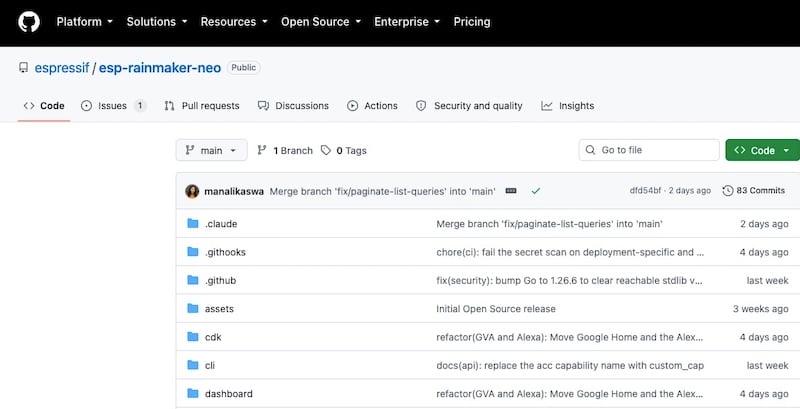
The Espressif ESP RainMaker Neo GitHub page
Matter support runs through all three tiers, from the ESP-Matter SDK on the device to commissioning and control in the mobile SDKs, and the cloud extends Matter with Fabric capabilities that let the backend interact securely with devices on the RainMaker Matter Fabric.
Developers can start three ways: a hosted public deployment on Espressif's own infrastructure that requires no cloud setup, a packaged backend for their own AWS account, or a full build from source.
Open-Source Backend
Since its 2020 debut on the ESP32-S2, RainMaker has offered open firmware, apps, and dashboards, but the cloud backend was a black box reachable only through documented APIs. Opening it changes what teams can do with the platform.
They can audit the code that handles their device fleet, customize any layer, and run the system without depending on Espressif. The company adds that documented specifications and extensive automated test coverage are intended to make the codebase safe for developers, and for AI coding tools, to extend.
In the company’s announcement, Espressif’s founder and CEO, Teo Swee Ann, said that in open-sourcing the stack, the company is aligning around its broader goal to democratize connected-device development, thereby making production-grade IoT more accessible to everyone.
Teams with cloud and embedded expertise, Espressif argues, can operate and maintain the platform independently, and that a fully open stack lets product companies differentiate on the platform itself without building foundational infrastructure from scratch.
Espressif still monetizes through an optional Enterprise plan that layers on technical support, SLAs, single sign-on, role-based access control, audit logs, and its ESP Insights device-observability service.
Leaning on AWS Serverless
Neo's architecture reflects how much AWS has changed since the original RainMaker was designed around the capabilities and pricing of roughly 2020. Where Classic built custom infrastructure to work around early limitations—Espressif avoided AWS IoT's native OTA service on cost grounds, for example—Neo relies directly on native AWS IoT services: Device Shadow for state, Thing Groups for organization, AWS IoT OTA for updates, and IAM-level access control for user and device permissions.
The result, per Espressif, is a leaner implementation with less RainMaker-specific infrastructure to maintain, one that inherits the scalability and security of the underlying AWS services.
Because the platform is serverless, there are no servers to provision or scale as a device fleet grows, and costs follow the pay-as-you-go model that Espressif says keeps the platform viable for cost-sensitive connected products. Deploying in the customer's own AWS account also keeps infrastructure, data, and access policies under the customer's control, a distinction from typical managed IoT platforms where fleet data lives in the vendor's cloud.
All images used courtesy of Espressif.