Facebook
 Google
 GitHub
 Linkedin
Exclusive Interview—AMD Discusses Edge AI, Embedded x86, Adaptive SoCs, and More
In this exclusive Embedded World 2025 interview, we talk to AMD’s Kirk Saban about edge AI, ASICs vs. FPGAs, Adaptive SoCs, embedded x86, and the outlook ahead.
This year’s Embedded World 2025 trade show in Nuremberg, Germany was a huge success, and an important event for our industry’s leading technology suppliers. AMD is no exception and I was pleased to have an exclusive conversation at the show with Kirk Saban, Corporate Vice President for Products, Software, and Solutions at AMD.
At Embedded World 2025, All About Circuits’ Jeff Child interviews Kirk Saban, AMD’s CVP for Products, Software, and Solutions.
In our interview, Kirk and I focused on a variety of topics. We talked about how AI is being implemented in today’s embedded markets, how innovation continues to advance at both the cost-optimized side of FPGAs as well as the advanced realm of Adaptive SoCs, where hardened IP and RF functionality offer key opportunities.
We also tried to make sense of the “ASIC versus FPGA” question, and the dynamics of embedded x86 technology in today’s market, and where things are headed in the year ahead.
Jeff Child, All About Circuits: Let’s start at a high-level view. What do you see as some of the most important technology and business trends impacting the embedded systems industry?
Kirk Saban, AMD: If you look at what's going on in the market today, obviously there's a huge amount of talk about AI. Today it's really been fundamentally predicated mostly on training models in the cloud. But we see AI moving to the edge over the next few years, and we expect that to be a megatrend.
If you look at our portfolio of product solutions across AMD Embedded, we think we're pretty well set up to be able to capitalize on that trend that's coming.
Child: That leads into my next question. Artificial intelligence…AI…has become an aspect of all corners of today's electronics industry. And that’s true for the embedded industry as well. As you said, AMD is well set up for AI moving to the edge. And more specifically, I know that AI processing is a part of the story for AMD, both for your embedded processors and for your Adaptive SoCs and FPGAs. In that context, can you dive deeper on how you are thinking about AI these days? And how is AI represented in AMD’s latest and greatest products?
Saban: On the embedded side of AI, what we see there is the need for our customers to be able to infuse some amount of AI into the solutions that they've traditionally taken to the market. And how they can leverage AI to make their products more efficient, more effective, and, in turn, achieve an overall better ROI for their customers.
In terms of where we're seeing AI opportunities, obviously, automotive has been leading the charge there. But we expect to see that proliferate into other markets as well—like industrial and the aerospace industry, and test and measurement—all those types of areas taking advantage of AI.
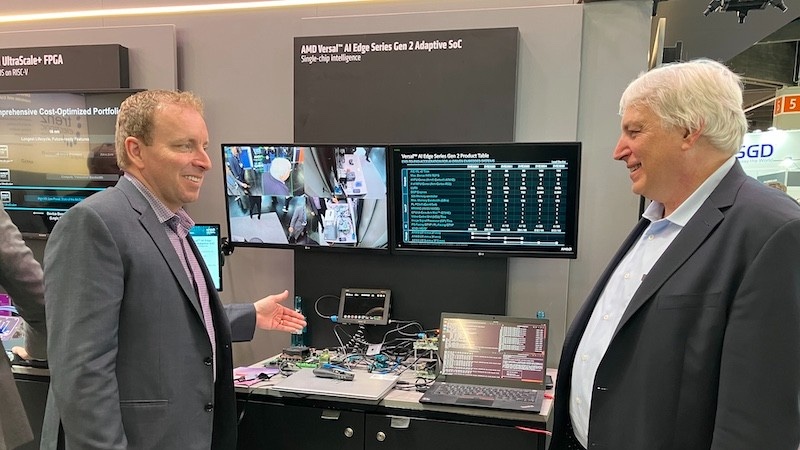
At Embedded World 2025, AMD’s Kirk Saban discusses AI with Jeff Child in front of the company’s AMD Versal AI Edge Series Gen 2 Adaptive SoC demo.
Saban: For our solutions, it's really not just about bulk AI processing. It's really about doing that pre- and post-processing and making real-time decisions at the edge—where you don't have the time and latency to be able to send the data back to the cloud to be able to make a decision for you. That means putting the right level of edge AI processing in our devices at the right power threshold. A lot of these edge applications are extremely power sensitive. Those are some of the key AI trends that we see.
As the industry evolves, we'll tailor some of our products to meet those market needs. But I think if you look at the portfolio we have now, across—as you mentioned—FPGAs, Adaptive SoCs, and our Embedded x86 portfolio, that gives you a whole broad range of products across different power envelopes and different price points to address a wide range of solutions that design engineering customers need.
Child: Let's talk about ASICs versus FPGAs. This choice has always been a moving target. I remember even back as far as the ‘90s, people were lamenting the cost, design time, and complexity of ASICs. This opened the door to choosing FPGAs over ASICs for many use cases. Fast forward to today, and ASICs are alive and well for situations where the high volumes can justify them. In your mind, how do you look at this FPGA versus ASIC question these days? Or do they even have a place alongside one another in some situations?
Saban: All of the above are true. I've been in this business for more than 20 years. And I don't think things have materially changed in that space over that time. Like you mentioned, when you get to a certain volume threshold, and your application is stable, and you're not needing to make field upgrades, then it does make sense to do an ASIC.
Now, the costs of ASIC at the more advanced process technologies continue to go up and up and up. It really comes down to what the customer's use case is. I think the benefits of FPGAs have always been quick time-to-market. We give you a platform that you can scale and get your product out with very, very quickly.
Meanwhile, FPGAs are adaptable, so they’re great for things like standards that have not materialized, standards that are in flux. AI is another great example where things are changing very, very quickly. If you're building an AI ASIC, it’s only appropriate for a fixed set of models.
So, those are all reasons why FPGAs are compelling in those markets. What we've seen over the years is things just always get more complicated and customers need to evolve with that. But in terms of the economics of FPGAs versus ASICs, the basics haven't fundamentally changed, at least from my perspective.
Child: A single FPGA or Adaptive SoC embeds an incredible amount of functionality and performance on a single chip. Just a couple decades ago, such capabilities required a large board-level system. Could you talk about where you see the state of the art in FPGA technology, both at the cost-optimized end of the spectrum, and at the leading edge performance and integration represented by Adaptive SoCs. And you can give AMD product examples at both ends of that spectrum?
Saban: Here at Embedded World, we're demonstrating two of our newest products for the first time publicly.
Spartan UltraScale+ is our latest and greatest low-cost FPGA as part of our cost-optimized portfolio. And, as you mentioned, that's the space that's been around for many years. And we continue to invest there.
The product complexity goes up here just like everything else, so that means more modern interfaces like DDR5 and PCI Express Gen 4. But these products are very capable. There's a lot of things a customer can put in that, whether it's a neural network processor or something else. We have soft RISC-V processor cores that we're demonstrating here today. All this gives our engineer customers the flexibility to be able to do whatever they need for their particular application.
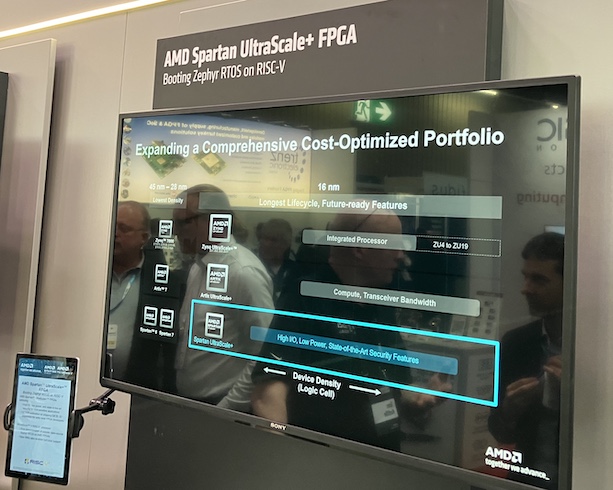
In this Embedded World AMD demo, a Spartan UltraScale+ is booting the Zephyr RTOS on the FPGA’s RISC-V cores.
Saban: It’s interesting to look at how the market has evolved. Looking back to the day when we were a pure-play FPGA provider, we did and still continue to invest in those FPGAs. But now, as you mentioned, we have the Versal Adaptive SoCs, which have more hardened intellectual property. You can almost argue that they're like a programmable ASSP.
We have different products tailored for different market applications, where we've hardened a lot of the higher-end IP. That IP would take up a huge amount of the programmable logic if you're going to implement it as soft IP.
Meanwhile, we've continued that evolution in things like our Zync RF SoC platform that we had at 16 nanometers. Then later this year, we'll have our Versal RF Series platform, which extends on that and builds on it with integrated RF-DACs and RF-ADCs.
"Again, all of this speaks to that integration play that you were talking about. This is how you bring together digital signal processing, RF, with embedded processing, all those kinds of things in a single-chip solution. Our engineer customers do find that kind of thing very compelling."
Child: Here we are in March 2025, getting near the tail end of the first quarter of the year. What’s your outlook about the year ahead—both for industry in general and for AMD in particular? How do you see AMD’s position in the market evolving or changing in the year ahead? Are those trends distinct between AMD’s embedded processor side of things and the FPGA/Adaptive SoC side?
Saban: A big thing we've been focused on, as part of the Embedded Business Unit with AMD, is that we've now got responsibility for AMD's Embedded x86 portfolio. Just here this week at Embedded World, we launched the Embedded version of Turin processor, and actually won a show award for that. That’s a new area that we're pushing into.
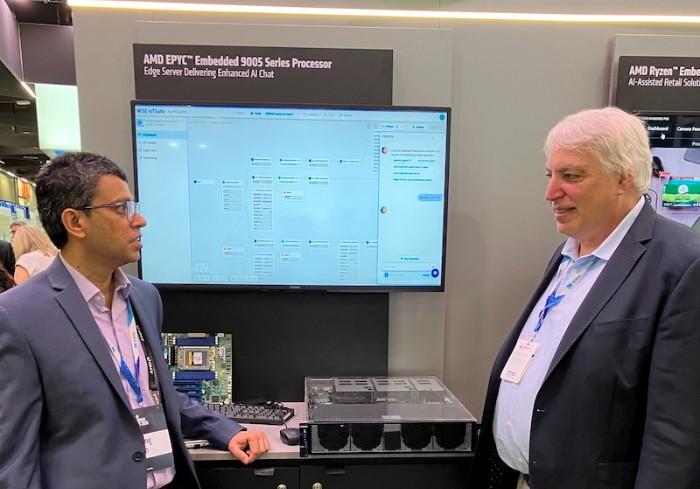
At the show, an AMD representative showed Jeff Child AMD’s demo for its newly announced Embedded 9005 Turin processor.
Saban: While AMD has not traditionally been a big player in the embedded x86 space, we do believe that we have the most compelling products from both a client and server perspective, and we're leveraging those as we go forward into the embedded space.
If you look at the entire embedded portfolio of products that we have now, we have a really strong, broad set of products with embedded processing capability from our lowest end Zync FPGAs—and even the Spartan devices I was talking about with a soft RISC-V cores—and then scaling that all the way up to multi-core and the hundreds of cores on embedded EPYC processors with Turin.
We can literally offer our customers almost any compute density that they need in the embedded space. We're very excited about getting AMD established as a player in the embedded x86 market and it’s going to be a big focus for us.
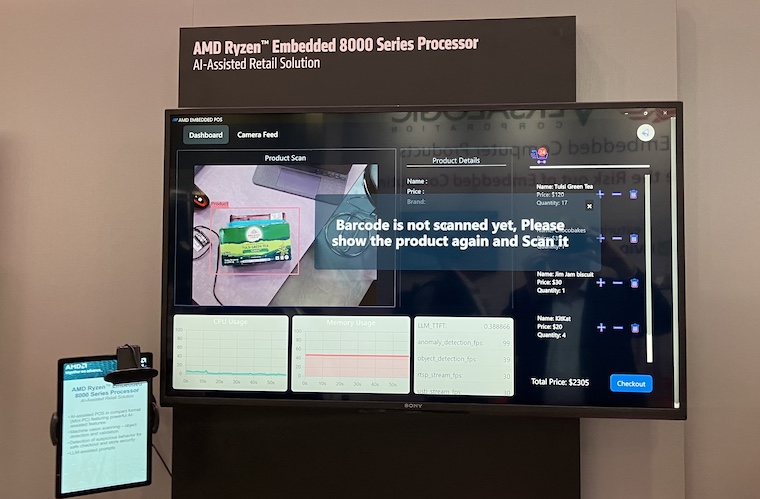
In this show demo at AMD’s booth, an Embedded Ryzen AI processor performs an AI-assisted retail task.
Saban: That breadth of products also extends to our Embedded Ryzen AI processors as well. It takes our AI story beyond just FPGAs and Adaptive SoCs into the embedded CPU space. You'll see a lot more from us over the next few years in that area. I'm sure we'll be back here at Embedded World 2026 next year, showing off some of those embedded x86 solutions as well. That's very exciting.
All images taken by All About Circuits at Embedded World 2025.