Facebook
 Google
 GitHub
 Linkedin
Five Design Wins Redefining Edge Intelligence, Connectivity, and Power
This roundup covers collaborations driving progress in AI processing, IoT radios, 5G NTN conformance, Auracast audio hardware, and indoor-light energy harvesting.
The edge keeps expanding in ways that can strain the usual hardware. You can’t just bolt on another wireless block or crank up the clock rate anymore; everything has to work together under tight power and space constraints. That’s why more vendors are partnering instead of going it alone. This week’s collaborations are a good example of how shared development is shaping the next generation of edge systems.
Five recent collaborations illustrate how shared development can accelerate complex hardware. Each partnership contributed to a different next-generation use case, including AI inference platforms, Matter-ready IoT systems, validated satellite 5G chipsets, long-range Auracast audio devices, and remotes that power themselves from indoor light.
Arteris FlexNoC Becomes the Backbone of Blaize’s Edge Architecture
Blaize has selected Arteris’ FlexNoC 5 interconnect as a key part of its edge AI platform. Blaize contributes a programmable architecture designed for multimodal workloads such as industrial vision, acoustic sensing, and language processing. Arteris provides the communication fabric that moves data efficiently between compute units while keeping power and area budgets under control.
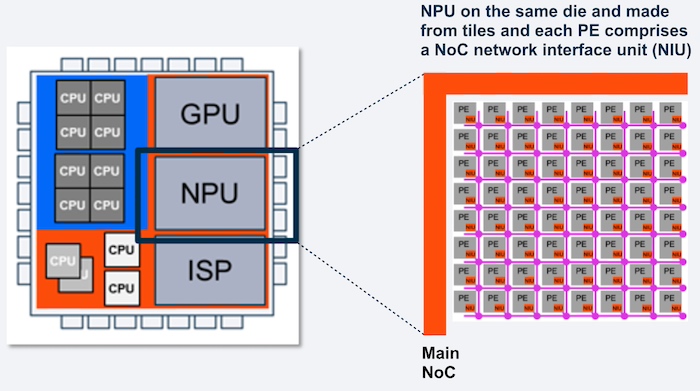
NoC tiling, a new feature with FlexNoC. Image used courtesy of Arteris
The integration allows Blaize to support higher model complexity without significantly increasing consumption or die size. FlexNoC offers bandwidth tuning, routing flexibility, and traffic management features that help maintain consistent latency for real-time inference. Together, the companies deliver a platform suited for edge deployments that need predictable performance under thermal and cost constraints.
IntelPro Builds a Matter-Ready SoC With Ceva’s IP
IntelPro has collaborated with Ceva to develop the new IPRO7AI SoC. The two companies pulled together several pieces that usually require separate chips. IntelPro handles the overall architecture, the security controller, the imaging path, and the on-chip neural processor. Ceva supplies the wireless foundation, including the Bluetooth Low Energy subsystem, the 802.15.4 stack, and the firmware that enables Thread, Zigbee, and Matter support. By splitting the work this way, the two companies ended up with a device that covers both short-range connectivity and local intelligence without piling on extra silicon.
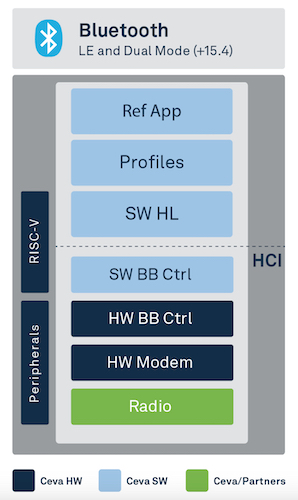
Ceva-Waves Bluetooth platform. Image used courtesy of Ceva
Intel’s finished chip target designs where space and power are limited, such as smart-home hubs, compact industrial endpoints, and small consumer devices. The chip includes a RISC-V security MCU for trusted setup, an NPU for running lightweight models at the edge, and built-in hooks for Matter onboarding. This single practical package handles networking, security, and basic AI tasks instead of juggling separate radios and coprocessors.
Samsung and R&S Complete Conformance Sweep
Samsung’s NR-NTN chipset has completed Release 17 conformance testing on Rohde & Schwarz platforms, showing compliant RF characteristics, resource-management responses, and protocol behavior required for satellite-routed 5G links. The assessment used the TS8980 conformance bench combined with TS-RRM and CMX500 signaling systems to reproduce link-budget conditions, channel dynamics, and timing profiles

The companies worked together to certify Samsung’s satellite-ready 5G chipset using Rohde & Schwarz conformance systems, completing the full Release 17 test suite. Image used courtesy of Rohde & Schwarz
These test results are an important step for satellite-based 5G, which must handle long signal paths, Doppler shifts, and moving orbital geometries. Validation ensures that devices designed with Samsung’s chipset can operate within global norms and prepare for commercial rollout, especially in remote-access and mobility applications.
Bettear Auracast Device Leverages Nordic SoC and RF FEM
Bettear’s B-RTX transceiver uses Nordic’s nRF5340 SoC together with the nRF21540 RF front-end module to create a handheld device capable of low-latency Auracast audio streaming. Bettear designs the audio system, user interface, and application features. Nordic provides the dual-core processor, the LE audio architecture, and the amplified RF path needed for extended range.
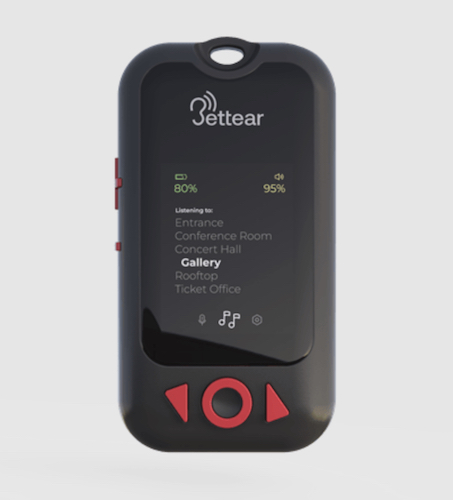
By using Nordic’s dual-core SoC and RF front end, Bettear created a portable Auracast device suited for venues needing reliable, low-latency audio. Image used courtesy of Nordic Semiconductor
It can broadcast or pick up Auracast streams, keeping the delay under forty milliseconds so speech still feels natural. People can listen through hearing aids, earbuds, or a wired headset, depending on the setup. A 1,400-mAh battery keeps it alive for long sessions—well over twenty hours in receive mode. Bettear designed it with public venues in mind, especially places like museums or university spaces where clear, consistent audio is important.
Google Uses E-peas PMIC for Light-Harvesting Remote
The Google TV G32 remote is shifting away from disposable batteries by pairing a small indoor-light photovoltaic cell with an E-peas power-management IC. Inside the G32 remote, Google integrated a small indoor-light PV panel and laid out the mechanical and interface parts around it. E-peas provides the power path with a PMIC that handles everything from capturing low-level light to maintaining the tiny storage cell and supplying a stable output. The arrangement lets the remote run off whatever light is already in the room rather than relying on replaceable batteries.

Google combined its PV-based remote design with E-peas’ energy-harvesting PMIC to create a G32 remote that runs on indoor light instead of disposable batteries. Image used courtesy of E-peas
With the power system reworked this way, the remote avoids the usual failure mode of drained batteries and allows the enclosure to be slimmer and fully sealed. It also shows where accessory design is heading; more living-room devices sit close to steady light sources and no longer need traditional batteries to stay functional.
Partnerships Solve Problems
In all of these collaborations, each company tackled a specific part of the problem—be it link fabrics, wireless stacks, satellite testing, audio transport, or energy harvesting—and the finished systems reflect that division of labor. The products that came out of it are more efficient and more capable, and they show how multi-company development is becoming the norm for edge designs that need to cover a lot of ground.