Facebook
 Google
 GitHub
 Linkedin
Forehead E-Tattoo May Help You Stay in the ‘Cognitive Goldilocks Zone’
Researchers at the University of Texas at Austin have developed a low-cost, wireless forehead e-tattoo that uses EEG and EOG signals to monitor mental workload in real-time.
In high-stakes professions such as aviation, medicine, and long-haul transportation, maintaining a mental state of “just right”—neither too strained nor too disengaged—can mean the difference between sharp performance and critical mistakes. Now, engineers at the University of Texas at Austin have developed a wireless, ultra-thin “electronic tattoo” for the forehead that could help users stay in this optimal zone of cognitive functioning.
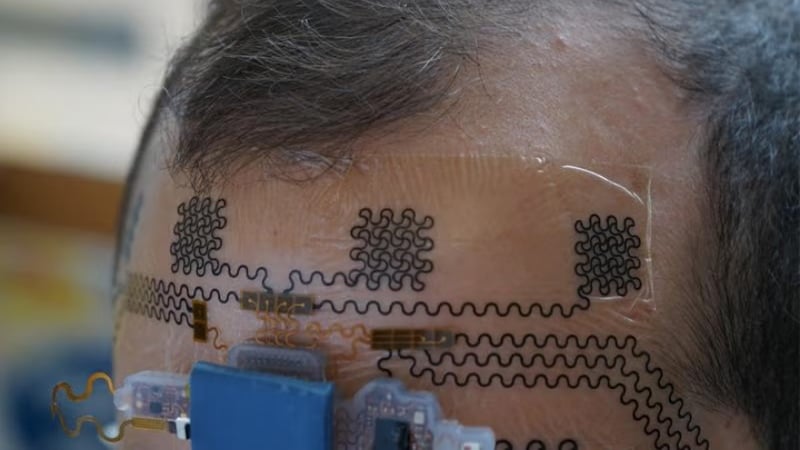
A prototype of the wireless forehead e-tattoo. Image used courtesy of the University of Texas at Austin
Dubbed the “forehead e-tattoo,” this flexible, skin-conforming sensor system wirelessly captures electroencephalography (EEG) and electrooculography (EOG) signals, offering a novel, real-time method for assessing mental workload. Unlike traditional EEG systems, which often involve cumbersome headsets, conductive gels, and price tags exceeding $15,000, this solution is not only more practical but also potentially transformative across various industries.
The Brain-Monitoring Wearable You’ll Actually Wear?
At the heart of the e-tattoo is an array of flexible electrodes made from graphite-deposited polyurethane (GPU), coated with a conductive adhesive polymer composite (APC). These electrodes are laid out in a serpentine design and laminated onto medical-grade Tegaderm tape. The result is a sensor patch as unobtrusive as a temporary tattoo that sticks seamlessly to the skin, even through walking, talking, and sweating.
Mounted atop this disposable tattoo layer is a reusable, flexible printed circuit (FPC) that carries the power management, analog front end, ADC, and Bluetooth module for wireless data transmission. With a system thickness of just 7.5 mm and a battery life of nearly 29 hours, the device captures high-fidelity signals without interfering with helmets, glasses, or other headgear.
Dual-Modality Monitoring for Richer Cognitive Insights
The device monitors two complementary biometric signals. The first is EEG, collected via four electrodes placed across the forehead (AF7, Fp1, Fp2, AF8). These electrodes track the brain’s electrical oscillations across key frequency bands: delta, theta, alpha, beta, and gamma. Notably, increases in theta and delta waves have been linked to higher cognitive demand, while reductions in alpha and beta waves can signal mental fatigue.

(A and B) Front- and side-view photos of the e-tattoo. (C) Stretchable EEG electrodes laminated with encapsulated flexible printed circuit on the forehead. (D) Three e-tattoo electrodes for EOG. (E) Reference or ground e-tattoo electrode attached to the mastoid. Image used courtesy of Science Direct
The second modality is EOG, which captures eye movements from three electrodes placed on the face. This helps monitor blinks, saccades, and gaze patterns, factors often associated with workload and attention levels. In initial trials, six volunteers wore customized e-tattoos while performing increasingly difficult memory tasks. The device reliably detected rising mental load based on real-time shifts in brainwave patterns and ocular behaviors.
Machine Learning Meets Neurotech
To move from signal to actionable insight, researchers trained a machine learning model to decode mental workload from the EEG and EOG features. Using a dual N-back task as a cognitive benchmark, the model achieved a strong correlation with task difficulty and subjective ratings from NASA's Task Load Index (NASA-TLX).
Notably, the system predicted not just whether a user was mentally active, but how close they were to cognitive overload. This has enormous implications for real-time adaptive systems that could intervene before attention lapses or decision errors occur.
Unlike conventional EEG systems, which are expensive, invasive, and prone to motion artifacts, the e-tattoo emphasizes portability, comfort, and cost efficiency. Each tattoo sensor costs roughly $20, and the reusable circuitry comes in under $200—a fraction of the cost of clinical-grade EEG systems.
The adhesive material also offers a key performance edge: contact impedance comparable to, or better than, that of gel electrodes, even after extended wear or physical activity.
From Workplaces to Classrooms and Beyond
While the initial use case targets high-risk professions such as air traffic control, surgical operating rooms, and truck driving, the technology could also be a game-changer for other fields. Applications range from enhancing student engagement in classrooms to optimizing mental performance in athletes, and even managing cognitive load in virtual reality (VR) or teleoperation environments. The researchers are already exploring enhancements such as hair-compatible ink-based electrodes for full-head coverage and sweat-resistant adhesive chemistries for long-term wear.