Facebook
 Google
 GitHub
 Linkedin
Gigadevice Debuts Motor Control MCU and Low-Power NOR Flash Memory
Gigadevice doubled down on efficiency at Embedded World—unveiling a motor-control MCU that slashes system complexity and a low-voltage NOR flash that cuts power use by a third.
Gigadevice made two announcements at Embedded World 2026 about a new microcontroller targeted at motor control and a low-voltage SPI NOR flash memory series. Ren Sun, senior department manager of Gigadevice's MCU EMEA/AME region, led the company’s presentation about the two new products.

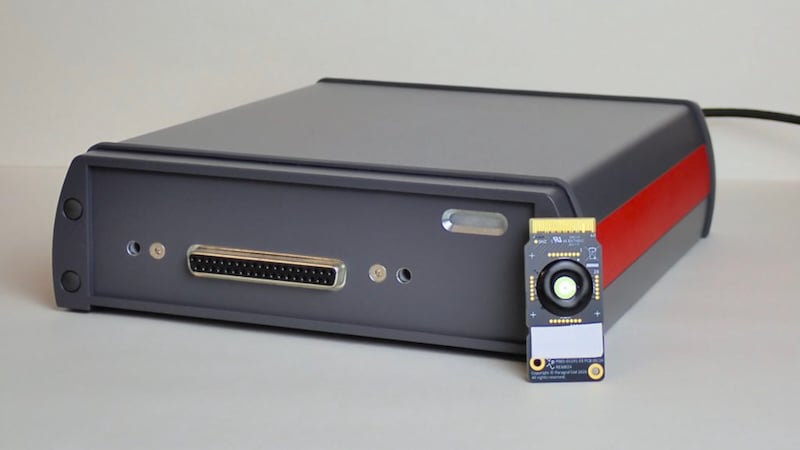
At the company's Embedded World booth, Ren Sun, senior department manager of Gigadevice's MCU EMEA/AME region, holds a board with the new GD32M531 MCU
Key Features of the GS32M531 MCU Series
Gigadevice's first announcement at the show was its 32-bit GD32M531 MCU, targeted at motor-control applications. The MCU series is powered by an Arm Cortex-M33 at 180 MHz with up to 256 kB of code flash, 64 kB of data flash, and 32 kB of SRAM.
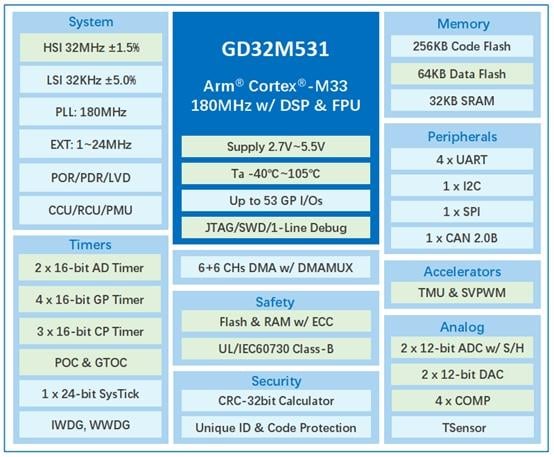
GD32M531 MCU architecture.
The MCU offers a rich set of features and peripherals designed for both modern and legacy applications. It supports flexible operating voltages, ranging from 2.7 V for newer designs up to 5.5 V for compatibility with legacy systems.
“Some motor control boards use 5 V, but 5 V is quite legacy. In the past, we had 8-bit controllers—a lot of those with 5 V,” Sun said. “Now, a lot of new designs, because of the latest CMOS technology, use 3.3 V or 1.8 V. This device also has 5 V, so we have a wide voltage range. This simplifies the power supply.”
The device provides up to 53 GPIO pins and includes two advanced timers, four general-purpose timers, three compare timers, SysTick, and a watchdog timer. For communication, it integrates four interfaces each for UART, I2C, SPI, and CAN. Additionally, it includes two 12-bit ADC units with 16 channels and a dual-channel DAC, supporting a wide range of analog interfacing needs.
Voltage flexibility, a broad built-in peripheral set, and motor control optimization reduce the need for power conversion circuitry and external peripheral chips. This reduces the bill of materials (BOM) count, supply chain complexity, and manufacturing costs. The GD32M531 variants come in small LQFP64 and LQFP48 packages. Sample quantities of the MCU and development boards are available now, with full production kicking off in April 2026.
Advanced Motor Control Features
The MCU includes multiple hardware accelerators for trigonometric functions that support space vector pulse-width modulation (SVPWM) and field-oriented control (FOC) algorithms. SVPWM is an algorithm that optimizes AC waveforms used to drive three-phase AC motors. SVPWN enables more precise control and more efficient operation of AC induction motors.
“You can either implement the algorithm by software or with a hardware accelerator,” Sun said. “With hardware acceleration, some math calculations, you can certainly get this better implemented.”
Implementing these features in hardware helps reduce the workload on the Arm core and improve overall performance. The GD32M531 includes DSP extensions and a hardware floating-point unit. Built-in power factor correction, working with the PWM, allows designers to achieve the greatest possible efficiency from AC motors.
Electrifying Homes and Buildings
The MCU is equipped with a generous set of consumer and industrial motor-drive-related features. Gigadevice hopes the MCUs find homes in devices that are contributing to the electrification of home and commercial facilities, such as:
-
Single and multi-phase AC motor drives that need power factor correction (PFC)
- Frequency conversion control for inverters, fans, and power management
- Multi-channel pulse width modulation (PWM) for photovoltaic systems, household energy storage, and DC-DC charging applications
Modern microcontrollers must account for cybersecurity in addition to traditional home and industrial safety certifications. The GD32M531 MCU integrates CRC, UID, code protection, and full ECC coverage to enhance digital system security and compliance. It is IEC 60730 Class B certified for home appliance functional safety standards.
GigaDevice Introduces Low-Voltage NOR Flash
Gigadevice's second Embedded World announcement covers its GD25UF series of SPI NOR flash memory. The flash operates at 1.14 V to 1.26 V for better integration with SoCs and processors, with a core voltage of 1.2 V. By matching the core voltage of high-performance processors, the need for interface circuitry is reduced or eliminated. This enables a simpler design, lower power consumption, and reduced BOM count. Gigadevice estimates that the new memory will use 33% less power than the prior-generation 1.8-V equivalent devices.
“Our new flash memory is using 1.2 V, and this certainly meets the requirement for low power consumption nowadays for portable devices, wearable devices, and lot of ultra-low power microprocessors already using 1.2 V as the input voltage,” Sun said.
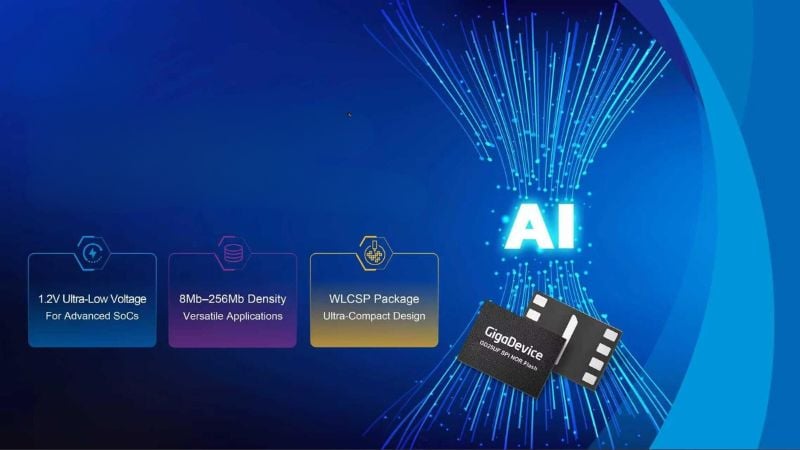
NOR flash at 1.3 V.
Reduced power consumption improves battery life in applications such as wearable electronics, smart home devices, and other battery-powered IoT devices. The GD25UF offers capacity options from 8 MB to 256 MB. It supports single-, dual-, quad-, and DTR-quad SPI modes, with clock frequencies up to 120 MHz in STR mode and 80 MHz in DTR mode. Data transfer speeds reach 80 MB/s.
“If the other components on the same PCB are using 1.8 V or 3.3 V, they increase the external bill of materials requirement. You need different PMICs for the power supply, and you also waste more energy when you convert,” Sun said. “For flash memory, the voltage is also important for certain reliability or endurance. So to have a lower voltage reflects a very high-level, reliable technology.”
Reliability stacks up with 100,000 program/erase cycles and a 20-year data retention design. It comes in three operating temperature ranges (40℃ to 85℃; -40℃ to 105℃; and -40℃ to 125℃) and meets typical automotive and industrial standards. The memory is now available in SOP8, WSON8, USON8, and WLCSP packages for greater deployment flexibility.
All images used courtesy of Gigadevice.
Related Content