Facebook
 Google
 GitHub
 Linkedin
Gigadevice Targets HMI and Edge Designs with New MCU Series
Gigadevice’s GD32F5HC MCU series combines high performance, compact size, integrated security, and rich peripherals to support HMI and IoT edge applications.
Microcontroller design has been pulling in two directions lately. More performance on one side. Smaller form factors and lower power on the other. The GD32F5HC series from Gigadevice is trying to cover both. Built on an Arm Cortex-M33 core, the new series runs at 200 MHz and is aimed at HMI systems and IoT edge devices where both compute and responsiveness matter. The hardware isn’t just about raw clock speed. It includes a DSP accelerator and a floating-point unit, which helps offload real-time processing and algorithm-heavy workloads from the core.
Memory is another part of the story. The GD32F5HC line offers up to 2 MB of Flash and 320 KB of SRAM, along with an instruction cache. That gives developers enough space to handle graphics frameworks, control logic, and data heavy applications. External memory can be added through QSPI or SQPI interfaces for systems that need more.
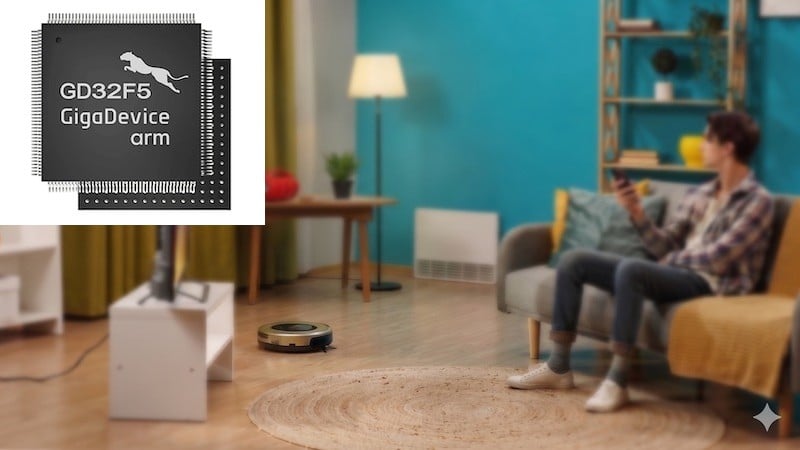
The GD32F5HC MCU is designed for compact embedded systems, enabling real-time processing in HMI and edge applications, including Smart Home and consumer devices.
Balancing Size, Speed, and Power
The design choices here are clearly aimed at compact systems that still need to move quickly. The MCU is available in small packages, including a 4×4 mm BGA. At the same time, it runs at a frequency high enough to support real-time control and UI-driven applications.
Power is handled through multiple operating modes. Run current sits higher when performance is needed, but the chip can drop into low power states down to microamp levels. That range makes it usable in industrial systems and battery driven devices that need to conserve energy.
Operating voltage and temperature ranges also lean toward industrial use. It supports a wide temperature range and includes built in monitoring features like voltage detection and reset protection, which helps keep systems stable under less controlled conditions.
Security Built Into the Architecture
Security is baked into the hardware rather than added later. The Cortex-M33 core supports TrustZone, which separates secure and non-secure execution at the hardware level. On top of that, the chip includes memory protection and access control through MPU and SAU. There’s also dedicated hardware for cryptographic operations. That includes AES, RSA, ECC, SHA, and a true random number generator, along with eFuse storage for keys. These features support secure boot, firmware updates, and protected debugging.
For applications dealing with connected devices or regulated environments, that level of integration matters. It reduces the need for external security components and simplifies system design.
Peripheral Layout and System Throughput
The peripheral setup is built to support a wide range of applications without external expansion. It includes SPI, I2C, USART, USB OTG, and high speed memory interfaces, along with analog input through a 12-bit ADC. Timers and DMA play a big role in how the system moves data. Multiple timer configurations allow for precise control in applications such as motor drives or synchronized systems. DMA channels handle data transfer in the background, which keeps the CPU free for higher level tasks.
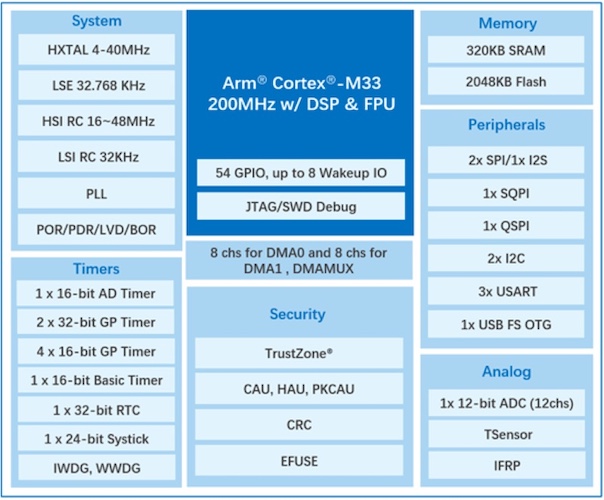
Block diagram of the GD32F5HC MCU showing core architecture, memory, security features, and integrated peripherals.
The result is a layout that supports both real-time control and communication-heavy workloads without overloading the core. More information can be found in the GD32F5HC data sheet.
Tools and Development Ecosystem
Gigadevice is backing the hardware with a full toolchain. That includes its own GD32 Embedded Builder IDE, debugging tools, and programming utilities. It also supports common development environments like Keil, IAR, and Segger. For HMI focused designs, the platform includes support for GUI frameworks with QSPI-driven displays up to 400 × 400 resolution. That makes it easier to build display-based systems without needing additional controllers.
Where It Fits
The GD32F5HC series is clearly aimed at applications that sit between simple control and full embedded systems. That includes industrial interfaces, smart displays, and edge devices that need local processing without relying on a larger system.
It’s also designed for environments where reliability matters. The series supports IEC61508 SIL2 functional safety requirements.
A Platform Built for Mixed Demands
The GD32F5HC series isn’t pushing one extreme. It’s trying to balance several at once. Performance, size, power, and security all show up in the design. That’s where it fits best. Systems that need to do more than basic control, but still have limits on space, power, or cost.
All images used courtesy of Gigadevice.