Facebook
 Google
 GitHub
 Linkedin
Higher Volts, Smaller Caps: New MLCCs for Auto, Aero, and Defense
Discover how the latest MLCCs from Samsung, Murata, and Kyocera are tackling extreme environments through unprecedented power density and miniaturization.
The multi-layer ceramic capacitor (MLCC) industry is one of the anchors of our technological world. MLCCs surround silicon to reduce noise, smooth voltage, and condition power—all while keeping pace with rapidly advancing active componentry.
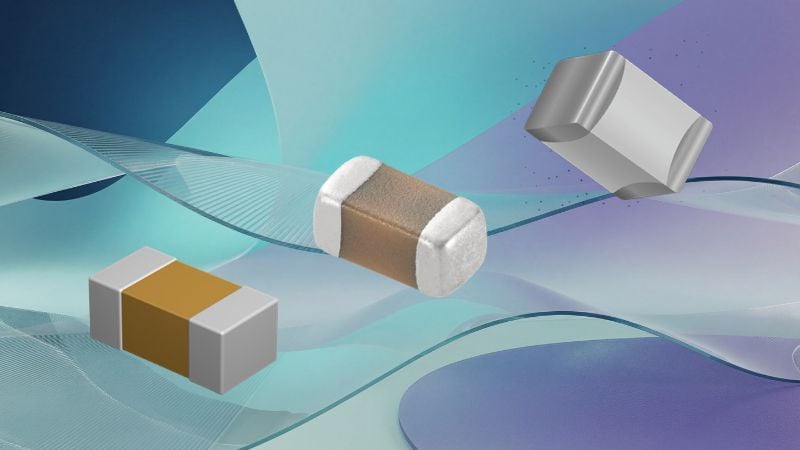
In this round-up, we look at MLCCs that push the boundaries in high-voltage operation, offer high capacitance for their size, and use base-metal electrode technology. The goal with all three introductions is to achieve greater capability with less space.
Samsung's Ultra-High-Voltage MLCCs for Electric Vehicles
Samsung Electro-Mechanics recently released a set of MLCCs designed for high-voltage powertrains in battery electric vehicles (BEVs) and plug-in hybrid electric vehicles (PHEVs). The parts add to Samsung’s C0G/X8G product line and extend the top-end voltage capability to an ultra-high 1,500 V.
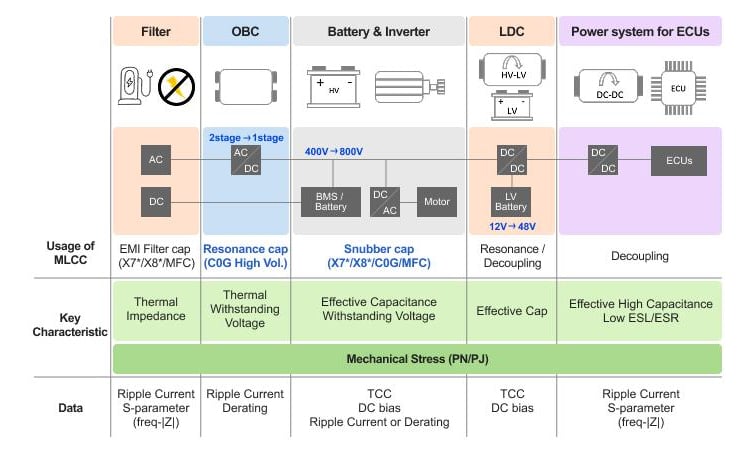
Applications for new Samsung UHV MLCCs. Image used courtesy of Samsung
The new line includes the following variants:
| Variant | Capacitance | Related Voltage |
| CL32G122KVV3PN# | 1.2 nF | 1,500 V |
| CL32C103JXV3PN# | 10 nF | 1,250 V |
| CL32C223JIV3PN# | 22 nF | 1,000 V |
| CL32C333JIV1PN# | 33 nF | 1,000 V |
They all come in surface-mount 1210 packages (33 mm x 25 mm). The 1.2-nF variant has a temperature coefficient of capacitance (TCC) rating of X8G, meaning a capacitance change rate in -55°C to +150°C, 0±30ppm/°C. The other variants are rated TCC at C0G, meaning -55°C to +125°C, 0 ± 30 ppm/°C.
Design targets include BEV and PHEV charging circuits, 800-V inverter traction power systems, and snubber applications for power-on/power-off noise suppression. Samsung uses proprietary electrode material miniaturization and ultra-precise ceramic layering to achieve higher-voltage capability in such small packages. All are currently available in mass production quantities.
Murata's Automotive MLCCs With ‘World-Leading Capacitance’
Murata introduced seven new AEC-Q200-qualified MLCCs. According to Murata, the new parts “achieve the world’s largest capacitance for a given rated voltage and size.” Five of the GCM series parts will be used in the circuitry of advanced driver assistance systems (ADAS) and autonomous driving (AD) electronics. These parts include:
| Variant | Size | Capacitance | Rated Voltage (DC) |
| GCM32ED70G227MEC4# | 1210 | 220 μF | 4 Vdc |
| GCM035D70E225ME02# | 0201 | 2.2 μF | 2.5 Vdc |
| GCM035D70G225MEC2# | 0201 | 2.2 μF | 4 Vdc |
| GCM31CD70E107ME36# | 1206 | 100 μF | 2.5 Vdc |
| GCM31CD70G107ME36# | 1206 | 100 μF | 4 Vdc |
The 1206-sized MLCCs replace earlier versions that came in the 1210 package, now taking up 36% less PCB area. The GCM035D70E225ME02 has, as of this writing, the world’s largest capacitance for a 4-Vdc MLCC in a 0201 size.
Murata designed its next two new parts for medium-voltage automotive powerline applications.
| Variant | Size | Capacitance | Rated Voltage (DC) |
| GCM155D71E105KE36# | 0402 | 1 μF | 25 Vdc |
| GCM31CC71E226ME36# | 1206 | 22μF | 25 Vdc |
Space for electronics is at a premium in the modern vehicle. By reducing the size of critical passive components, PCBs can shrink while maintaining greater capability. Murata designed these new MLCCs to address just that challenge.
Kyocera's Defense-Qualified MLCCs
Kyocera announced new members of its defense-qualified products, including the MIL-PRF-32535 BME NP0 MLCC line. The new MLCCs have higher capacitance/voltage (CV) ratings than their precious-metal-electrode (PME) equivalents and are certified for the same rugged applications while using lower-cost base-metal electrodes (BME).
BME uses copper and nickel, while PME uses palladium silver. Past BME designs came with reliability concerns. However, the new Kyocera parts meet the MIL-PRF-32535 standard and are listed in the DLA Qualified Products Database (QPD). BME construction allows for component pricing that is lower than PME without sacrificing quality or reliability.
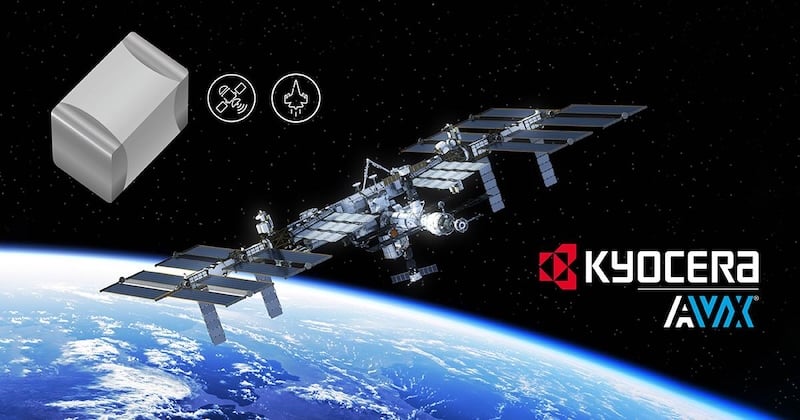
The new MLCC parts target aviation, defense, and space applications. Image used courtesy of Kyocera
The MIL-PRF-32535 standard, issued by the Defense Logistics Agency (DLA), covers extended specification ranges, general-purpose, and temperature-stable surface-mount MLCCs. The standard outlines M-level (standard reliability) and T-level (high reliability) qualifications. Kyocera’s use of BME brings high-reliability MLCC pricing closer to that of commercial-grade parts while retaining the quality required for harsh applications.
The new parts are now available in surface mount sizes 0402, 0603, 0805, 1206, and 1210. They range in capacitance from 68 pF to 47,000 pF and are rated from 4 V to 100 V. All of the new capacitors meet E1 and BP dielectric stability classifications.
Though MLCCs are small to begin with, complex electronics contain large numbers of them. Size and weight reductions enable higher-performing electronics in ever-smaller systems. The lower-cost BME construction helps with designs under budget constraints that still require high reliability.
Related Content