Facebook
 Google
 GitHub
 Linkedin
How Brain-Inspired Hardware Is Learning to Scale
While brain-inspired computing and neural interfaces have long promised transformative advances, scaling those systems has remained a challenge. New research suggests that the barrier is beginning to fall.
Researchers have looked to the brain as both a model and a challenge for decades. Biological neural systems outperform conventional computers in efficiency, adaptability, and parallel processing while operating on remarkably little energy.
Scaling those systems beyond small prototypes, however, has proven difficult. Synchronization overhead, invasive wiring, limited bandwidth, and bulky form factors have repeatedly turned promising demonstrations into fragile, hard-to-extend platforms. That picture is now beginning to change.
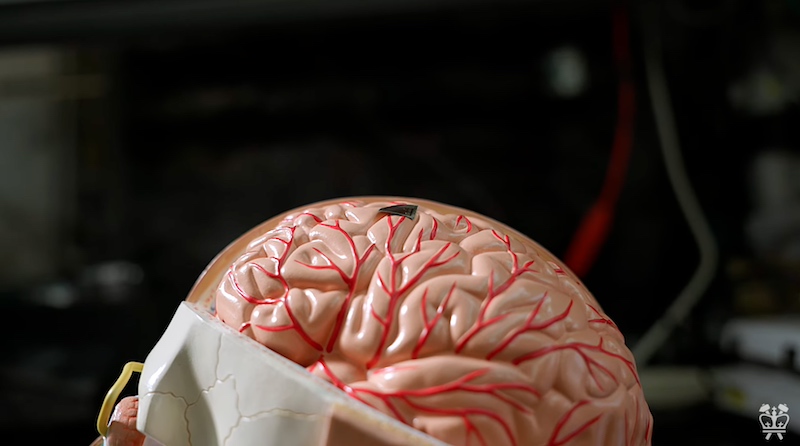
Columbia University's brain-machine interface, outlined in more detail below. Image used courtesy of Columbia University
Recent work from teams at Yale University, Northwestern University, and a multi-institution collaboration led by Columbia University points to a common shift in thinking. Rather than focusing on individual components, these groups are re-examining how brain-inspired systems scale as a whole.
Moving Beyond Global Synchronization in Neuromorphic Computing
Most neuromorphic systems remain repeatable by forcing everything to adhere to a single, shared timing scheme. While that keeps experiments clean, it also creates a choke point. As soon as the system grows, progress slows to match whatever block happens to lag behind. Add more chips, and the bookkeeping starts to outweigh the work. What felt reasonable in a small setup turns into dead weight once the system gets bigger.
A team at Yale University set out to remove that limitation. Their solution, called NeuroScale, replaces global synchronization with a decentralized alternative. Instead of forcing all neurons to align to a single timing signal, NeuroScale synchronizes only local clusters of neurons and synapses that directly interact with one another. This change may sound subtle, but its implications are significant. By allowing different regions of a neuromorphic system to operate independently, NeuroScale avoids the bottleneck imposed by global barriers. In effect, the system scales according to the same constraints that govern biological networks, rather than artificial coordination rules imposed by hardware.
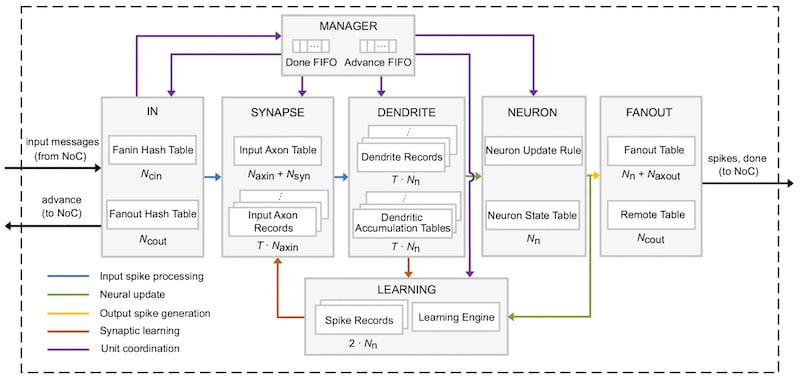
The core architecture of NeuroScale. Image used courtesy of Nature Communications
The work demonstrates that large neural simulations can run efficiently across thousands of cores without being throttled by synchronization overhead. At present, NeuroScale exists as a simulated prototype; the researchers’ next step is fabrication. Moving the design into silicon will test whether the architectural advantages observed in simulation can be realized in physical hardware. The team is also exploring hybrid approaches that combine local synchronization with elements of conventional neuromorphic designs, potentially easing integration with existing systems.
Delivering Information to the Brain Without Wires
Optogenetics has been one of the most powerful tools for studying and controlling neural activity. Researchers can precisely influence specific neural populations by using light to activate genetically modified neurons. Traditionally, however, optogenetic experiments rely on fiberoptic cables tethered to external light sources, restricting movement and limiting the complexity of stimulation patterns.
Researchers at Northwestern University have taken a different approach. They describe this solution as a wireless, fully implantable optoelectronic device that delivers information to the brain using light, without penetrating brain tissue or relying on external wires. The soft, flexible device sits beneath the scalp but on top of the skull, conforming to its surface and shining patterned bursts of red light through bone to activate neurons across the cortex.
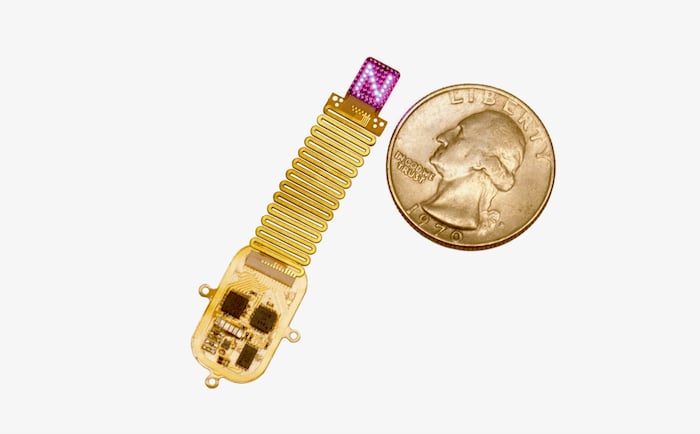
The wireless device uses light to send data directly to the brain. Image used courtesy of Mingzheng Wu/Rogers Research Group and Northwestern Medicine
The architecture integrates a programmable array of up to 64 micro-LEDs, each roughly the width of a human hair, along with a wireless power and control module. Because each LED can be controlled independently in real time, researchers can generate complex spatial and temporal patterns of stimulation. Earlier systems focused on stimulating one small area at a time.
The device does not focus on a single region. It drives activity across several areas simultaneously. In testing, mice learned to distinguish different stimulation patterns and responded to them consistently. Even in the absence of traditional sensory input such as touch, sight, or sound, the animals used these artificial signals to make decisions and complete behavioral tasks. The results suggest that the brain can quickly assign meaning to entirely new forms of input, provided the patterns are delivered in a coherent, distributed manner.
The implications extend beyond basic neuroscience. The Northwestern team envisions applications ranging from sensory feedback for prosthetic limbs to new forms of rehabilitation after injury. Future work will explore denser LED arrays, deeper-penetrating wavelengths, and more complex stimulation patterns, with the long-term goal of translating the technology toward therapeutic use in humans.
Collapsing the Brain-Computer Interface Into a Single Chip
Brain-computer interfaces run into a different problem. It isn’t synchronization or signal delivery so much as hardware sprawl. Most BCIs still rely on several separate components to handle recording, stimulation, wireless links, and power. Those pieces are usually packaged in a large implant with wires running to the brain, which makes the system bulky and hard to maintain over time.
A collaboration involving researchers from Columbia University, New York-Presbyterian, Stanford University, and the University of Pennsylvania has proposed a radically different solution. Their platform, known as the Biological Interface System to Cortex (BISC), integrates all of these functions into a single silicon chip.
Fabricated as a complementary metal-oxide-semiconductor (CMOS) integrated circuit thinned to just 50 micrometers, the BISC implant slides into the space between the brain and skull, conforming to the cortical surface. Despite its minimal form factor, the chip integrates tens of thousands of electrodes, over a thousand simultaneous recording channels, and more than sixteen thousand stimulation channels.

The team says the new implant may open doors for treating neurological conditions such as epilepsy, spinal cord injury, ALS, stroke, and blindness. Image used courtesy of Columbia University
The implant communicates wirelessly with a wearable relay station that provides power and manages data transmission. Using a custom ultrawideband radio link, the system achieves data transfers of up to 100 megabits per second, far exceeding those of existing wireless BCI platforms. From the relay station, data can be streamed to external computers for decoding using machine learning and deep learning frameworks.
That single-chip architecture simplifies the hardware and removes many common failure points. Preclinical tests show stable recordings, and early human intraoperative studies are now underway. To move beyond the lab, the researchers have launched a spin-off company, Kampto Neurotech, to commercialize versions of the technology for research and clinical use. Early target applications include epilepsy, where high-resolution, minimally invasive monitoring and stimulation could improve diagnosis and treatment.
One Bottleneck Addressed at Multiple Layers
On the surface, each of these projects tackles a different problem. One rethinks how neuromorphic systems synchronize, another changes how information is delivered to the brain, and a third collapses the hardware behind brain-computer interfaces. What ties them together is scale. Getting these systems to work isn’t the hard part. Getting them to grow without introducing new failure modes is.
NeuroScale removes coordination limits inside the computing architecture. The Northwestern platform focuses on getting information into the brain without wires or localized stimulation. BISC confronts the hardware interface itself, demonstrating that high-bandwidth, bidirectional communication can be achieved in a form factor small enough for practical deployment. In each case, the solution involves abandoning architectures that worked for small demonstrations but break down at scale. The result is not just incremental improvement, but a rethinking of how these systems are built.
The path forward is still complex. Fabrication challenges remain, regulatory hurdles loom large, and ethical considerations will shape how these technologies are deployed. Yet the trajectory is clear. Brain-inspired hardware is no longer defined solely by what it can demonstrate in isolation. It is increasingly shaped by how well it can grow, integrate, and operate outside tightly controlled environments.
Related Content