Facebook
 Google
 GitHub
 Linkedin
IBM Charts Roadmap to First Practical, Fault-Tolerant Quantum Computer
The company aims to realize a 200-logical-qubit system by 2029.
IBM recently announced its plan to deliver the world's first large-scale, fault-tolerant quantum computer, IBM Quantum Starling, by 2029. According to IBM, the new computer will support circuits containing 100 million gates and 200 logical qubits, potentially performing up to 20,000 times more operations than today's quantum systems.

Rendering of IBM Quantum Starling. Image used courtesy of IBM
The announcement also coincides with IBM's updated quantum roadmap and the release of two important research papers detailing the hardware and software frameworks that underpin the Starling architecture.
The Bicycle Architecture and Quantum Starling
IBM's strategy centers on the adoption of the bicycle architecture, a modular fault-tolerant computing platform built from quantum low-density parity-check (LDPC) codes. Two variants, the gross and two-gross bivariate bicycle codes, are central to this implementation. These codes enable the construction of logical qubits from clusters of physical qubits with reduced overhead and improved error suppression. The gross code encodes 12 logical qubits into 144 physical qubits, while the two-gross version doubles the physical qubit count to achieve longer code distances and lower error rates.
To achieve fault-tolerance, IBM will utilize shift automorphisms, in-module and inter-module Pauli measurements, and T-state injection techniques. These operations are orchestrated across a network of code modules and ancillary components, including logical processing units (LPUs) and T-factories for magic state distillation. Each module communicates via long-range couplers, enabling entanglement across the quantum network while preserving modularity.
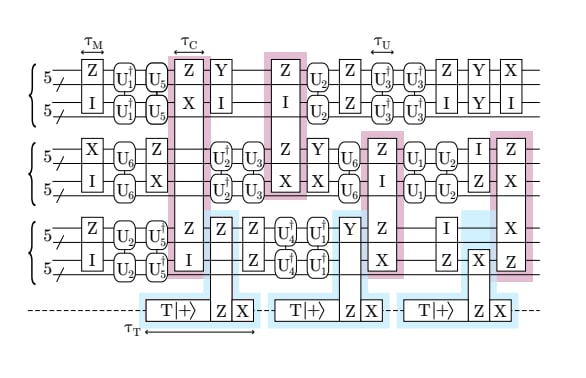
An example circuit expressed in the universal set of bicycle instructions. Image used courtesy of Arxiv
IBM designed the system for scalability. The company's 2025 roadmap highlights that Starling's 200 logical qubits will enable circuits with 100 million gates, a tenfold increase over current thresholds. In 2033, the planned successor system, IBM Quantum Blue Jay, will target 2,000 logical qubits and a billion-gate depth. Logical error rates in current simulations suggest orders-of-magnitude improvements over surface code architectures using the same number of physical qubits.
Bivariate Bicycle Codes in Fault-Tolerant Quantum Computing
Bicycle codes belong to the family of quantum LDPC codes and present a marked departure from the surface codes traditionally used in fault-tolerant quantum computing. Surface codes are limited by their need for dense, planar connectivity and high physical qubit counts per logical qubit. Bicycle codes mitigate these constraints by allowing sparse yet long-range connectivity and more efficient code constructions.
Each bicycle code module is defined on a toroidal lattice with both short- and long-range parity checks. These checks provide error detection and correction while supporting modular designs that are inherently more scalable. Logical operations, including Pauli measurements and Clifford gates, are implemented through lattice surgery and circuit-level, fault-tolerant procedures tailored to the bicycle code topology.
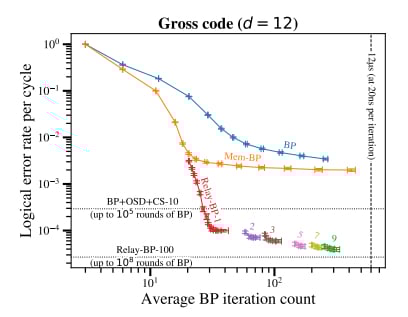
Logical codes versus average number of BP iterations. Image used courtesy of Arxiv
Another important component is the decoding strategy. IBM introduced Relay-BP, a compact and parallelizable belief-propagation-based decoder suited for real-time FPGA or ASIC implementation. This decoder adapts standard BP algorithms with disorder-enhanced memory updates and a relay-ensembling scheme, yielding improved convergence and decoding accuracy under circuit-level noise models.
These novel techniques collectively address the six essential criteria for a scalable fault-tolerant architecture as defined by IBM: logical fidelity, addressability, universality, adaptiveness, modularity, and efficiency. The bicycle architecture satisfies each of these through its combination of LDPC coding, modular hardware, efficient instruction sets, and real-time control.
Toward Utility-Scale Quantum Systems
IBM's roadmap for delivering a utility-scale, fault-tolerant quantum computer by 2029 sets a precedent for the quantum computing industry. By pivoting to bivariate bicycle codes and investing in modular system design, IBM hopes to demonstrate a pragmatic route to overcoming the limitations of surface code architectures. If realized, IBM Quantum Starling will open the door to solving quantum chemistry, optimization, and cryptographic problems at an unprecedented scale. Hardware availability will depend on the success of ongoing error rate reductions and system integration, with early results indicating promising performance improvements over competing frameworks.