Facebook
 Google
 GitHub
 Linkedin
In Memoriam: Donald Bitzer, the Father of PLATO and Plasma Displays
Donald Bitzer, a monumental figure in plasma display technology and computer-assisted education, passed away last month at the age of 90.
Electrical engineer and computer scientist Donald Bitzer passed away at his home in Cary, North Carolina, on December 10, 2024, at the age of 90.
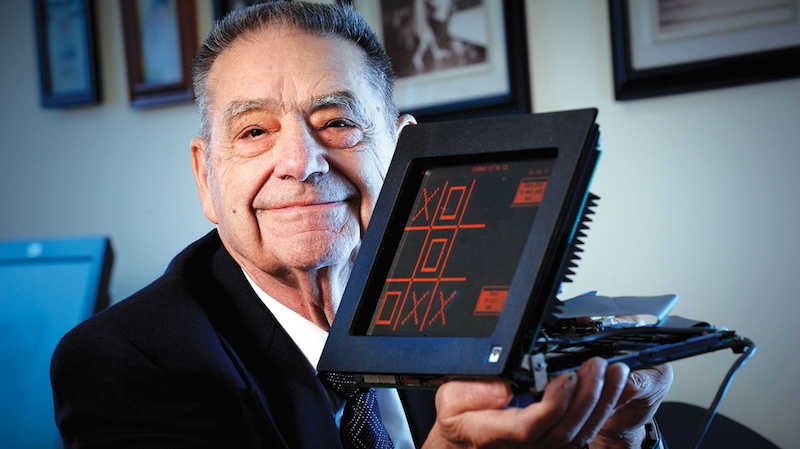
Bitzer’s work has had a lasting impact across various fields, including entertainment, and he received two Emmy Awards as a result. Image used courtesy of NC State University
Donald Bitzer was well known for developing PLATO, the world’s first generalized computer-assisted instruction system, and co-inventing plasma display technology, fundamentally transforming education and communication technologies.
Early Life and Education
Bitzer was born in East St. Louis, Illinois, on January 1, 1934, to a family who owned a chain of local car dealerships. While his family hoped Bitzer would take over the family business, Bitzer was drawn instead to science and technology from a young age.
“I knew since I was five that I wanted be an engineer, and particularly an electrical engineer,” Bitzer said in an interview with Computer History Museum. “I had gone to the stores around town, and they gave me all their spare vacuum tubes. I used to love to build things.”
“We built a short-wave superheterodyne receiver with my uncle right at the end of World War II, and it was good enough that when we got it up, we could listen to the reports from London on that receiver,” Bitzer recalled.
Bitzer went on to receive three degrees in electrical engineering, a B.S., M.S., and Ph.D., from the University of Illinois Urbana-Champaign. After completing his master's degree, he also worked on several confidential government projects, including studying stress in wing spars and solid fuel rockets.
“I'm the happiest person when I'm working on a problem that they tell me can't be solved,” Bitzer noted.
PLATO: Programmed Logic for Automated Teaching Operations
After obtaining his doctoral degree, Bitzer was called upon by the head of a laboratory where he worked, imploring him to help the lab develop a computer to improve education.
Bitzer recalled the conversation that spurred the PLATO project:
The head of the lab said, 'The people who know how to teach don’t know how to engineer. The people who do engineering don’t know how to teach. Do you agree?'
'No,' I said. 'We got the equipment upstairs to immediately connect to the ILLIAC. We can get things going. Give me two weeks, and I’ll have a terminal up and running for you and the modem we’re talking about.'
So he did, and they made me the head of it.
In 1960, Bitzer launched Programmed Logic for Automated Teaching Operations (PLATO). Designed in response to educational inequality, Bitzer aimed to introduce computer-assisted learning on a scale that had never been seen before. PLATO allowed students to interact directly with computers, learning at their own pace through a system that combined instant messaging, email, chat rooms, and gaming. These then-experimental features were decades ahead of their time.
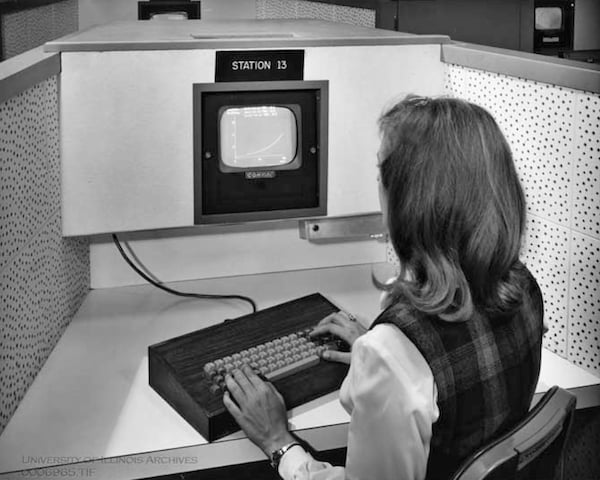
A PLATO III student terminal at the University of Illinois. Here, the student terminal is being used to display the population growth curve for given birth and death rates. Image used courtesy of the University of Illinois
PLATO’s development moved quickly under Bitzer’s direction. By 1969, PLATO III supported 20 terminals connected to a single mainframe, representing a significant advancement in computing power and accessibility. Then, in the early 1970s, PLATO IV pushed the boundaries further by introducing a plasma display and a touch-sensitive interface. By 1972, PLATO IV could accommodate up to 1,000 users simultaneously, a feat made possible by Bitzer’s pioneering time-sharing techniques adapted for CDC 1604 computers. These systems demonstrated how scalable, interactive platforms could serve a broad audience effectively, thereby establishing the foundations for future multi-user systems.
Developing the Plasma Display
After developing the initial PLATO system, Bitzer sought to make the system’s interface more functional and user-friendly, thereby making PLATO itself more accessible. Together with Gene Slottow and Robert Willson, Bitzer co-invented the first flat-panel plasma display as an alternative to cathode ray tubes, which came with a myriad of inherent limitations: scaling difficulties, limited image quality, and bulkiness, to name a few.
Plasma displays operate on principles similar to fluorescent lamps and neon tubes. They use small cells containing ionized gas (plasma) that respond to electric fields. Each pixel consists of three subpixel cells, one each for red, green, and blue phosphors, functioning like a tiny neon light that glows to display information and retain its state to serve as both a display and a memory device.
The plasma display’s built-in memory was the key innovation for Bitzer’s PLATO system, allowing it to retain digital information without relying on additional storage systems. This immediately improved performance and efficiency while also enabling more compact designs. The display’s brightness and contrast significantly improved existing technology, making it well-suited for classroom settings where clear visuals were important. Bitzer and his team also devised a flat-panel structure that laid the foundation for modern flat-screen TVs, revolutionizing display technology for educational and entertainment applications.
A Double-Emmy Recipient
Bitzer’s lasting influence extends well beyond the initial scope of his work. PLATO introduced tools and features that prefigured today’s social networking and online learning platforms. Chat rooms, multiplayer games, and forums, initially created to enhance the learning experience, have since become staples of digital communication and education. The plasma display, originally developed to support PLATO, became the forerunner of contemporary flat-panel television and display systems and was a ubiquitous presence in the homes of millions of people worldwide until the development of newer technologies like LCD and OLED.

Donald Bitzer won two Emmy Awards, his first in 1992 and second in 2002. Image (modified) used courtesy of NC State University
Throughout his career, Bitzer received numerous accolades for his contributions to engineering and technology. He was elected to the National Academy of Engineering in 1974. In 1992, he received an Emmy Award for Outstanding Achievement in Television Technology, followed by another Scientific Development and Technological Achievement Emmy in 2002 for the invention of the plasma display panel.
Bitzer’s career serves as a reminder of how engineering can tackle long-term challenges outside of the field. Through his invention of PLATO and plasma technology, Bitzer laid the groundwork for countless innovations in education, entertainment, electronics, and information technology.
Concluding his interview with the Computer History Museum, Bitzer imparted his advice to young people:
"Keep going. Work hard and don't give up, because everything may be tough, but it's all worthwhile in the long run. Don't be afraid to do new things. Don't be afraid to think differently. Be yourself, and see how much you can get done. Just keep going.”