
 Facebook
 Google
 GitHub
 Linkedin
Intel 2708: The EPROM That Made Microcomputers Programmable
In 1975, the 2708 became the first EPROM that engineers could practically socket into 8-bit systems, if they could power it.
By the early 1970s, mask ROMs were a bottleneck. Every time firmware changed, hardware teams had to wait for new lithography masks, incurring both delay and cost. The Intel 1702, introduced in 1971, was a breakthrough, representing the first erasable programmable read-only memory (EPROM) based on floating-gate transistors that could be reset by UV light. But the 1702 was a PMOS device, slow to read, awkward to program, and poorly matched to the emerging world of fast NMOS microprocessors, like the 8080.
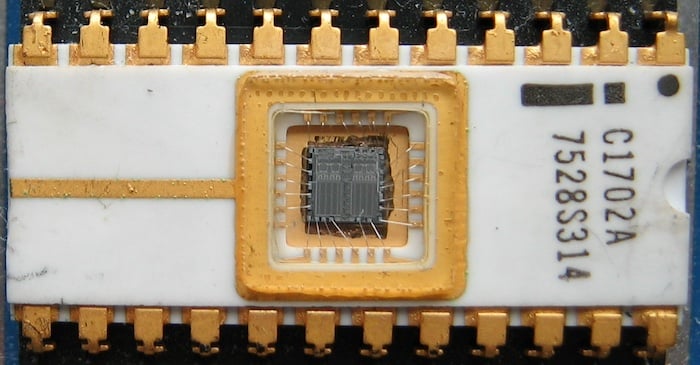
The Intel 1702A, one of the earliest EPROM types, from 1971. Image used courtesy of Poil via Wikimedia Commons (CC BY-SA 3.0)
That changed with the Intel 2708, the first NMOS EPROM designed to serve byte-wide data directly to 8-bit microcomputers. Introduced around 1975, the 2708 packed 8 kilobits (1 KB) into a ceramic 24-pin DIP and could be programmed electronically, then erased optically using ultraviolet light. It became the first EPROM practical enough for hobbyists and professional engineers alike to burn firmware into and socket directly onto a microprocessor board.
Three Rails, One Window
While the 2708 represented a leap forward in functionality, it brought with it some serious electrical demands. In an era when most TTL and NMOS systems ran off a simple +5-V rail, the 2708 asked for three things:
- +5 V (VCC) for standard logic-level operations
- +12 V (VDD) for EPROM array biasing
- –5 V (VBB) for substrate bias
And if you wanted to program it, you also needed a ~25–26 V (VPP) pulse on the program pin, with strict timing requirements for address, data, and chip-enable signals.
These constraints made the 2708 something of a bear to support. Microcomputer systems, such as those based on the Intel 8080 or Motorola 6800, often required dedicated power supplies or adapter boards just to run EPROMs reliably. During programming, engineers had to apply the high-voltage pulse for exactly the right duration. Too short, and the bit wouldn’t latch; too long, and the floating gate could be overcharged or degraded.
Even so, the 2708’s design brought important advantages over earlier EPROMs like the 1702. It used NMOS floating-gate avalanche injection MOS (FAMOS) transistors, which offered faster read access (~450 ns) and tighter integration than PMOS cells. Its 1,024 x 8 organization matched the natural word width of 8-bit microprocessors, making firmware storage and memory-mapped I/O cleaner to implement.
Inside the EPROM
The 2708, like all EPROMs, was built around the concept of a floating-gate MOSFET. Unlike regular MOS transistors, which have a single gate terminal that controls conduction, the FAMOS structure embeds a second, electrically isolated gate beneath the control gate.
During programming, a high-voltage pulse causes electrons to tunnel through the gate oxide and become trapped on the floating gate. This trapped charge changes the threshold voltage of the transistor, effectively storing a digital “0” or “1” depending on its presence.
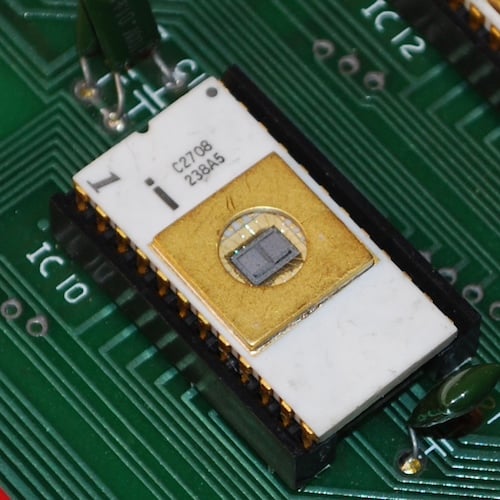
Intel 2708 EPROM. Image used courtesy of Michael Holley via Wikimedia Commons (Public domain)
Because the floating gate is insulated, the charge remains for years unless intentionally removed. That’s where the quartz window on the top of the 2708 package comes in. By exposing the die to ultraviolet light at 253.7 nm, the trapped electrons gain enough energy to escape the gate oxide and discharge back to equilibrium. Once erased, the chip could be reprogrammed.
This mechanism made EPROMs both flexible and reusable, albeit with some quirks. Erasing was all or nothing; you couldn’t target individual bits or bytes. And erase times were long, typically 10 to 30 minutes under a UV lamp, with an admonition to let the chip “rest” before reprogramming.
Nonetheless, this combination of electronic programming and optical erasure gave the 2708 an unprecedented ability: firmware could now be changed in the field, revised during development, or shared between systems without silicon rework.
An Important Transitional Device
The 2708 didn’t last long in production terms, but it marked the first time a memory device offered non-volatile, electrically programmable, byte-accessible storage in a form that system designers could realistically build around. It quickly became the firmware medium of choice for early S-100 computers, single-board kits, and embedded controllers.
That said, the triple-voltage requirement was a constant engineering frustration. As system voltages standardized around +5 V, the market demanded simpler power schemes. Within just a couple of years, Intel and others began producing successors like the 2716, which doubled the capacity to 2 KB and eliminated the –5 V and +12 V rails for read operations, requiring only a single +5-V supply during normal use, with +25 V retained only for programming.
These newer EPROMs made the 2708 obsolete almost overnight. Adapters were built to convert 2708 sockets to 2716s, and programmers dropped support for the old triple-rail parts.
Even so, its legacy is undeniable. The 2708 showed what firmware could be when designers weren’t locked into mask ROMs or cumbersome diode matrices. It put reprogrammable memory into the hands of engineers, educators, and hobbyists, and it set the pinout and packaging conventions that EPROMs would follow for decades.
Did the Intel 2708 change the way you approached firmware? Tell us about your experiences with this EPROM in the comments below.











My first microprocessor project used 1702 on two board, AFAICR 4K words x 16 bits, and a National Semiconductors PACE processor. The PACE ran at a blistering 2MHz with a 20uS register to register add time, but it was a genuine 16 bit processor, modelled on the Data General NOVA instruction set with an added subroutine stack. I wrote my own floating point math to perform some fairly hairy statistical analysis on count form a scintillation detector with Cs137. I architected the package as an RPN engine so I could test out the algorithms quickly on an HP65 programmable calculator. The HP65 was slower in execution but ever so much quicker to reprogram.
I never felt hard done by using the 1702. It was what it was. The first 2708 was a kinda “so what”. Than I think it was the 2716 that came in two flavours from two manufacturer, one 3-rail, the other 5V only. But at that stage of the game you’d buy a programmer, so again “so what”. Later I did make my own programmer, at the 2764 or so stage, and was using them with mainly Z80s’
I came in contact in 1982 with the 2708. Our first PLC (programmable logic controller) with Z80 equivalent U880 for the internal grinding machines (sold worldwide). The formerly GDR (east germany) produced the 2708 under label U555C. Due to production bottleneck we got chips from the UdSSR (soviet union), the K573RF1. It was terrible with these chips, need more than 1 hour for erasing and get sometimes not burned well. The controller was written in BOOL-Logic for valves etc., but in assembler for the stepping motors and 7-segment display. So our programming knowledge immerged deep into each register of PIO and CTC. Still have Z80 Home-computer BIC A5105 with BASIC and CPM (clone).
What a heaven in today programming µicro-Controller with flash storage in seconds.
My first microprocessor project was a digital oscilloscope that used an 8080 CPU and 24K bytes of 1702 EPROM. This was the first oscilloscope to have an embedded processor and allowed it to do math on the waveforms (introduced in 1975). The next iteration of this device used 5V only 2716’s saving a lot of space.
You say the 2708 needing three supplies was an unusual demand but the original Intel 8080 used theses same three supplies.