Facebook
 Google
 GitHub
 Linkedin
Keysight Pushes VNA Capabilities Up to 250 GHz With Frequency Extenders
Keysight’s new 170/250 GHz frequency extenders and calibration kit enable differential broadband testing for next-gen semiconductors and AI-era networks.
As data rates surge past 1.6 and 3.2 terabits per second and semiconductor geometries shrink, engineers need measurement tools that can keep up. Millimeter-wave and sub-terahertz devices demand validation at frequencies that far exceed the reach of traditional test equipment.
Keysight Technologies has responded with two new frequency extender modules, the NA5305A (170 GHz) and NA5307A (250 GHz), along with a precision calibration kit designed to extend the performance of its PNA and PNA-X vector network analyzers (VNAs). Together, these tools allow researchers to run fully calibrated, single-sweep broadband S-parameter measurements from as low as 100 kHz up to 170 GHz or 250 GHz.
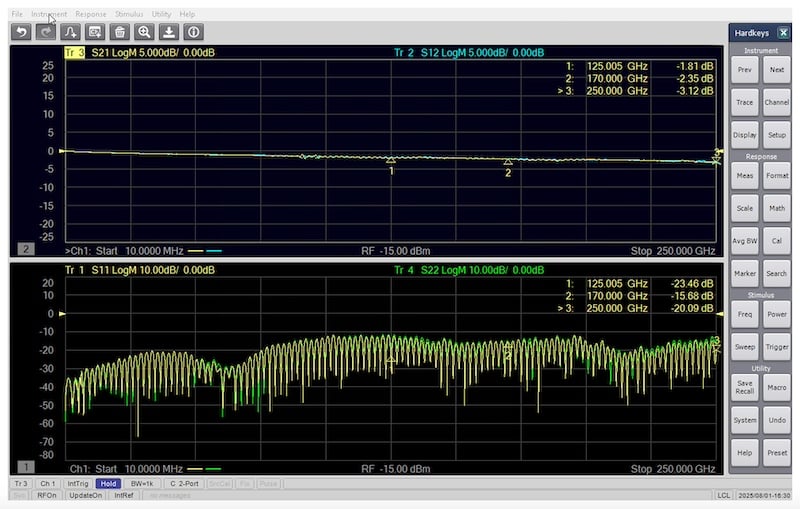
An S-parameter measurement is taken from 10 MHz to 250 GHz.
By enabling such a wide span in one sweep, the solution eliminates the need to stitch together narrowband measurements, streamlining design and verification for advanced semiconductors, high-speed interconnects, and sub-THz wireless components.
Broad Testing Capabilities
The new extenders expand testing well into frequency ranges critical for validating devices that underpin future communication and computing systems. Engineers can characterize on-wafer and packaged parts such as optical drivers, transimpedance amplifiers (TIAs), printed circuit boards, high-density connectors, cables, filters, and passive components.
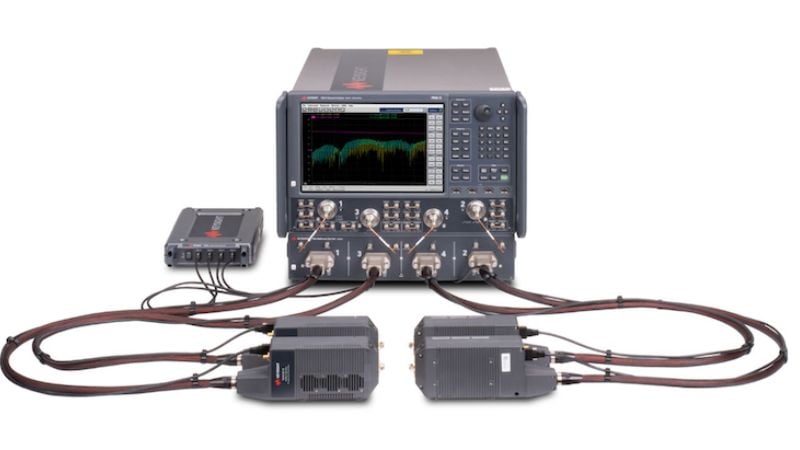
The frequency extender.
Calibration is supported by the 85065A 0.5-mm precision kit, which covers the full 250-GHz range with 16 impedance standards. Coupled with Keysight’s broadband test set controller and USB-connected extender hub, the system provides a calibrated test path from baseband through the sub-THz spectrum. The setup also delivers high dynamic range—110 dB from 20 GHz to 170 GHz and more than 100 dB up to 220 GHz—ensuring sensitive measurements across lossy devices and active circuits.
Differential Measurements Matter
One of the key upgrades is support for four-port differential S-parameter testing. High-speed interconnects and modern ICs use differential signaling to cut noise and keep signals stable at multi-terabit speeds. Single-ended tests often overlook problems that appear only under differential conditions, so this capability allows engineers to test the way the devices are actually used.
With the new extenders, it becomes possible to measure how balanced lines perform, how skew impacts results, and how differential amplifiers behave under load. This level of testing is critical for high-rejection filters, lossy passives, and wideband amplifiers, where even minor mismatches can affect overall performance.
AI Workloads Driving Test Evolution
High-performance computing places heavy demands on hardware. Such applications require faster memory, wider interconnects, and efficient optical links. Large clusters can move petabytes of data in a single day, adding pressure to both chips and networks. Test solutions capable of broadband sweeps up to 250 GHz give engineers the tools to validate these designs, close the gap between simulations and real-world performance, and accelerate the development of next-generation semiconductors.
Ecosystem Partnerships
Keysight has partnered with probe, adapter, and cable specialists to build a full test ecosystem. FormFactor and MPI have developed coaxial probes capable of differential on-wafer measurements at 250 GHz, while Spinner and Junkosha supply ruggedized adapters and high-performance cables. This ensures that the extender modules integrate into practical setups without limiting performance at the probe tip or connector interface.
Preparing for the Next Wave
Keysight’s NA5305A and NA5307A extenders, used with the 85065A calibration kit, provide a complete solution for testing high-frequency devices. The setup supports calibrated sweeps from 100 kHz to 250 GHz, differential measurements, and a complete coaxial ecosystem. These capabilities give semiconductor engineers and system designers the tools needed to validate next-generation components under real operating conditions.
All images used courtesy of Keysight Technologies.