Facebook
 Google
 GitHub
 Linkedin
Konrad Zuse and the Z1: The Dawn of Programmable Computing
Zuse's Z1 computer was the first freely programmable computer in the world to use Boolean logic and binary floating point numbers.
Konrad Zuse (1910–1995) was a German civil engineer and pioneering computer scientist who built a series of machines that laid the foundation for the computers we use today.
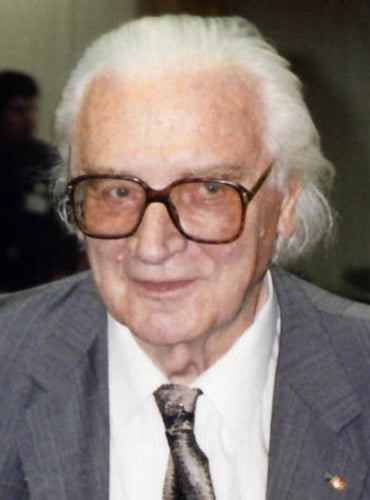
Konrad Zuse. Image used courtesy of Wolfgang Hunscher, Dortmund via Wikimedia Commons (CC BY-SA 3.0)
Frustrated by the slow and error-prone manual calculations in his engineering work, Zuse began to imagine a machine that could handle these tasks automatically. His groundbreaking work on the Z1, and the later evolution of his machines through the Z4, turned his vision into reality.
Building the Z1
Zuse’s Z1 computer, completed in 1938, was the first binary programmable computer. The Z1 was entirely mechanical, made from over 30,000 parts, and represented a bold departure from the calculators of the era that relied on the decimal system.
The Z1 used a concept Zuse had developed specifically for his computer, binary arithmetic. This system encoded numbers as sequences of ones and zeros, an innovation that would eventually act as the foundation of digital computing. Zuse also implemented floating-point arithmetic, allowing the Z1 to process a broader range of numbers efficiently. Boolean logic, another feature of the Z1, enabled the machine to perform logical operations.

A replica of Zuse’s Z1 in the German Museum of Technology, Berlin. Image used courtesy of Mike Peel via Wikimedia Commons (CC BY-SA 4.0)
The Z1’s architecture separated its core components: memory, control unit, arithmetic unit, and input/output devices. This clear division of responsibilities prefigured the modular design of modern computers. Programs were stored on 35-mm film punched with holes, an early form of external program storage. The Z1 accepted inputs via a keyboard and displayed results using light indicators.
Despite how innovative it was for its time, the Z1 had significant limitations. Its mechanical design naturally meant that breakdowns would occur. These happened regularly. Still, it marked the first step in automating complex calculations and set the stage for Zuse’s subsequent advancements.
From Z2 to Z4: Evolving Computational Power
Zuse didn’t stop with the Z1. In 1939, he built the Z2, which introduced electromechanical relays to replace its predecessor's less reliable mechanical components. This hybrid approach increased speed and reliability. Zuse’s work on the Z2 was funded by the German military, which was interested in computational tools for its operations.
Another breakthrough followed in 1941 with the development of the Z3, the first fully electromechanical and programmable computer. The Z3 used telephone relays for its operations and was the first program-controlled processor that executed a series of instructions without human intervention. This feature made it a precursor to the modern general-purpose computer.
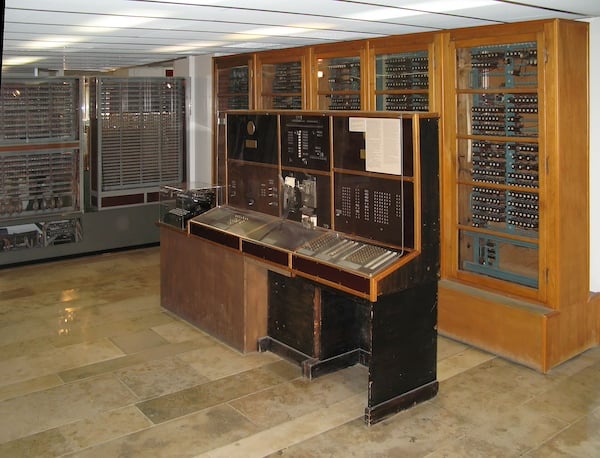
Zuse's Z4 is on display at the Deutsches Museum, Munich, Germany. Image used courtesy of Clemens Pfieffer via Wikimedia Commons (CC BY 2.5)
The Z4, completed in 1950, brought Zuse’s vision to the market and demonstrated, for the first time, many of the practical applications of computers we take for granted today. It was the first computer designed for business use, marking the start of commercial computing. The Z4 incorporated 2,000 electromechanical relays and used separate memory for data storage. Its performance was impressive for the time, with addition operations taking up to 1.25 seconds and multiplication up to 3.5 seconds.
Wartime Delays
World War II had a profound impact on Zuse’s work. Although the German Air Ministry supported his efforts to develop the Z4, the war also caused major setbacks. In 1945, the Z3 was destroyed in an Allied air raid on Berlin. The Z4 was relocated from Berlin to protect it from similar destruction, thereby delaying its completion.
During the wartime years, Zuse worked without access to ideas in computing emerging in the United States and Britain. Nevertheless, his innovations were groundbreaking enough to influence the trajectory of computing in their own right.
Zuse's Blueprint for Modern Computing
Zuse’s machines introduced several principles that are central to modern computing. His early adoption of binary arithmetic set the standard for digital systems. The Z3’s programmability was a huge leap forward, establishing the concept of program-controlled processors. Floating-point arithmetic, a feature of Zuse’s machines, efficiently handled complex calculations—a capability that would only be widely adopted decades later.
Beyond hardware, Zuse also worked on software. He developed Plankalkül, one of the world’s first high-level programming languages, years before similar concepts emerged in mainstream computing. While Plankalkül wasn’t widely used in his time, it demonstrated Zuse’s vision for making computers more accessible and versatile.
Zuse’s legacy is firmly rooted in the history of technology. His work not only solved immediate problems in computation but also set the stage for the digital age. From the Z1 to the Z4, his designs introduced features and concepts that continue to underpin modern computing.