Facebook
 Google
 GitHub
 Linkedin
Light Research, Heavy Implications: LEDs for Medicine, Displays, & Optics
Recent research has pushed LED and OLED performance into new territory, from photothermal cancer therapy to nano-OLEDs capable of directional light control.
New work from research teams in Texas, Tokyo, and Zurich highlights how LEDs and OLEDs continue to evolve beyond their traditional roles in lighting and displays.
One study demonstrates a selective LED-based cancer therapy that replaces expensive lasers with a low-cost, nanomaterial-driven photothermal process. Another addresses the long-standing voltage and color-purity barriers in blue OLEDs by introducing a new dopant family that delivers BT.2020-grade deep blue at just 1.5 V.

Researchers Artur Pinto and Jean Anne Incorvia, who are involved in the UT Austin Portugal Program. Image used courtesy of UT Texas
A third shows how nanoscale fabrication can shrink OLED pixels below the wavelength of their emitted light, enabling ultra-high pixel densities and optical wave-control effects not achievable with conventional devices.
New Cancer Treatment Combines LED and Tin Flakes
Researchers at UT Austin and the University of Porto demonstrated a low-cost LED-driven photothermal cancer treatment that uses near-infrared LEDs to activate tin-oxide “SnOx” nanoflakes. The device overcomes long-standing barriers in light-based cancer therapy—namely, the high cost of lasers, limited access to specialized clinical facilities, and the risk of damaging healthy tissue.
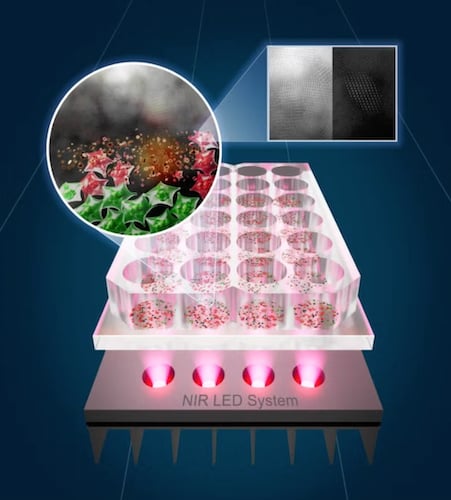
The infrared LED heating system activates nanoflakes that heat and neutralize cancer cells (green: live cells, red: cells killed by the photothermal therapy). Image used courtesy of UT Austin
By replacing lasers with an inexpensive LED heating system and engineering nanoflakes that selectively heat cancer cells while sparing healthy ones, the team achieved up to 92% eradication of skin cancer cells and 50% of colorectal cancer cells within 30 minutes, with no observed harm to healthy human skin cells.
The work positions LED-based photothermal therapy for applications ranging from post-surgical skin-cancer treatment to more accessible, potentially even at-home devices in regions lacking specialized equipment. Next steps include studying the underlying light-heat interaction in greater detail, identifying additional catalytic materials, developing clinical-ready devices, and advancing an implantable version for breast cancer patients under newly awarded program funding.
Deep Blue OLED Operates at Just 1.5 V
A team at the Institute of Science Tokyo has developed a deep-blue upconversion OLED that operates on a single 1.5-V battery. This OLED overcomes the long-standing high-voltage and color-purity limitations of blue emitters by introducing a new molecular dopant that avoids charge trapping.

The study illuminates the complex doping mechanisms in UC-OLEDs while also establishing a framework for designing energy-efficient, high-color-purity blue UC-OLEDs for optoelectronic applications. Image used courtesy of the Institute of Science Tokyo
Earlier UC-OLEDs could reduce voltage via triplet-triplet annihilation but produced broad, sky-blue spectra because common narrow-band dopants such as DABNA had HOMO levels that trapped holes and raised the driving voltage. The researchers solved this by designing and screening QAO-family dopants—multi-resonance TADF molecules with lower HOMO levels that prevent hole trapping—culminating in a derivative that delivers sharp 447-nm emission with a 20-nm bandwidth meeting BT.2020 display standards.
The work demonstrates a pathway to low-power, high-color-purity blue pixels for next-generation televisions, smartphone displays, and other OLED-based systems, while establishing molecular design rules that guide future dopant development for even more efficient, stable deep-blue UC-OLEDs.
Nanoscale OLEDs Smaller Than the Wavelength of Light
Researchers at ETH Zurich have demonstrated a manufacturing method that produces organic light-emitting diodes with pixel sizes as small as 100-200 nm—smaller than the wavelength of their own emitted light. These prototypes achieve a level of miniaturization far beyond current OLED technology.

With a resolution of 50,000 pixels per inch, these organic nano-LEDs display the ETH logo. Image used courtesy of Jiwoo Oh/ETH Zurich, Nature Photonics
This breakthrough addresses a long-standing challenge in OLED fabrication. Namely, conventional metal masks used to deposit light-emitting molecules impose size limits that prevent the creation of truly nanoscale pixels. The team overcame this constraint by using ultrathin, rigid silicon nitride ceramic membranes to create templates roughly 3,000 times thinner than those used in standard vapor-deposition processes, enabling “one-step” patterning of nano-OLED arrays directly compatible with semiconductor lithography.
With pixel densities up to 2,500 times greater than today’s displays and the ability to place pixels closer than the diffraction limit, these devices unlock precise control over light direction and polarization, setting the stage for applications in things like ultra-sharp, near-eye screens and biosensors.
Beyond imaging, the extremely small pixel spacing enables neighboring nano-OLEDs to interact optically, enabling wave-interference effects similar to those found in phased-array antennas. The ETH team has already demonstrated directional emission and polarization control using these interactions, and their next phase focuses on electrically addressing each nano-pixel individually to fully exploit phased-array behaviors.
Related Content