Facebook
 Google
 GitHub
 Linkedin
AI-Powered Compliance: Reducing Market Barriers for Electronics Manufacturers
Learn how AI-powered compliance replaces manual, fragmented regulatory workflows with structured, automated data, dramatically lowering the cost of EU market entry for SMEs and manufacturers.
For an electronics manufacturer, CE marking is not a stamp obtained at the end of development—it is a set of obligations that shape design decisions from the first schematic.
A product entering the European Economic Area must satisfy every applicable directive (EMC, RoHS, the Radio Equipment Directive, Low Voltage, and increasingly the GPSR), apply the relevant harmonized standards, and stand behind a Technical File that authorities can demand for up to 10 years after the last unit is placed on the market (EMC Directive 2014/30/EU).
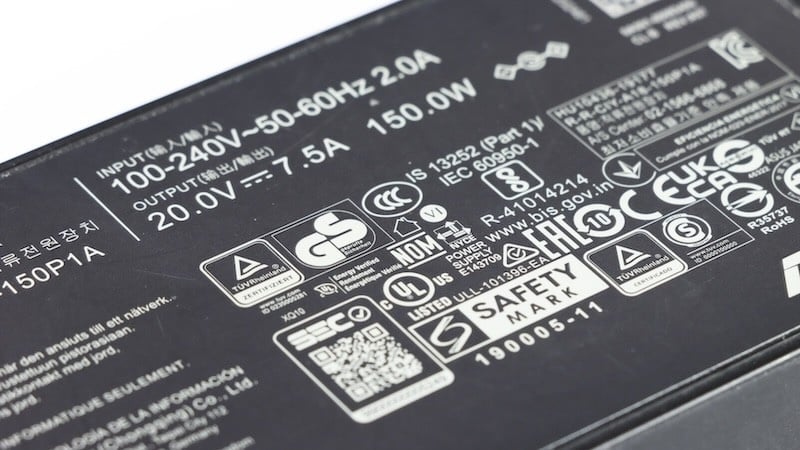
There’s a lot that has to go into achieving compliance approvals for an electronic product. Image used courtesy of Adobe Stock (licensed).
The economics are punishing, and they fall hardest on smaller firms. The European Commission conservatively estimates the annual cost of regulation to EU business at roughly 3.5% of EU GDP, and 55% of SMEs name regulatory obstacles and administrative burden as their single greatest challenge (BusinessEurope, 2026).
The costs are also non-linear in company size: SMEs report cross-border set-up costs of €10,000–15,000 per member state (Accountancy Europe, 2025), and even the raw inputs add up—a single harmonized standard costs €300–1,500 to purchase (Government of Canada Trade Commissioner Service), and most electronics products fall under several directives, each referencing multiple standards.
The prize on the other side of that barrier is large—a single market of roughly 500 million consumers and 21 million SMEs (European Commission, REFIT)—which is precisely why the cost of entry, not the size of the opportunity, is the deciding factor for most first-time and non-EU manufacturers.
Why the Established Tools Fall Short
The friction is not a shortage of expertise—it is that the existing toolset doesn't scale.
- Expert consultants are accurate but expensive and non-linear. Each new product, or each regulatory change, means another engagement. The knowledge lives in people, not in a system.
- Regulatory information is fragmented. Directive texts, the harmonized-standards lists in the Official Journal of the EU (OJEU), and member-state guidance are published across different sources, in different formats, on independent schedules. There is no single queryable surface.
- Templates are generic. Off-the-shelf Technical File and Declaration of Conformity templates don't map to a specific product's directives, components, or test results, so they still demand heavy manual tailoring.
- There is no real-time signal. When a standard is superseded or a directive amended, manufacturers usually learn of it reactively—often during a market-surveillance action or a customer audit.
That last point carries real teeth. Market-surveillance authorities conduct random inspections and laboratory testing, and a product can be barred from the market for even a minor nonconformity.
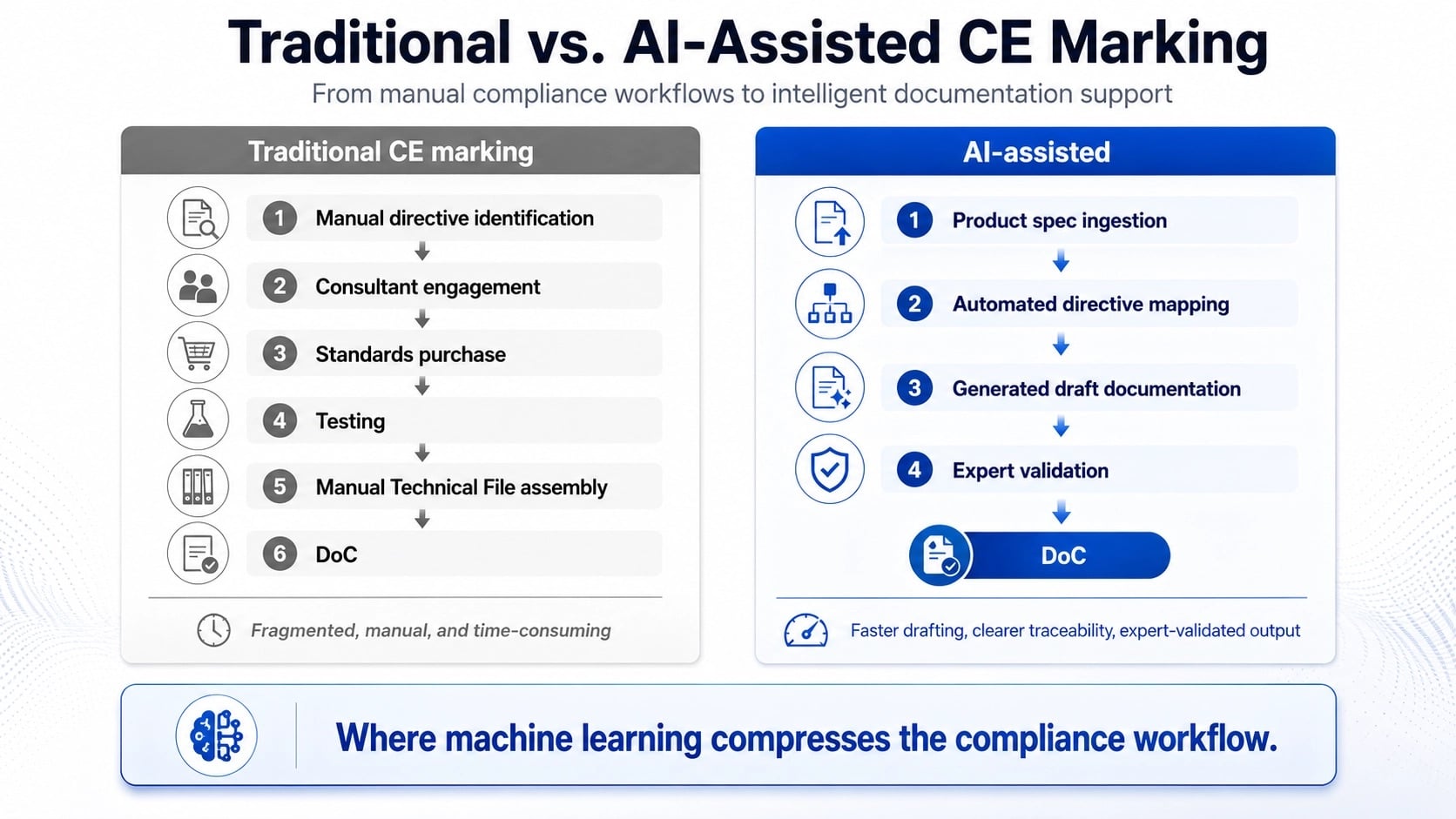
Where machine learning compresses the compliance workflow. (Click on image to enlarge).
Penalties are set nationally and are not trivial: EMC violations in Germany can draw fines of €3,000–€30,000 and up to a year's imprisonment, and in the UK an unlimited fine and up to two years (national implementations of the EMC Directive).
Critically, the most common failure mode during surveillance is rarely "the product wasn't tested"—it is that the manufacturer cannot demonstrate a traceable chain of evidence linking the product configuration to the standard, the test report, and the signed DoC.
What AI-Assisted Compliance Changes
A category of compliance tooling has emerged that treats regulatory knowledge as structured, machine-readable data rather than tribal expertise. The pattern is consistent across implementations: ingest the regulatory corpus, map a specific product to its obligations, generate draft documentation, and monitor for change—with human experts validating the output rather than producing it from scratch.
The shift is from consulting as bespoke labor to consulting as a reviewed, automated workflow. That is what makes the economics work for low-volume product lines that could never justify a full consulting engagement.
Under the Hood: How the System Actually Works
This is where the engineering lives. Four components do the work.
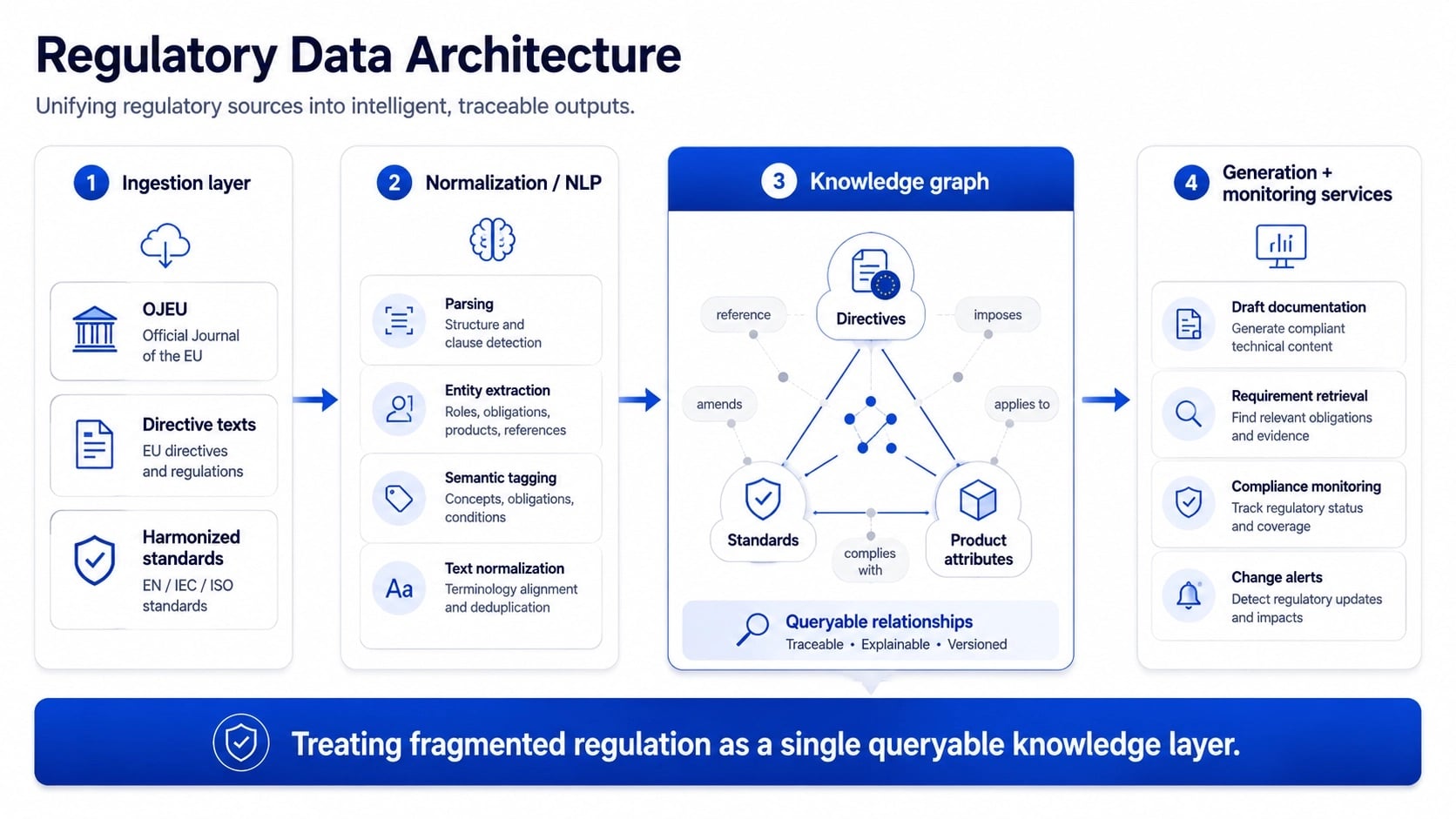
Treating fragmented regulation as a single queryable knowledge layer. (Click on image to enlarge)
1. Regulatory ingestion and parsing.
Directive texts, OJEU standards listings, and member-state guidance are pulled in and processed with natural-language techniques—named-entity recognition to extract directive references, standard numbers, product categories, and obligation clauses; document segmentation to preserve the structure of legal text.
The output is normalized records, not free text, so "EN 55032:2015" in one source and a reference to the same standard elsewhere resolve to a single canonical entity.
2. A knowledge graph linking products to obligations.
The normalized data populates a graph connecting directives, harmonized standards, product categories, and component attributes. When a manufacturer describes a product—function, operating voltage, wireless capability, materials—the system traverses the graph to determine which directives apply and which standards must be demonstrated.
This replaces the consultant's "which rules apply to me?" judgment with a traceable, queryable mapping; however, a qualified technical expert approves the results and makes judgments on edge cases that need further validation.
3. Documentation generation.
With the applicable obligations identified, the system assembles product-specific Technical File contents and drafts the Declaration of Conformity, pulling the correct directive and standard references for that exact product rather than a generic template.
Retrieval-grounded generation—constraining the model to cite the actual regulatory records it retrieved—directly addresses the traceability failure mode that surveillance authorities flag most often, and reduces the risk of fabricated or outdated references that naïve LLM use can introduce in regulated contexts.
4. Change detection and audit trail.
Because the corpus is monitored continuously, the system can diff new OJEU publications against the standards a manufacturer already relies on and flag affected products when a standard is superseded or a directive amended. Every generated document, mapping decision, and regulatory version is logged—producing the audit trail that surveillance and customer audits require, and that manual processes typically reconstruct after the fact.
The defensible claim is not "AI does compliance." It is that AI converts a slow, expertise-bound, reactive process into a fast, traceable, continuously updated one—with expert validation kept in the loop precisely because the stakes are legal.
What This Means for the Industry
The downstream effect is access.
Compliance tooling that scales lowers the fixed cost of EU entry, which matters most for the manufacturers currently priced out: SMEs and first-time non-EU entrants.
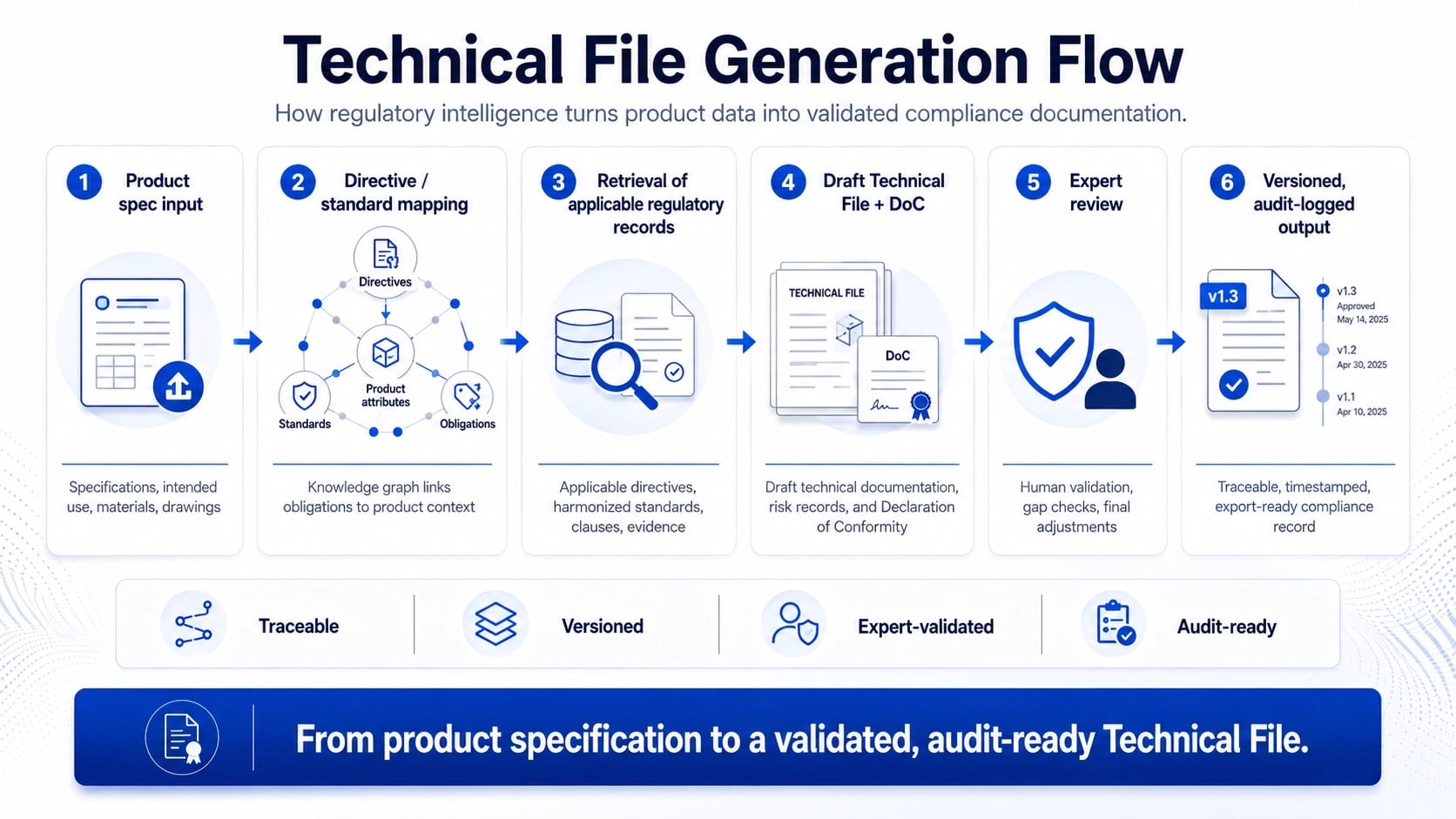
From product specification to a validated, audit-ready Technical File. (Click on image to enlarge).
The limits are worth stating plainly, because doing so strengthens credibility rather than weakening it. AI does not assume legal responsibility, the manufacturer signing the Declaration of Conformity still does. Notified Body involvement remains mandatory for higher-risk product categories.
And the quality of any generated documentation is bounded by the quality and currency of the regulatory data ingested. Automation removes the repetitive, error-prone, and slow parts of the process; it does not remove the accountable human.
The broader trend for the EE industry is regulatory knowledge becoming infrastructure—queryable, versioned, and continuously maintained—rather than a service rebought for every product.
For an SME weighing whether the EU's 500-million-consumer market is worth the documentation overhead, that shift changes the arithmetic. And it is happening now.
All images used courtesy of EcoComply, unless otherwise specified.
Related Content