Facebook
 Google
 GitHub
 Linkedin
Melexis Unveils Inductive Sensor That Reads Two Sets of Coils at Once
The device is Melexis’ first dual-input inductive ASSP sensor, purpose-built for demanding automotive applications like steer-by-wire and torque feedback.
Melexis has introduced the MLX90514, a dual-input inductive sensor IC that simultaneously processes signals from two sets of coils, enabling differential and vernier angle measurements directly on-chip. Sensor requirements are changing rapidly as modern vehicles transition toward electrification, autonomy, and steer-by-wire architectures. Designers must capture more data from more inputs—faster, more reliably, and in tighter spaces.
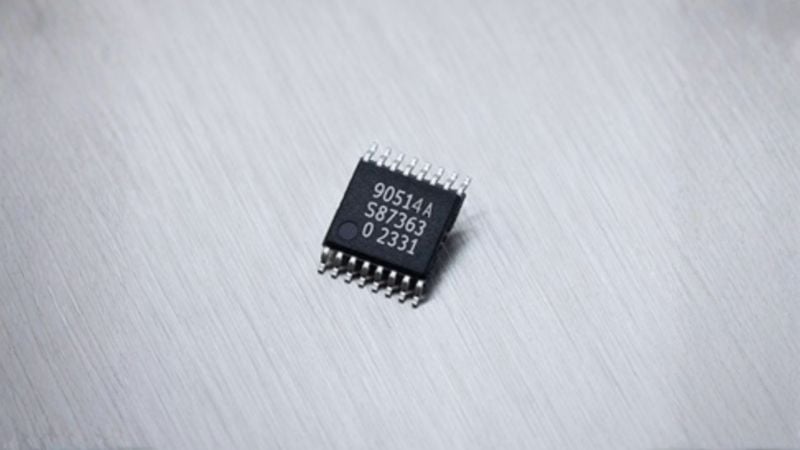
The MLX90514 dual-input inductive position sensor interface IC.
Rather than relying on two separate sensor ICs or more complex magnetic sensor setups, the MLX90514 offers a compact, synchronized solution targeted at critical control systems like steering torque sensors, angle encoders, and electric rack motor feedback, particularly in systems pushing toward ASIL D compliance.
This is Melexis’ first dual-input inductive ASSP, and it marks a push into simplified but high-functionality signal chains. The MLX90514’s ability to compute multi-channel angles in real time significantly reduces the processing load on host microcontrollers, while its flexible output interfaces and support for compact PCB designs make it especially appealing for Tier-1 suppliers seeking to streamline modules without sacrificing performance or safety margins.
A Purpose-Built Sensing Architecture
In traditional automotive position sensing, capturing torque or angle often requires two separate ICs, either to provide redundancy for functional safety or to support dual coil sets arranged in a vernier or differential pattern. This approach not only increases bill-of-materials costs but also introduces challenges in synchronization and latency. The MLX90514 (link downloads datasheet) eliminates that overhead by integrating dual synchronous inputs, each of which connects to a dedicated coil set. The sensor performs real-time signal processing internally and delivers either differential or vernier angle output through standard automotive digital interfaces.
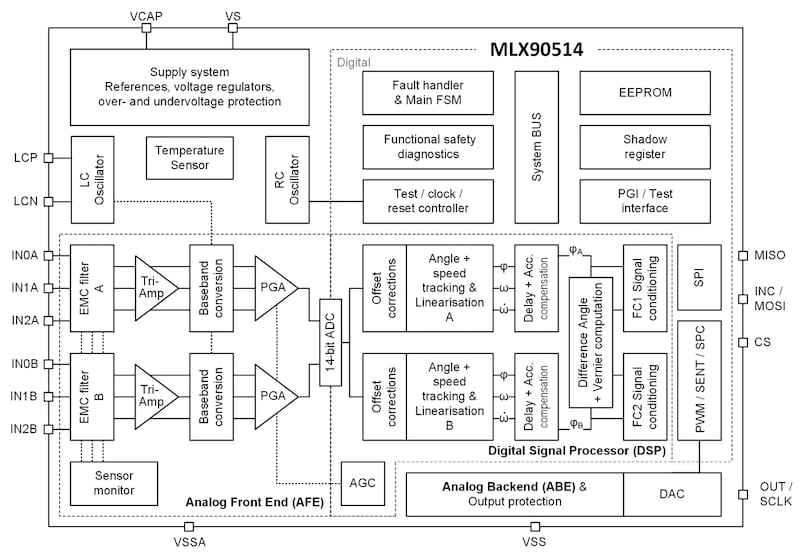
Block diagram of the MLX90514.
This internal computation is particularly relevant for steer-by-wire applications, where latency and determinism are key considerations. By executing synchronized angle measurement within the sensor, rather than delegating calculation to an external processor, the MLX90514 reduces data path length and enables zero-latency, dual-channel output, which is a requirement for any system operating as a safety element out of context (SEooC) in ASIL D environments. Melexis also supports functional safety documentation for the device, positioning it as part of a broader inductive sensing portfolio that aligns with ISO 26262.
Interface Flexibility
The MLX90514 supports multiple output protocols. Depending on system architecture, the sensor can operate in standalone mode using SENT, SPC, or PWM interfaces, or in embedded mode via SPI for microcontroller-managed systems. SENT and SPC modes enable fast, point-to-point communication with high data integrity, and support up to 24-bit payloads. This eliminates the need to transmit multiple sensor streams separately or reconstruct synchronization in software.
PWM output provides an option for backward-compatible systems where analog-like signal representation is still required, while SPI gives embedded designers full access to the device’s internal configuration and diagnostics. This range of interfaces is key in modern vehicle platforms where central ECU architectures coexist with distributed sensor nodes, often within the same steering or braking subsystem. The MLX90514 can therefore be used both as a drop-in sensor for existing modules and as a building block for newer zonal designs.
Tight Coil Integration
While function and interface are key considerations, physical integration often determines whether a sensor survives design validation. The MLX90514 addresses this by supporting small-signal inductive inputs, allowing engineers to work with compact coil geometries without sacrificing resolution or SNR. This, in turn, supports tighter PCB layouts, reducing the sensor footprint in space-constrained applications such as integrated steering columns, motor shafts, or brake actuators.
This capability opens up new opportunities for engineers to design single-board, dual-channel sensing modules, eliminating the need for mezzanine arrangements or stacked daughter cards to achieve redundancy. Fewer components and a flatter BOM also contribute to reduced system cost and increased assembly reliability.
The sensor is available now and is backed by Melexis’ established inductive sensing ecosystem, including application design support and coil design tools.