Facebook
 Google
 GitHub
 Linkedin
Microchip Forays Into Capacitive Touch Controllers for Buttons & Sliders
The MTCH3380P and MTCH3240P sample up to 12 sensor channels at once, which Microchip says keeps response fast on interfaces with up to 64 sensors.
Displayless HMIs are becoming more commonplace as designers seek intuitive, interactive experiences baked into everyday life. But in many cases, their underlying designs can be cumbersome, slow to respond, and complex to build.
To make displayless HMI more accessible, Microchip recently released the MTCH3380P and MTCH3240P controllers. The company’s first set of turnkey touch controllers using parallel sensing, the new products are said to cut system cost and design complexity by bringing a central control hub to otherwise expansive sensor networks.
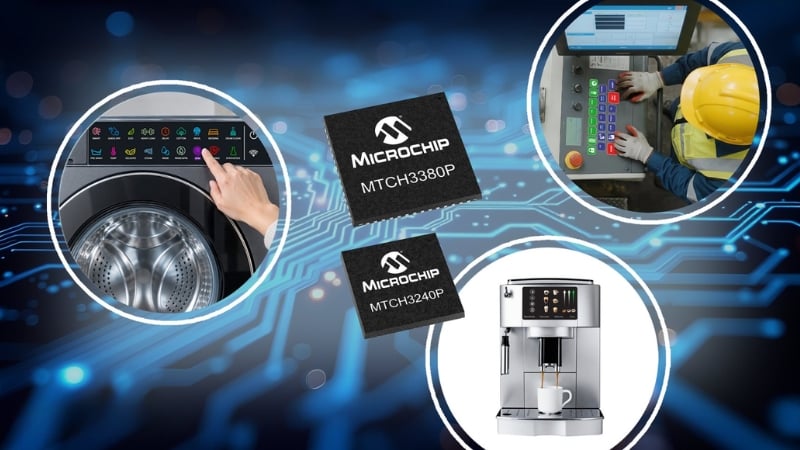
Microchip's new capacitive touch controllers. Image used courtesy of Microchip
Microchip claims that, with faster response times and simpler designs, these controllers can help more designers bring display-free touch control to more everyday appliances and equipment.
Parallel Sensing: The Secret Sauce of the New Controllers
One of the biggest design challenges for HMI designers is reading from many sensors simultaneously while keeping acquisition times short. Microchip’s answer is parallel sensing, delivered in the MTCH3380P and MTCH3240P through 12 integrated on-chip ADCs.
With that architecture, the MTCH3380P supports up to 38 self-capacitance or 64 mutual-capacitance sensors, while the MTCH3240P supports 24 or 32. According to Microchip, both parts reach those counts without the acquisition-time penalties designers generally see with large sensor arrays. The datasheet lists the fastest explicit acquisition interval as 10 ms per scan, at ~4 mA of current consumption. Designers can also group keys into up to eight sliders or wheels on the MTCH3380P.
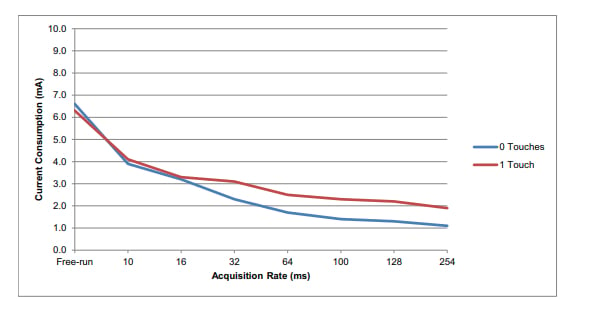
Acquisition rate versus current consumption for the MTCH3380P. Image used courtesy of Microchip
Beyond sensor count and acquisition rate, Microchip says the controllers' touch sensitivity and noise immunity allow reliable detection through thick cover materials and gloved fingers. According to the MTCH3380P datasheet, designers can mount sensors behind glass up to 6 mm thick or plastic up to 3 mm, depending on stack-up. Microchip also rates the part for conducted noise immunity under IEC 61000-4-6 at 10 VRMS.
For these reasons, Microchip is targeting applications where moisture and gloved operation are common, such as ovens and washing machines. It also cites EV chargers, parking meters, and kiosks, which need durable protective covers and dependable cold-weather operation. For appliance makers, the company designed both parts to support customer-driven IEC/UL 60730 Class B functional safety certification.
Why Sensor Count and Cover Thickness Strain Touch Designs
Capacitive touch is a common sensing technique, but it suffers from very weak signal amplitudes. Generally, these designs use a PCB-mounted electrode that detects a nearby finger as added capacitance, with the finger acting as a second capacitor plate above the electrode.
However, when designers specify thicker covers or users wear gloves, they widen the gap between the finger and the electrode, reducing the touch signal. System noise, however, generally stays the same, so SNR falls. Users with wet hands create the opposite problem, because water on the panel can couple to an electrode and mimic a touch.
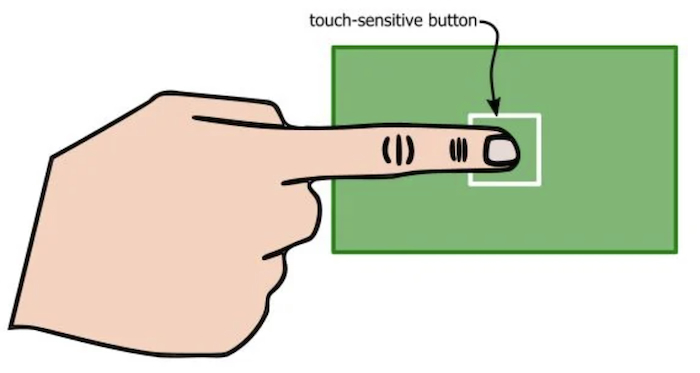
A finger touches a capacitive button formed by an electrode on a PCB.
In these cases, designers typically boost the signal by averaging or integrating more samples per sensor. But when sensors are measured one at a time through a single channel, this scheme significantly lengthens the total scan time as designers add more buttons, slider segments, and wheels to the system. For those reasons, on large panels, designers generally trade responsiveness for sensitivity.
Development Support
The MTCH3380P and MTCH3240P are available now, with Microchip offering the MTCH3380P in a 56-pin XQFN package and the MTCH3240P in a 38-pin XQFN, along with evaluation boards for both parts.
On the software side, designers can tune and validate their layouts with mTouch Studio and the touch plug-in for mTouch Data Visualizer. Microchip also supplies host drivers for Linux and Zephyr.
Related Content