
 Facebook
 Google
 GitHub
 Linkedin
MEMS and Modular Platforms Drive Breakthroughs in Audio Designs
From AI glasses to earbuds to long-range Bluetooth audio, three new product wins highlight how MEMS and RF front-end technologies are reshaping wireless sound.
In the span of a few weeks, three companies have showcased how MEMS speakers, haptic actuators, and modular RF platforms are transforming wireless audio across wearables, personal audio, and professional broadcast use cases.
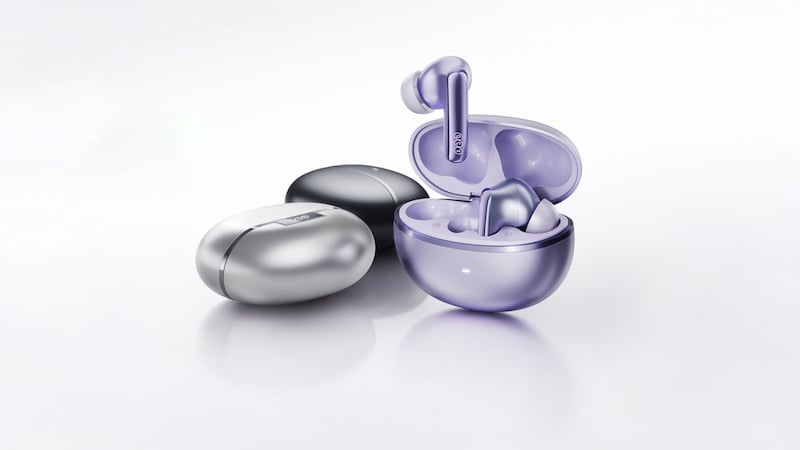
QCY's MeloBuds N70 earbuds. Image used courtesy of USound
xMEMS Unveils AI Glasses Prototypes With MEMS Tech
At its 2025 xMEMS Live event, xMEMS Labs introduced a set of AI glasses prototypes showcasing how MEMS-based acoustic and haptic technologies can deliver immersive, discreet, and power-efficient performance for wearable computing platforms.
The prototypes integrate xMEMS’ Montara Plus micro-speaker, which features a solid-state piezo MEMS actuator in a monolithic silicon design, with Cowell, the company's MEMS-based dynamic haptic driver. Together, the technologies provide directional audio with low distortion and lifelike vibration feedback, all in an ultra-compact form factor tailored for space- and energy-constrained devices like AI eyewear.
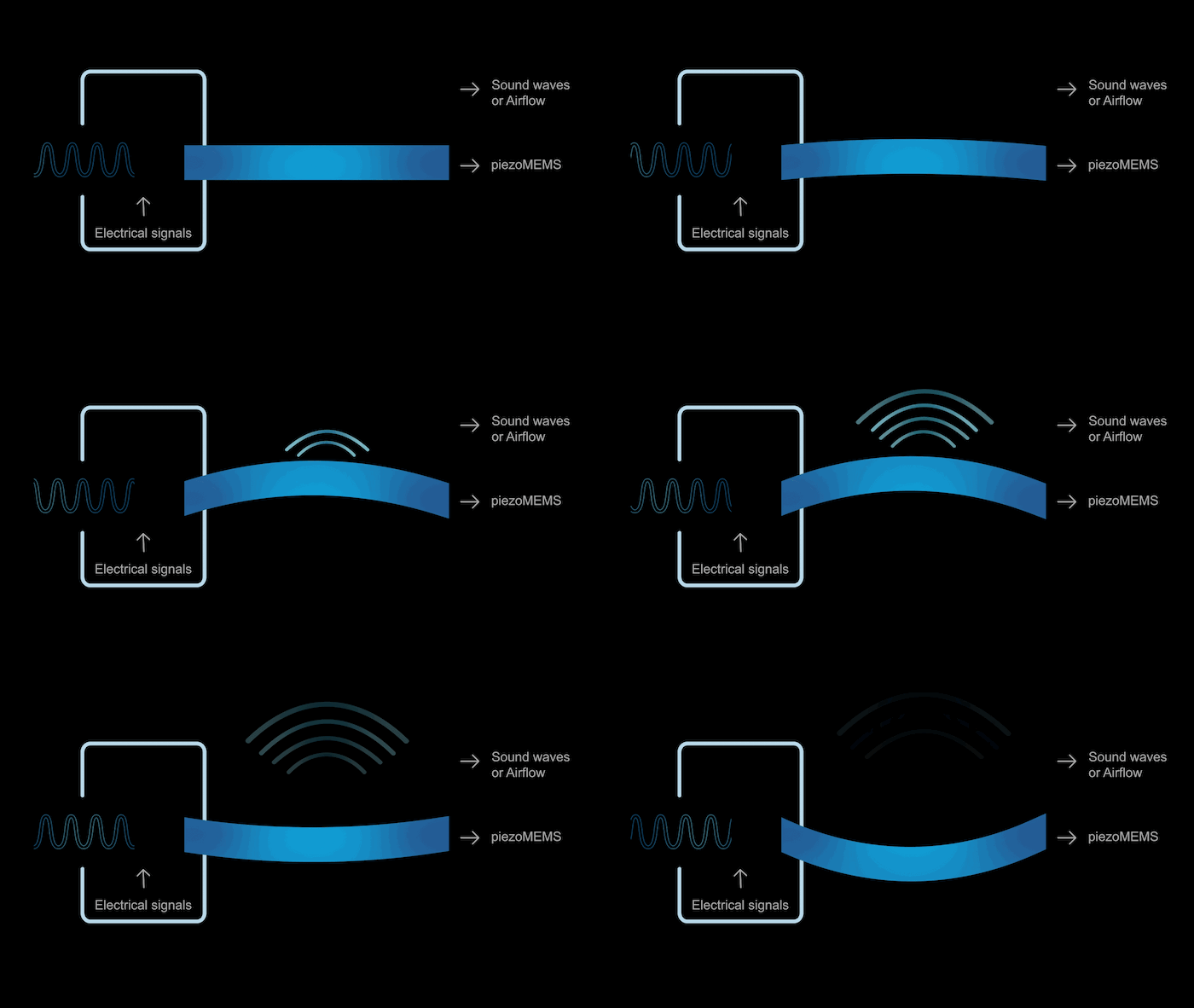
xMEMS' Piezo MEMS technology leverages the inverse piezoelectric effect, which converts electrical energy into mechanical energy by applying an input voltage to make the piezo MEMS material contract. Graphic used courtesy of xMEMS
Unlike traditional speaker designs, the all-silicon Montara Plus speaker eliminates moving coils and suspension components, significantly reducing mass and increasing phase coherence across frequencies. This enables clearer voice reproduction, directional sound fields for personal audio zones, and minimal acoustic leakage. Meanwhile, the Cowell haptics module introduces subtle, programmable feedback to simulate touch or confirm commands, offering a new layer of user interaction without displays or audible alerts.
xMEMS positions this reference design as a blueprint for OEMs developing next-gen AI wearables that merge context-aware computing with high-fidelity user engagement, powered by scalable MEMS platforms.
USound MEMS Speaker Powers QCY MeloBuds
USound has announced that its MEMS-based speaker technology is featured in QCY’s new MeloBuds N70 true wireless stereo (TWS) earbuds, offering a leap in acoustic performance, miniaturization, and energy efficiency. The collaboration integrates USound’s MEMS micro-speakers, designed for ultra-compact audio systems, into QCY’s latest in-ear product aimed at delivering high-quality sound in a lightweight, ergonomic form factor.
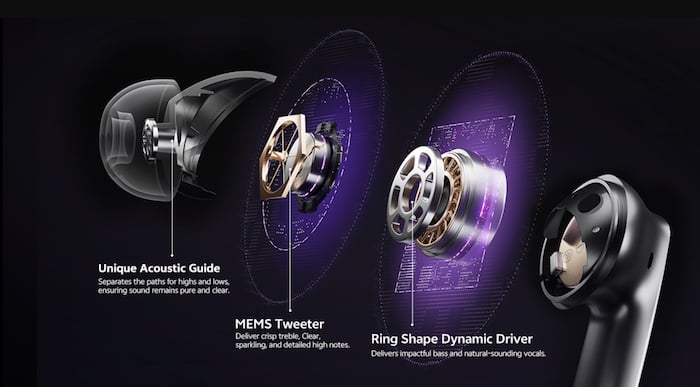
The QCY MeloBuds N70 include QCY’s DualCore Acoustic System. Image used courtesy of USound
Unlike traditional moving-coil drivers, USound’s solid-state MEMS speakers utilize silicon microfabrication techniques to achieve a slimmer profile and more consistent performance. This enables the MeloBuds N70 to deliver clearer treble, enhanced vocal reproduction, and low distortion in a compact, energy-efficient package. The adoption of MEMS technology in commercial TWS earbuds reflects growing demand for smaller, more reliable, and scalable speaker architectures in the consumer audio space. According to USound, this design approach supports greater integration and reduced assembly complexity, pointing toward broader adoption in future wearable and mobile platforms.
A Long-Range, Low-Latency Bluetooth LE Audio Platform
Cloud2GND, in collaboration with Ezurio (formerly Laird Connectivity), has launched the Aurawave AW100, a compact development platform designed to accelerate Bluetooth LE Audio and Auracast product design.
At the heart of the AW100 are Ezurio’s BL5340 and BL5340PA modules, both integrating Nordic Semiconductor’s nRF5340 dual-core SoC, with the BL5340PA additionally incorporating the nRF21540 RF front-end module (FEM) for extended range, lower latency, and improved throughput. The AW100 platform includes USB audio support, QSPI Flash, full I/O access, and a debug connector, allowing it to operate as a standalone or host-managed Auracast transmitter or receiver.
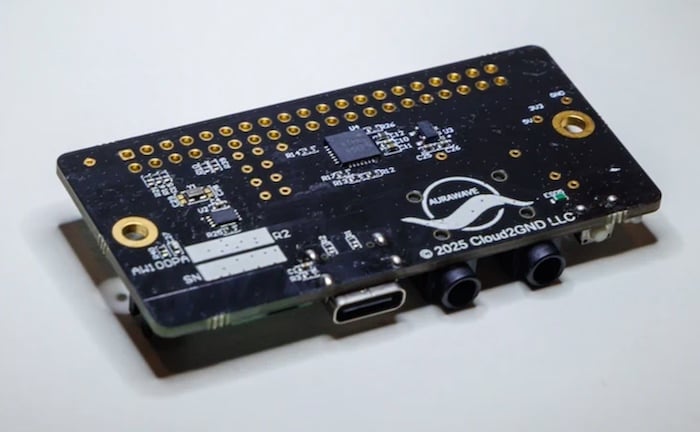
Cloud2GND’s Aurawave AW100 platform integrates Ezurio’s BL5340PA module, which includes Nordic’s nRF5340 SoC and nRF21540 RF FEM. Image used courtesy of Nordic Semiconductor
Supporting the hardware is the Aurawave Audio Framework, AT command-based software built on Nordic’s nRF Connect SDK. This enables flexible deployment scenarios for high-quality LE Audio broadcasting and multi-receiver Auracast use cases.
With enhanced RF performance from the nRF21540 FEM and Nordic’s multi-protocol SoC, the platform may be useful for environments demanding robust wireless audio, including public venues, industrial installations, and smart audio products. Ezurio emphasizes that few modules on the market offer this unique combination of certified long-range capability and dual-core processing, opening the door to advanced use cases beyond audio, such as predictive maintenance and industrial IoT.
Related Content











有用