Facebook
 Google
 GitHub
 Linkedin
NXP Drives Zonal Computing Transition With New Reference System
Announced today, the new zonal reference system includes pre-validated hardware and software for automotive intelligent data handling and multi-volt power distribution.
At Embedded World 2026 today, NXP introduced its newest tool for automotive electronics designers, the NXP CoreRide Z248 zonal reference system. NXP designed the system to act as a scalable foundation for zonal electronics within software-defined vehicles (SDVs). It includes intelligent data routing, audio, diagnostics, AI-enabled virtual sensing, and gateway functions. The hardware and software are pre-validated and near-mission-ready.

Karl Leiss of NXP Semiconductors demonstrates the Z248 reference board to All About Circuits' Jeff Child.
By including hardware and software validation, code integration, testing, and deployment (CI/CT/CD) tools, NXP is enabling automotive OEMs to accelerate the development of zonal computing and control systems. The Z248 system is leading the industry toward standardized vehicle computing hardware and away from hyper-customized electronics that make software development more difficult and leave the industry vulnerable to supply chain disruptions.
Julien Battiston, NXP's senior director of SDV marketing, explained NXP's overarching objective with this release:
"We want to provide a scalable, safe, and cost-optimized foundation that can scale and adapt easily to the different flavors of an SDV architecture, whatever it is: ICE, hybrid, or EV platforms.”
Zonal Automotive Computing Architecture
A motor vehicle contains a payload compartment, propulsion, and a large number of electronic control units (ECUs) to make it all go. The ECUs are all networked to a master computer that manages the vehicle as a system.
Zonal design organizes automotive electronics based on their location in the vehicle. Each zone has dedicated computing resources, and all zones are tied to a powerful central computing system. It answers the “distributed computing vs. centralized computing” question by including the best of both. A zonal architecture can significantly reduce the number of distributed ECUs without overburdening the central computer. This accelerates the design cycle and simplifies post-sale updates without compromising safety or capability.
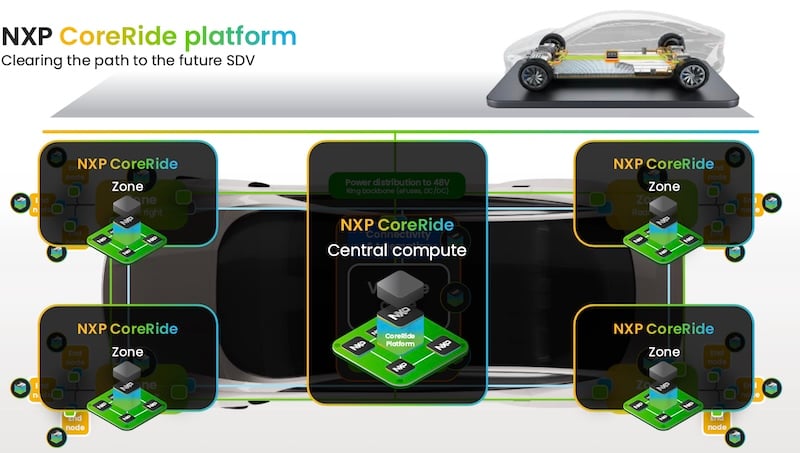
Zonal architecture.
NXP designed the multi-voltage switching in the CoreRide Z248 for the future as well. The next generation of automotive power includes 48 V, in addition to 12 V. NXP’s Z248 includes switching and power distribution to accommodate the different voltage requirements. It further includes high-speed data switching for multiple automotive protocols.
The Hardware Layer
NXP provides a reference system for the Z248 based on the company's S32K5 MCU, released at Embedded World 2025. The S32K5 MCU family draws its computing power from Arm Cortex-M7, Cortex-R52, and DSP cores, clocked at up to 800 MHz. It also includes a dedicated eIQ Neutron neural processing unit (NPU), NXP's scalable machine learning accelerator. Machine learning delivers power-efficient, real-time sensor processing with a reduced need for external processing nodes.

Diagram of the NXP CoreRide Z248 zonal reference system.
The device is qualified to automotive-grade AEC-Q100, Grade 1, with a -40°C to 125°C temperature range and is safety-qualified to ISO-26262 up to ASIL D (the highest risk classification). The S32K5 has pre-integrated zonal and electrification system solutions for scalable software-defined vehicle (SDV) architectures.
Easing the Supply Chain and Development Burden
Battiston listed three primary goals for the Z248 reference system:
- Simplify automotive computer complexity by reducing the number of ECUs
- Reduce time to market for new models
- Add resilience to supply chain disruption
He went on to explain that, globally, the best-performing automotive design teams, as NXP has seen in China, can release a new car design in two years, compared to a more traditional five years. Presenting a reference architecture that includes pre-validated hardware and software both fulfills the reduced ECU promise and cuts system design time.
The third goal stemmed from supply chain vulnerabilities that became evident in 2020. During COVID, many car manufacturers were unable to deliver finished vehicles because one or a few, even inexpensive, parts were unavailable. Some components were out of stock or on severe allocation for a year or more.
A standardized computing platform based around the SDV concept reduces dependence upon proprietary hardware systems. Hardware can be modular and more interchangeable, and software toolchains can enable more code reuse. The result is faster design, easier maintenance, and less supply chain vulnerability.
All images used courtesy of NXP Semiconductors.